Message from our Executive Director – January 2020
During his keynote at last fall's EdLeader21 Conference, educational thought leader, Tony Wagner, did not mince words. “A graduate portrait without an
Read More


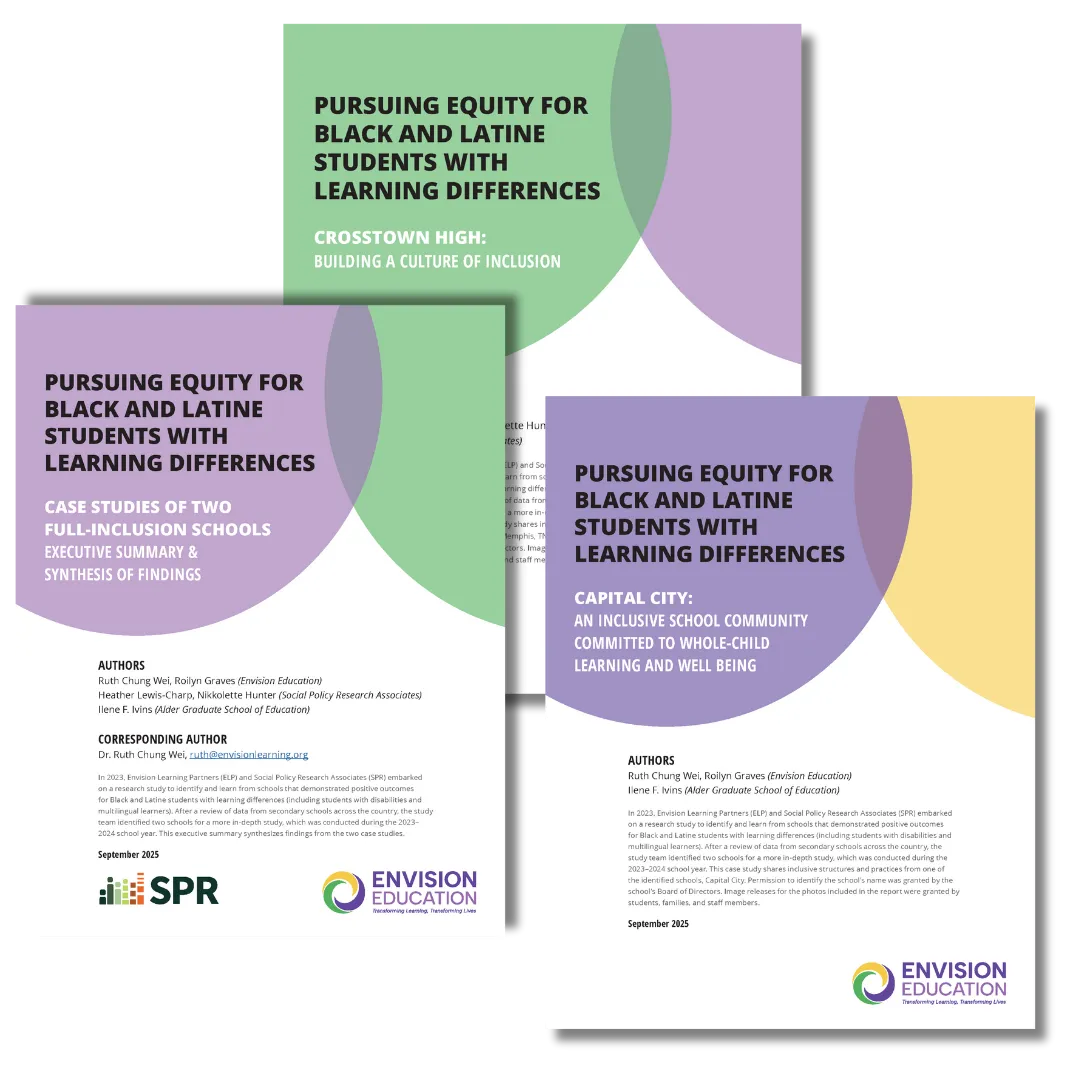
Envision Education is excited to share the culmination of its two-year research project, Pursuing Equity for Black & Latine Students with Learning Differences, which
documents and illustrates the systems, practices, cultures, and supports that are associated with the well being and success of Black and Latine students with learning differences – students with disabilities and multilingual students with disabilities.
In 2023, Envision Learning Partners (ELP) and Social Policy Research Associates (SPR) embarked on a research study to identify and learn from schools that demonstrated positive outcomes for Black and Latine students with learning differences (including students with disabilities and multilingual learners). After a review of data from secondary schools across the country, the study team identified two schools for a more in-depth study, which was conducted during the 2023–2024 school year.
The results of the research are shared through case studies of the two schools that were the focus of the research: 1) Crosstown High: Building a Culture of Inclusion; 2) Capital City: An Inclusive School Community Committed to Whole-Child Learning and Well Being; and 3) An Executive Summary/Synthesis of Findings.
In addition, we have authored four practice briefs based on the findings of the research that provide practical steps that schools can take to create more inclusive environments that support the success of Black and Latine students with learning differences.
This research was made possible through the generous support of New Profit, a venture philanthropic organization, and the Oak Foundation.
During his keynote at last fall’s EdLeader21 Conference, educational thought leader, Tony Wagner, did not mince words. “A graduate portrait without an assessment,” he said, “is useless.”
The audience members—mainly district leaders from around the country—audibly shifted in their seats. Although it’s hard to disagree, it’s also hard to pull off. How can school districts assess skills that are as complex as the ones we see on a typical graduate profile?
Tony followed up his challenge with two recommendations:
He’s right. Portfolio assessment and presentations of learning (which come in many forms, including defenses and student-led conferences) are two effective, customizable, scalable, and actionable ways to move from “poster to practice.”
ELP cheers the graduate profile movement because of its potential to change our society’s conception of education’s purpose. But we also worry for the movement. If we don’t see graduate profiles made visible in the actual work of our students—“show don’t tell,” says this old English teacher—then we’re destined to look back on this as another edu-trend that came to nothing. That’s why Tony Wagner’s admonition is so urgent.
The challenge of assessing graduate profiles is one of the major themes of next month’s Assessment for Learning Conference. I know I will see many of you there, and I am excited for the opportunity to work on this together.
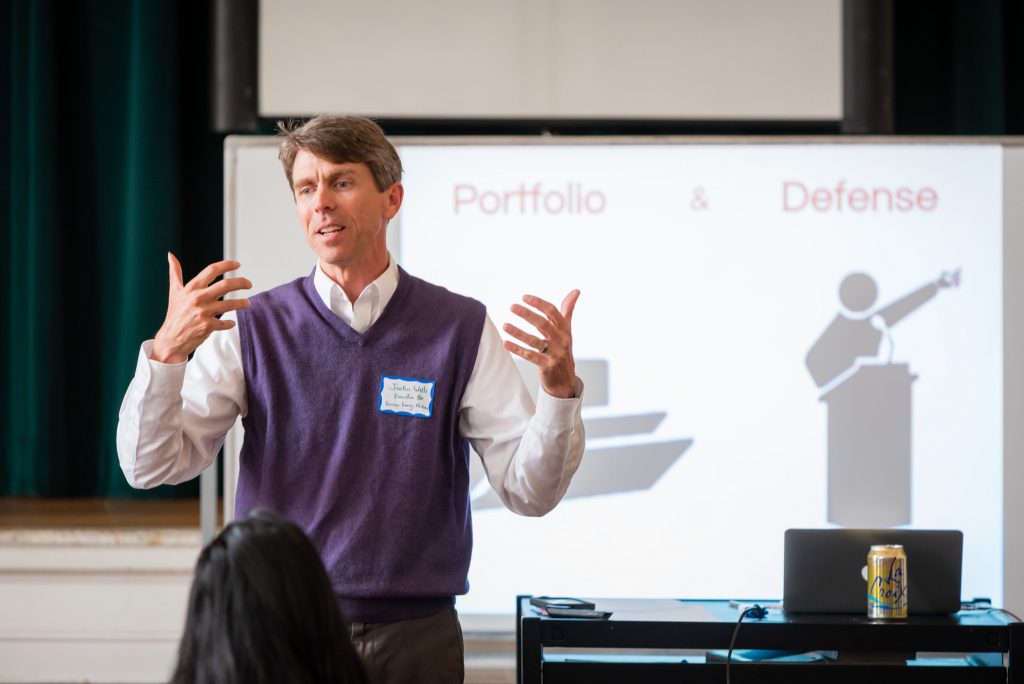
Justin Wells,
ELP Executive Director
This month, Envision Education’s CEO, Gia Truong is our guest blogger, writing about our Portfolio Defense assessment model, it’s impact on students and the work we are doing collectively to improve it. We know that our model is transformative for some, but not yet for all and not consistently for the most marginalized. In order to truly serve our black and brown students, we must find ways to center their experiences and eliminate racist structures within our system, so that all students have access to transformative learning experiences. Read on to learn what we are doing…
Envision Schools’ mission is to transform the lives of students – especially those who will be the first in their families to graduate from college – by preparing them for success in college, career, and life. We accomplish our mission through our Portfolio Defense assessment model, which authentically measures the most important things students need in order to succeed in college and career. Portfolio Defense gives students the academic, social-emotional and leadership skills they need to get into college and persist. One of the biggest problems facing underserved students is educational inequity. Because of this inequity, poor students are far less likely to receive an education that will transform their life trajectory. We know that only 1 out of 10 low-income students earns a 4-year college degree by their mid-twenties, significantly limiting their income potential for their entire lives.
The signature practice of every Envision school is the Portfolio Defense. In 8th, 10th and 12th grades, every Envision student stands before a panel of teachers, peers, family and friends, and delivers a comprehensive presentation that demonstrates how and why they are ready for the next academic challenge. Every defense is both an authentic academic assessment and a celebration of what students have accomplished. The essential outcome of the model, above and beyond rigorous academic preparation, is the agency our students can develop: they graduate ready to take charge of their educational future and advocate for themselves on the path to receiving a college degree.
We also know that our model is not yet building that agency for enough of our students. It is transformative for some, but not yet for all and not consistently for the most marginalized. We know that in order to truly serve our black and brown students, we must find ways to center their experiences and eliminate racist structures within our system, so that all students have access to transformative learning experiences.
Last year, Envision Academy (EA), our Oakland California school’s 11th and 12th grade teachers observed that too many student defense presentations felt like pro forma exercises, lacking authentic student engagement and falling short of the potential of Portfolio Defense. They could see that the Defense — a model designed to empower students — was not working for enough of their students. EA teachers hypothesized that students would be far more engaged and their agency would increase if their identities as learners were more central and if the Defense process were more inclusive and culturally responsive. We hypothesize that with these improvements, students will be better prepared for college, less likely to confront imposter syndrome, and more likely to persist until they earn a degree.
As a result of the EA teachers’ inquiry, in 2018-19 Envision Academy changed the driving question of the Defense to one that asks each student to describe who they were, are, and want to be as a scholar, the kind of person they want to be, and the role of education in shaping their identity. The teachers also found ways for students to bring more of their culture and community into the process, including giving their presentations in their native language. As a result of these changes, other aspects of model changed as well: the senior Advisory curriculum shifted to focus on the Identity Statement, with significant time dedicated to writing and revising; new strategies were put in place to align the Identity Statement with each students’ portfolio of academic artifacts; teachers developed tighter frameworks for assessing projects and calibrated with each other to ensure consistency. These changes led to stronger, more personal defense presentations, richer connections to academic content, and clearer reflections from students about their identities, their goals for the future, and their awareness about their areas of growth.
The improvements we have piloted at EA have already had a strong, positive impact on students. In the words of one graduate: “I was able to express more about myself and my passions in my defense presentation, especially where we explained who we are, who we used to be, and who we want to be. That was very powerful because the presentation wasn’t just academic but also about the student and their goals; it felt more authentic.” Teachers also noticed important changes: “I’ve always thought Portfolio Defense was amazing, but last year was just incredible. The new process really put our students at the center. It was rewarding to see them, in the 2019 presentations, be more engaged and invested; presentations were more personal, and so many more of them presented like scholars. That’s how I know these changes have made a huge difference.”
Anecdotally, these quotes represent what we know is possible: with a more student-centered Portfolio Defense system, our students will be more invested in their education, they will actively develop a scholar-warrior identity, and they will be more prepared to meet the challenges of college and persist through them. With a college degree, they will be positioned to change the economic trajectory of their lives. As these students gain financial autonomy, they can break the cycle of generational poverty, positively impacting the individual student, their families, and their communities more broadly.
In community,
-Gia
Click here for more information about Envision Schools.
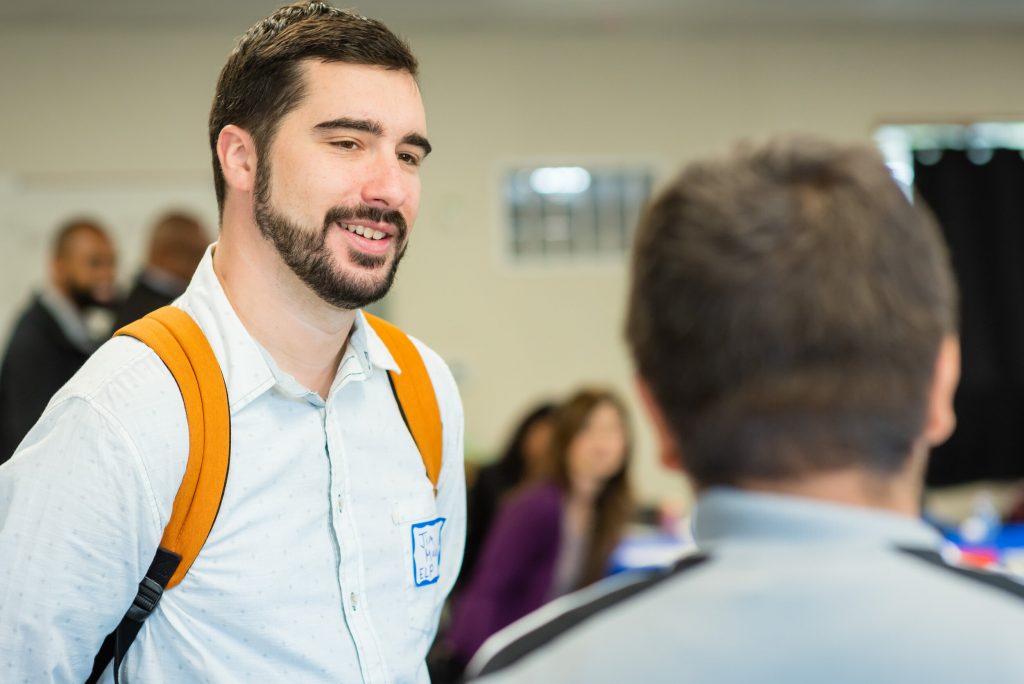
This month, watch ELP STEM assessment specialist, Jim Malamut, share his ideas on Proximity of Evidence to student thinking.
Looking for more resources? Visit the ELP blog page for all past newsletter content.
ELP continues to have a strong presence at conferences all over the US in 19-20:
Upcoming conferences:
NEW ELP PARTNERS FOR 19-20
Each school year, ELP welcomes new education partners from across the country. Please join us in welcoming:
GATES FOUNDATION PROFESSIONAL LEARNING PARTNERSHIP GRANT
We are delighted to share that ConnectED and Envision Learning Partners are partnering with the San Diego Unified School District to enhance the integrated sequence of the Illustrative Mathematics high school curriculum. This work is funded by a grant from the Gates Foundation. In collaboration with our partners, we will leverage existing curriculum-embedded instructional resources and parent engagement approaches, elevating strategies that close achievement gaps for English Learners.
I am excited about the upcoming Assessment for Learning Conference and encourage everyone in the performance assessment movement to join us in San Diego this February (11–13th).
For the past three years, the educators and system leaders of the Assessment for Learning Project have been designing, learning, and innovating together to reimagine what’s possible for assessment. Having learned much from being part of this community, ELP has been hungry to see it grow. So we’re thrilled that the Assessment for Learning Project is stepping up to host its first-ever conference. The event will be populated with some of the most innovative, thoughtful, equity-minded, and visionary educators and system leaders when it comes to assessment.
ELP is proud to be a co-designer of the conference, and it’s shaping up to be a cutting-edge learning experience for attendees, who will be challenged to apply innovative assessment principles to their own 3-day learning journey. This is a conference designed for practicing, not preaching.
There are so many educators around the country who are doing incredible work to transform assessment, and this conference is a chance for us to learn with each other and build on the momentum to create an Assessment FOR Learning movement. I hope you will join us!
For more info and to register, go to www.assessmentforlearningconference.org.
Sincerely,
Justin Wells, ELP Executive Director
Describe what you do at ELP?
I lead the operations side of Envision Learning Partners. This primarily involves behinds the scenes work to ensure our infrastructure and systems are running smoothly so our coaches can deliver high-quality professional development. ELP’s start-up culture has built our service and systems through many years of relationship building, prototyping, and refining.
What experiences brought you to ELP?
I began my work with Envision as an English teacher at City Arts and Tech [our school in San Francisco]. After stepping out of the classroom, I worked closely with all of our schools in a highly successful reading intervention program. In 2010, I became a founding member of the Envision Learning Partners team. We spent the first several years of ELP figuring out the most high leverage work we could do with our external partners. The journey has been amazing – we’ve grown our service from 3 team members serving 1 partner to 11 team members serving over 60 partners.
What do you enjoy most about working for ELP?
I am driven by the mission of ELP and expanding positive educational impact to all students. I believe deeply in providing access and high-quality learning experiences to all students. At ELP we primarily work with adult learners to refine their teaching practices and educational systems, but my motivation still comes from impacting students’ lives by shifting adult teaching and learning.
What do you like to do when you’re not working?
I spend most of my time on outdoor adventures with my wonderful husband and two children. We like to hike, rock climb, backpack, ski, and camp whenever we have the opportunity. Almost every morning before the sun is up you can find me at a barre class and I always sneak in time to read several novels per month.
What is an accelerator? Accelerator programs are designed to foster and support innovation. They usually have a set timeframe in which individual companies spend anywhere from a few weeks to a few months in an intensive, immersive environment working with a group of mentors to build out their business and avoid problems along the way. [Techrepublic]
What is Tinquevation? to introduce something new and/or to make changes in anything established through seeking knowledge/understanding by questioning/investigation, with the explicit intent to obstruct, threaten, & dismantle systems of oppression.
What did you most enjoy about being a coach with ELP?
My favorite thing about being at Envision Learning Partners has been the people. It has been so great to work with a team of people full of such brilliance, integrity, and creativity. Most of the best moments have been during car (or plane) rides between professional development sessions and post-meeting meetings where we’d all talk and argue and learn about each others’ challenges, questions, insights, and strategies for helping schools.
What was your favorite coaching experience?
It is really hard to pick just one favorite coaching experience but, if I had to, it would probably be working with Vinci Daro [ELP’s Director of STEM Learning] and Tamyra Walker [Envision Education’s Director of Math] to build out professional learning programs for the Envision math teachers.
What are your plans now?
My plan is to pursue a Ph.D. in Math Curriculum & Teacher Education so I can, hopefully, learn even more ways to be more useful to schools.
Jim’s Background
As STEM Assessment Specialist at Envision Learning Partners (ELP), Jim played a key role on the ELP STEM team in his work with teachers and school leaders to improve math instruction, connect assessment and learning, and build educator capacity to support students’ language development in the process. Jim came to ELP from Understanding Language/Stanford Center for Assessment, Learning, and Equity (UL/SCALE), which he joined in 2016 after working for two years as a teacher collaborator on SCALE’s PBL curriculum project Learning Through Performance Middle School Mathematics. He taught 6th grade mathematics at East Bay Innovation Academy (Oakland, CA), which uses a combination of blended learning and project-based learning. Before that, he taught at public schools in Philadelphia and in Ghana.
Jim’s experience as a middle school math teacher brings a classroom lens to his work on performance task design, rubric design, analysis of student work, and professional development. Jim’s curriculum development experience includes building language development opportunities into math and science curricula, including the Illustrative Mathematics OER curriculum, and working with the English Learner Success Forum to train curriculum developers in designing materials that attend to both mathematical and language development. His professional development experience includes working with the CALLI (California Language and Learning Innovation) Collaborative project. At ELP, he continued to facilitate professional development empowering math teachers to write high-quality performance assessments. He is also a member of the research team for the Measures of Deeper Learning project, supporting our work with schools engaged in the assessment of social-emotional learning competencies.
Follow Jim on Twitter @JimMalamut.

Hear why our newest Deeper Learning Coach, Morgan Vien, joined ELP and is excited about her new role working with our partners across the country.
Why did you apply for the Deeper Learning Leadership Forum (DLLF)?
[ELP’s Deeper Learning Coach] Alcine had worked with our district for a year, helping us develop our Graduate Profile. During one of our training sessions, she informed me of the DLLF geographic plan to include our area. That year I was also assuming a new role of Director of Pupil Personnel/Equity Officer and felt that the forum would greatly benefit my professional growth as well as the direction of my district.
What are the benefits of being a part of the DLLF?
Learning from a group of diverse educators has been the greatest reward. There are members from large and small districts who are willing to go on the deeper learning/equity journey that will take our school systems to the next level.
How has it helped you with your professional work?
The DLLF experience has provided me with a network of educators that will serve as a professional learning community for 18 months and beyond. The structured and unstructured collaboration has allowed me to introduce ideas in my district that “disrupt” the typical processes of education.
What is your individual project?
Introducing equity systems across my district. Building the concept of equity in our district is definitely in its infancy stages. To complete my project, I used Kotter’s 8 Stages of Change to introduce and implement equitable practices in my district.Robert is the Director of Pupil Personnel and Equity Officer for the Mason County School District in Kentucky.
Learn more about the Deeper Learning Leadership Forum experience by clicking here.
Envision Learning Partners is delighted and honored to introduce Capital High with the Madison Metropolitan School District in Wisconsin. We started our partnership with the district back in 2016, and this year we are thrilled to be working with three of their schools. Karyn Stocks Glover is the principal of Capital High and has shared her thoughts on our work together below.
How are you advancing your Performance Assessment System?
Capital High is guided by an equity vision and four equity drivers that support doing school differently. Capital High is launching its Graduation by Portfolio Performance Assessment this year. With the support and expertise of our Envision Learning Partners (ELP), we are designing a portfolio model that is aligned to competencies identified in the Madison Metropolitan School District’s graduate vision, that is specifically focused on growth mindset as a critical driver for deeper learning, and that is incorporated in all areas of learning through our Core Benchmarks (see in Appendix).
Madison Metropolitan School District’s Graduate Profile
Our participation in the Tinquevation Accelerator Workshop this summer with ELP supported us to engage in designing at the margins, and an outcome of this five-day intensive was naming and claiming growth mindset as a core value and a core practice across all areas of teaching and learning. Recognizing that our students and staff are inherently resilient, we framed our growth mindset skills (curiosity, planning, risk-taking, reflection) in this core belief. We are beginning to develop rubrics for our performance assessment system, which we will do in partnership with ELP.
We will have our first portfolio defenses in May 2020. Over the next two years, we will continue to partner with ELP in order to expand our graduation by portfolio model to include self-knowledge and interpersonal skills.
What have you learnt during this process?
We have learned doing school differently means defining deeper learning through asking students what they need to be successful in the long term and in the moment, and through supporting teachers to work in teams that prioritize student demonstration of mastery in knowledge and skills over time and through multiple opportunities in a variety of academic settings. We have learned that we thrive through shared leadership.
What is the impact you are seeing on students and their work?
Our students are building trust with their peers and the adults who support them; they are learning that Capital High is a community that believes completely in their innate goodness and intelligence, and that their voices are valued. We are seeing evidence of students being thoughtfully reflective about their learning through the lens of growth mindset.
What is the impact you are seeing on teachers and their practice?
Staff choose to work at Capital High because our goal to do school differently aligns with their values and because they want to work in professional partnership with their peers. Staff recognize that teaching skills versus content, measuring progress versus outcomes, and embracing collaboration versus isolation require curiosity, planning, risk taking and reflection with peers. Capital High staff are applying a growth mindset in their own practices.
What is the impact of this work ON YOU as a practitioner?
As the founding principal of Capital High, I value the partnership with ELP to support our journey to do school differently. While I brought a number of leadership strengths to the role, I have found that my capacity for leading transformational change is enhanced by working with an organization that has always prioritized identity work through student voice and student growth. I appreciate that ELP is not a model one adopts, but rather a way of working that centers race and equity and applies design thinking (where you are encouraged to design at the margins) so that schools can write their own stories.
Capital High’s Equity Vision
Empowered by personalized learning in a diverse and supportive community, and strengthened by family and school partnerships, all students will graduate prepared to succeed on their individual pathway.
Who We Are
Capital High is a non-traditional high school that is committed to deeper learning in the Madison Metropolitan School District. Our work is guided by the district’s Strategic Framework and Graduate Vision, as well as our school’s equity vision. We have an unwavering commitment to racial equity and an ambitious plan to serve opportunity youth. Our mission is to change the narrative for opportunity youth by providing learning through interests opportunities and preparing youth for post-secondary success in college and career.
We are engaged in a school design and development process that is fortified by a dedicated staff who are deeply committed to transformational change – individually, collectively, and institutionally. Disciplined and thoughtful professional collaboration is a standard of practice at Capital High. Together, we are creating and sustaining a thriving school community that is anchored in its commitment to anti-racist values and learning partnerships with students and families.
Our Approach
Our approach prioritizes opportunities and practices for youth engagement through student involvement and shared power. Our work is guided by four equity drivers – competency teaching and learning, advisory, experiential learning, and professional collaboration. These transformational change drivers support our commitment to a clear vision with targeted strategies and are embedded in “fail forward, fail fast” practices of innovation in service of opportunity youth. Our academic competency model is aligned to Common Core State Standards and articulated through measurable benchmarks of college readiness. Our advisory model prioritizes student agency through goal setting and reflection, as well as developing well being through relationships to self and others. Our experiential learning model promotes student inquiry and exploration of higher education, career pathways, and community partnerships. Our professional collaboration model is built on the belief that through collective efficacy we improve the lives of all members of our school community. Students graduate by portfolio with multiple opportunities to meet and exceed competencies in mastery of content and growth mindset.
ELP hosted its first “Tinquevation” Summer Accelerator, piloting a new structure that supports system design and transformation. The week-long experience was attended by Design Teams from 4 of the Envision Schools, and a client school from Madison, WI, Capital High. Click here to read more about Capital High, as Karyn Stocks Glover, principal of Capital High, shares her thoughts on our work together.
Design Teams consisted of school leaders, teacher leaders, and student leaders who came together in downtown Oakland to be in community together as we investigated how to re-imagine our systems with an uncompromising priority of putting equity at the center.
The Accelerator borrowed structures from the world of technology and start-ups to try and create spaces for people to learn deeply and then to immediately prototype applying that learning to their own contexts.
Each morning started with informative and diverse panels of speakers representing voices that we need to inspire and push our thinking – alumni, business leaders, higher education folks, etc. Personal and collective equity work was woven throughout each day, and thanks to the leadership of ELP coach, Alcine Mumby, it became clear that the most important work we need to do is to center the voices of our most marginalized in our systems.
One of the most impactful dimensions to the Accelerator was the uplifting and centering of student voice. Not surprisingly, having students at the table who felt invited and supported in speaking authentically about their lived experience within our systems was the richest content created during the week.
Teams left the Accelerator with plans to locate the most marginalized voices at each school and to engage in deep and relational empathy with these folks in order to better understand their realities, their needs, and their asks for changes to be made. Our school teams developed a clear path forward after the accelerator:
The Accelerator planning is being wonderfully lead by ELP team member, Abby Benedetto, learn more about her in this post, and is being supported by a long-time deeper learning colleague and thought leader around equity in education, Shane Safir.
ELP looks forward to the next iteration of the Accelerator, stay tuned for more details.
The September Newsletter’s Resource Corner provides some of the slides from the Accelerator and to read more about its development, click here.
LOOKING FOR THE NEXT DLLF COHORT!
ELP is pleased to announce that applications and nominations for the fourth cohort of The Deeper Learning Leadership Forum (DLLF) will be open on October 1st!
The DLLF is a cohort-based leadership experience that aims to develop, strengthen, and support a group of educational leaders to work at the intersection of equity and design thinking. We invite you to contribute your expertise and passion to this collective effort to increase educational equity.
For more information click here and view the Guest Blog here, written by Cohort 3 member, Robert Moore.
AMPLIFIED LABS JOINS ELP AS A STRATEGIC PARTNER
Each year, ELP works with schools, districts, and states to help them in their journey to deploying High-Quality Performance Assessment Systems. We are often asked by our partners what digital student portfolio systems can we recommend. Based on our work in districts that have adopted the platform, we believe Amplified IT’s Backpack for Google Drive is a promising system for students to curate, reflect upon, and showcase digital learning artifacts against a district-defined skills framework.
FAREWELL, JIM
Deeper Learning Coach, Jim Malamut, left ELP this summer to pursue a Ph.D. in Math Curriculum & Teacher Education at Stanford to learn even more ways he can help support schools. Read more about Jim and his favorite ELP coaching moments here.
Sometimes it’s important, in our jargon-loving profession, to put things as plainly we can. That’s certainly true for a concept such as performance assessment.
A word that comes in handy is the word challenge. I use it for two key questions:
The first is, How are we challenging our students?
Schools and districts that are consciously building a performance assessment system tend to have crisp answers to that question: “We challenge our students to do a year-long research project.” “Our 3rd graders plan and facilitate their own conferences.” “11th graders must design and implement a statistical analysis with help from an outside expert.” “Our kids have to defend their learning every two years.”
The second question is then, How are we challenging ourselves and our system to prepare our students for their challenges?
Again, I am encouraged by crisp answers: “We look at student work and calibrate on our rubrics once per month.” “Our grade level teams meet in the summer to design two multi-disciplinary projects per year.” “The science department will be using a Next-Gen-aligned rubric for assessing inquiry projects next year.” “We’re investing in PD so that our teachers can teach public speaking across the curriculum.”
Try it. As you build your performance assessment system, keep asking, “How are we challenging our students?” and “How are we challenging ourselves?” Tighten up your answers. Then live them.
Sincerely,
Justin Wells, ELP Executive Director
What experiences brought you into coaching?
I had the incredible experience to be on the team that founded Envision Learning Partners. I was half-way into my teaching career at that point and was offered the opportunity to design and create a way in which we could share some of what makes Envision special with others around the country who were interested. I spent 2 years feeling like I had gone back to grad school as we built ELP, as I was learning so much in the process! Wanting to put into practice for myself all of the rich growth I had experienced, I went back into the classroom at Envision for 5 more years. It was a natural and wonderful return to coaching in 2016 when I was able to re-join the team on this side of the organization.
What do you most enjoy about being a coach?
I feel so inspired by the brilliant educators with whom I get to cross paths and sit shoulder to shoulder while on my coaching journey. I was worried that I would miss the beautiful chaos of teenagers on a daily basis when I left teaching, but coaching provides similarly vibrant relationships with the folks I get to partner with. Coaching offers a bit of a different cognitive challenge as I get to think about units of change larger than my own classroom. This is invigorating and often makes my brain hurt in really cool ways.
What do you like to do when you are not coaching?
When not on a plane or sitting in an airport, you can find me running the trails of the incredible hills and redwood forests in the east bay, talking to every dog I pass on the sidewalk, enjoying the incredible food and wine that we have at our fingertips, traveling to far off magical lands as often as possible, cooking dinner for former students, and stepping out on a dance floor when the music is right.
Historically, education has been the least nimble of all of our institutions. Walk into classrooms across the country and many of them have not changed significantly in 150 years. We are trying to shift the way that schools organize and engage all students in meaningful deeper learning so that every young person has the skills they need to be their most fully expressed selves as they go out into the world. The Summer Accelerator borrows structures that support innovation and rapid prototyping from the tech and business sectors. This will be an intensive, immersive experience during which inclusive school design teams consisting of adults and students will learn, imagine, and plan for how we might redesign school models to better serve all students.
We are using an equity-centered design model for both the experience that the teams will go through, as well as for the lens through which they will be designing. There will be structured learning experiences in the first half of each day, and supported work time/office hours with access to experts in the second half. Each day will end with some type of feedback loop during which teams will present something with which they are grappling and receive thought partnership from the larger group so that they can move forward the following day. By the final day, each team will leave with a prototype of a Graduate Profile, performance outcomes associated with each skill they selected, and a plan for what component of their system they will begin to test the prototype. The school design teams will come from the 5 Envision Education schools: Envision Academy High School and Middle Grades in Oakland, City Arts & Technology High School in San Francisco, and Impact Academy of Arts & Technology High School and Middle Grades in Hayward, as well as from one of our client schools in Madison, WI.
Each school design team is intended to be as representative of diverse voices and perspectives as possible. Schools are required to bring teams that include at least the following: 1 administrator, 2 teachers from different grade/subject/experience levels, and 2 students from different grade/experience levels. Schools may choose to add more to their teams if possible and/or relevant. This will be the first year that we are piloting the Summer Accelerator, so we are wanting to keep the participant list manageable and targeted to schools who are in a similar phase of readiness for transformation.
The mission of Envision Schools is to transform the lives of students – especially those who will be first in their family to attend college – by preparing them for success in college, career, and life. Our high schools were all created with an arts & technology focus in terms of curriculum because we believe that young people need skills of creativity and technology in order to be successful in today and tomorrow’s jobs. Our students primarily come from underrepresented populations in tech – 75% of them qualify for free and reduced lunch, 72% of them will be first in their family to attend college, and 90% are students of color. We are working to create systems of education that allow all students to see themselves in any career of their choosing, specifically encouraging them to consider tech and tech-related fields as vibrant and viable options. The goal of the Summer Accelerator is to situate equity at the center of our thinking and planning at every level such that we work towards creating more inclusive educational systems for students in Oakland and beyond.
The Accelerator planning is being wonderfully lead by ELP team member, Abby, learn more about her in this post, and is being supported by a long-time deeper learning colleague and thought leader around equity in education, Shane Safir.
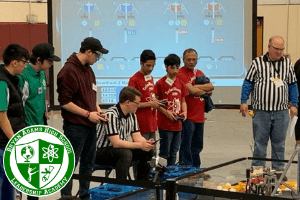
Envision Learning Partners started working with Bryan Adams High School (Dallas, Texas) four years ago to help them transition their entire High School of 2,000 students to a Performance Assessment System. MaryAnn Suhl (Bryan Adams Vice Principal and the lead on this transition) shares her experiences on the project in this blog post:
How are you advancing your Performance Assessment System?
Since we began implementing our Performance Assessment System, we have continued to evolve it into something that works for our campus. Our Performance Assessment system is so beneficial and powerful for our students. When we host defenses, students want to stand in front of their peers, administrators, family members and the community so that they have an opportunity to share their story. It is something so transformative for our students, but also has had a major impact on our teachers because they can now see what students learned in their classes. In some cases, it has caused our teachers to rethink what and how they are teaching based on student defenses and performance assessments.
What have you learnt during this process?
Robot match for engineering students that was a performance assessment in their class
We have learned that this process takes time and that you have to keep it simple. It is important to create as much buy-in and support from all levels of staff so that it doesn’t become an initiative that “they are making them do” instead of what is best for students and their learning. Finally, don’t give up. You will hit snags and run into some roadblocks but the payoff in student learning and engagement makes the struggle so worthwhile.
What is the impact you are seeing on students and their work?
The direct impact is that students are being provided with greater opportunities to discuss the work they are doing in their classes and how it will impact and relate to what they want to do once they graduate high school. Now that we are four years into this process, it has become the thing that is done and students are now excited to participate in defending their learning and are excited to have a greater sense of purpose in what they are learning.
What is the impact you are seeing on teachers and their practice?
There has also been an unintended consequence of moving to performance assessments and defenses and having all of our faculty serve on defense panels to evaluate students on their ability to articulate their learning: Teachers at our campus now have a greater sense of ownership in the process and can now witness students struggle to describe their learning. In other words, it has caused deep reflections in our faculty on what and how they are teaching because it brought to light a realization that “hey, that is a really cool project and students loved getting to make it, but now I can see that they didn’t actually learn from it what the teacher intended – that is so powerful.” This awareness for students and teachers has brought a more critical and analytical lens to the assessments that our teachers are designing for students. The direct impact has been higher levels of rigor for so many of our classrooms and projects. Students can now engage in meaningful and relatable work – they can better articulate how it will help them in their futures.
Performance Task in Health Class
What is the impact of this work on you as a practitioner?
It has really forced me to rethink teaching and learning at the secondary level to consider the question of how are we really preparing our students for life after high school. As a teacher you spend days, weeks, and sometimes months on an assessment that you are so passionate about and think that it is well-structured and designed intricately so that your students are able to master all of the topics you’ve developed. It’s incredibly rewarding to watch students stand in front of their peers (defending their learning) and say things that are so profound, making deep connections to the lessons and to their own personal lives. Students describe how learning these skills, they feel that they are now better equipped to function in society – there is nothing like it. This experience makes me want performance assessments to be standard practice in all classrooms across the country. I have witnessed the true power of engaged learning that takes place when students have to demonstrate what they know, what they can do, and finally, reflect on how their learning has shaped themselves and their future. I am excited to take this learning and experience to more schools in our district to help other educators begin to see the power of performance assessments.
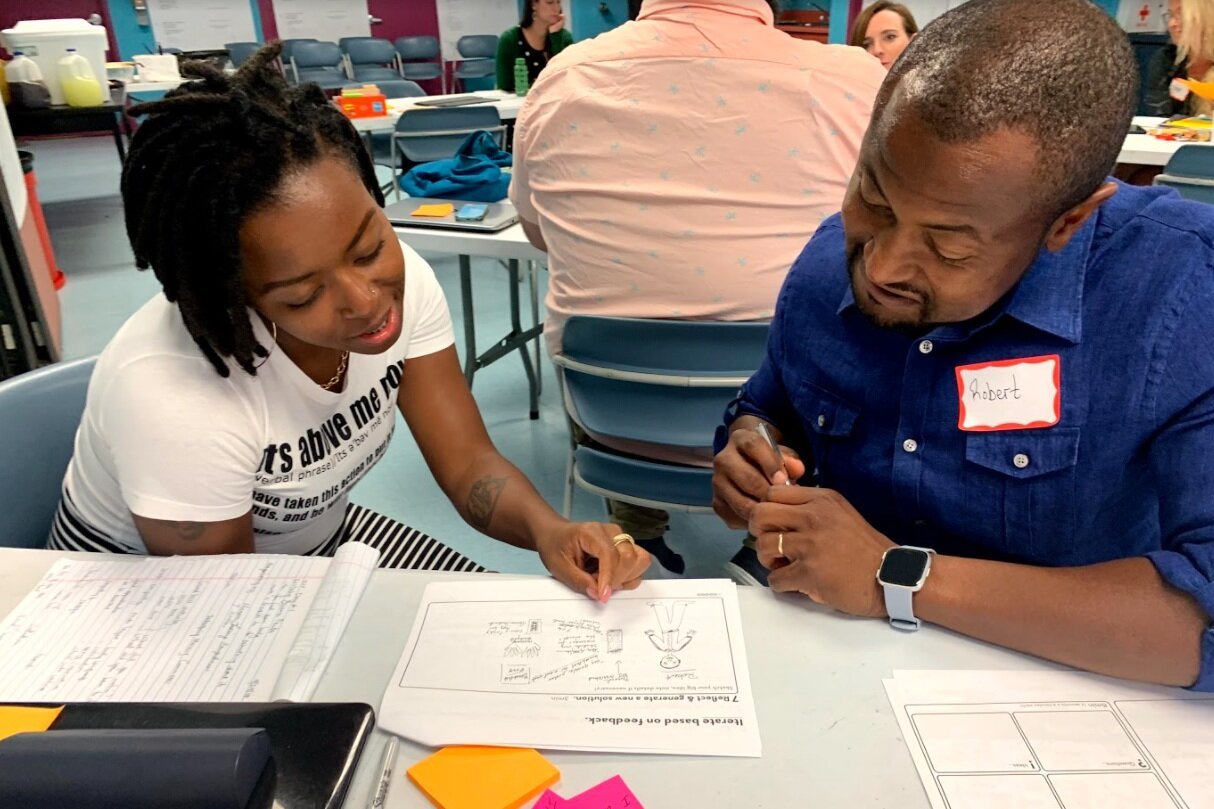
Teacher-leaders working together on creative solutions to develop performance assessments
Is there one story you can share that illustrates how this work is benefitting your school and your students?
This past year, I was sitting in a senior defense and a young lady stated that she had been accepted to nursing school and her performance assessments she discussed were mostly related to her career in the medical field. What was so profound is that this young lady was able to articulate the learning she participated in her classes, particularly in her science classes. She had a strong understanding of the ways in which learning that information in her classes was going to be very beneficial as she was embarking upon nursing school. She also was very candid about how she thought during her freshman year that defenses and performance assessments were silly and just extra projects. She didn’t think they were connected at all to leadership or preparing her for her future. Now she does.
This year’s Defense Design Studios (DDS), our annual portfolio defense showcases, are all completed! These events might have been the closing for the students who presented but for a lot of the educators who attended, it’s just beginning. Many of this year’s attendees are looking to implement portfolio defenses into their schools.
Two visitors from The Edge Foundation, based in London, attended the DDS at Envision Academy in Oakland and later wrote about the portfolio defense model and their experience at observing our students. Read their reflection here.
ELP hosts DDS at Envision schools in the Bay Area, as well as partner schools in Sacramento and Dallas. There are even a few schools in LAUSD that hosted their own DDS without ELP’s support this year, for the first time! Texas saw attendees all the way from Missouri, Sacramento had teams from Fresno and Colorado, and Envision schools gladly welcomed groups from Wisconsin, New York, and even the UK. All in all, over 100 educators attended the ELP hosted DDS this year.
The ELP team had a full and exciting year in 2018-19:
ELP added 20 cities to it’s operational reach this fiscal year, totaling 56 cities in the US and one in Beijing. ELP also quadrupled its support of State Departments, working with Virginia last year, and serving Ohio, Kentucky, and Colorado this year.
ELP is relaunching our blog – keep up with past newsletter content, including more in-depth articles and shared resources! Click on any of the section titles in the newsletter for a quick link to that blog post.
ELP was recently highlighted in an EdWeek article, thanks to a partnership between two of our team members, Ruth Chung Wei & Vinci Daro, and a charter school in Washington DC. Two Rivers Public Charter School started offering a 12-month program for teachers focused on better defining, teaching, and assessing critical thinking and problem-solving skills. Ruth and Vinci provided feedback to the cohort members on their assessment task designs.
ELP is thrilled to welcome Morgan Vien to our team of Deeper Learning Coaches. Fabulously talented and exploding with ideas, Morgan complements our team with her experience in K-8 school leadership (most recently, serving as principal at ASCEND School in Oakland) and facilitating design thinking (as a School Retool Coach for Stanford’s d.school). We, and our client partners, are going to learn so much from her. Please welcome Morgan when you see her out in the field.
In other ELP news, we recently hatched a new strategic plan, our first since joining forces with the Stanford Center for Assessment, Learning, and Equity (SCALE) over a year and a half ago. ELP’s vision—every student in America is learning within a high-quality performance assessment system—is ambitious in scale and generational in scope, so we know we need to set ourselves up for the long haul. In the coming three years, our strategic priorities are:
As always, we welcome your thought partnership. Let us know what you think about our plan, or ask any one of us to elaborate when our paths cross in the field.
Sincerely,
Justin Wells, ELP Executive Director
9 Tips for Writing Effective Rubrics – Adapted from the important thinking of our partners at SCALE, this tool attempts to capture the quality criteria of solid rubric design. The tool is helping our partner schools all over the country to develop performance indicators that serve to define proficiency for their Graduate Profile skills. Take a look and share with us any quality criteria you’ve found effective!
Envision Learning Partners has had the honor of working with Antelope Valley Union High School District since 2017 and we’re excited to share an update on how they are Integrating Portfolio Defenses into the Curriculum: All-in for Success in this Guest Blog written by Duane Robertson.
It is more critical than ever to equip students with a range of skills that will prepare them for college, careers, and life. One strategy that has been implemented in the Antelope Valley High School Districts (AVUHSD) Career Technical Education (CTE) pathways is the Portfolio Defenses. The portfolio defenses not only enhances communication but also fosters students confidence, critical thinking, and collaboration. Recognizing this importance, AVUHSD set a plan to integrate the portfolio defenses into the curriculum, making them an essential component of pathway students’ learning experiences. The implementation plan, the challenges faced, and the successes achieved by AVUHSD is outlined below.
Identifying the Need
After discussions with CTE administration and feedback from teachers, it became apparent that many students lacked opportunities to practice public speaking in structured, meaningful ways – especially after COVID 19. While presentations occasionally appeared in class, they were sporadic and often lacked uniform standards, rubrics or assessments. To address this gap, portfolio defenses were implemented to incorporate presentations as a formalized, skill-building component of CTE pathways.
Setting the Objectives

The primary goals for integrating defenses into the curriculum included:
Developing the Plan
The implementation plan was multi-faceted and involved the following steps:
Overcoming Challenges
While the initiative was ultimately successful, it came with its share of challenges:
Measuring Success
The impact of this initiative was evaluated through teacher and student reflections, and academic outcomes. Key findings included:
Expanding the Vision
Encouraged by the success of the program, plans are underway to further enhance the initiative by extending portfolio beyond CTE classes:

Conclusion
Integrating portfolio defenses into the curriculum has transformed the learning environment, empowering students with communication skills that extend far beyond the classroom. This initiative exemplifies how thoughtful planning, collaboration, and a commitment to students can create meaningful change in education. As students continue to excel in their portfolio defenses and critical thinking abilities, the benefits of this learning strategy reaffirm the importance of such initiatives in preparing our students for the future.
Duane Robertson is the Coordinator of CTE for the Antelope Valley Union High School District.
Mr. Robertson left his position as a multimedia and computer science instructor and Academy Coordinator of the Lancaster High School Engineering and Multimedia Academy, the first Linked Learning Silver-Certified academy. He previously taught business classes as an Adjunct Instructor, after a 15 year career as a project manager. He received his B.S. in Business with an emphasis in Management from Cal State Dominguez Hills, and his first Masters Degree in Education from Chapman University and a 2nd Masters in Administrative Leadership from Cal State Bakersfield.
Duane’s desire to reach students led him to his current role as CTE Coordinator for the Antelope Valley Union High School district. Under his leadership, the CTE classes and academies continue to align with the district’s vision of “every student who graduates will be prepared to pursue college and any career to which he or she aspires”.
Duane is also an alumni of ELP’s Deeper Learning Leadership Forum, Cohort 4.
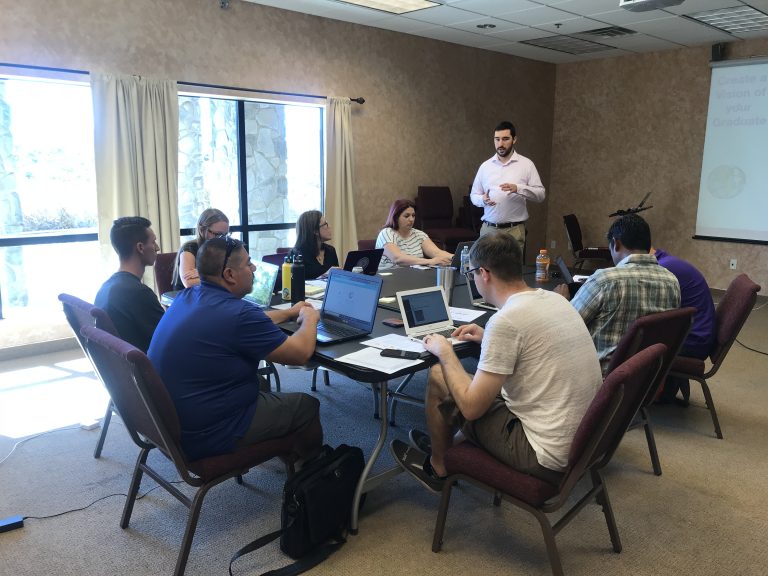
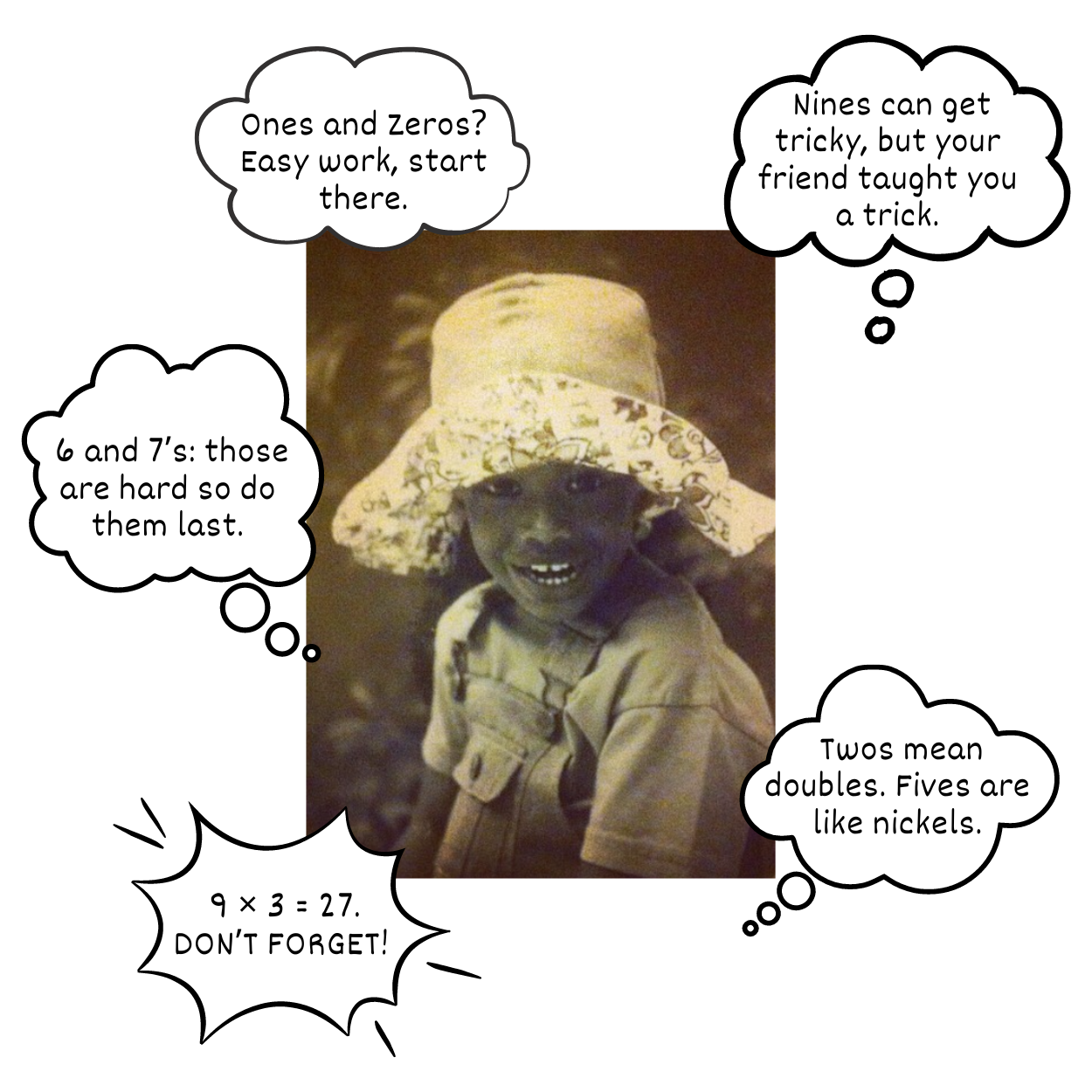
When I was a kid, I was thrilled by timed multiplication tests. You know the ones. Fresh paper flipped with the blank side up, while you recite to yourself…
Then go! You flip your paper and, hardly registering the numbers, answer 60 multiplication problems in 60 seconds (or less) with the speed of Usain Bolt. And when the time is up, you pass the paper to a classmate, hopefully a friend, to grade your paper in purple gel pen and find out whether you are a math genius or…well…hopefully you have other talents.
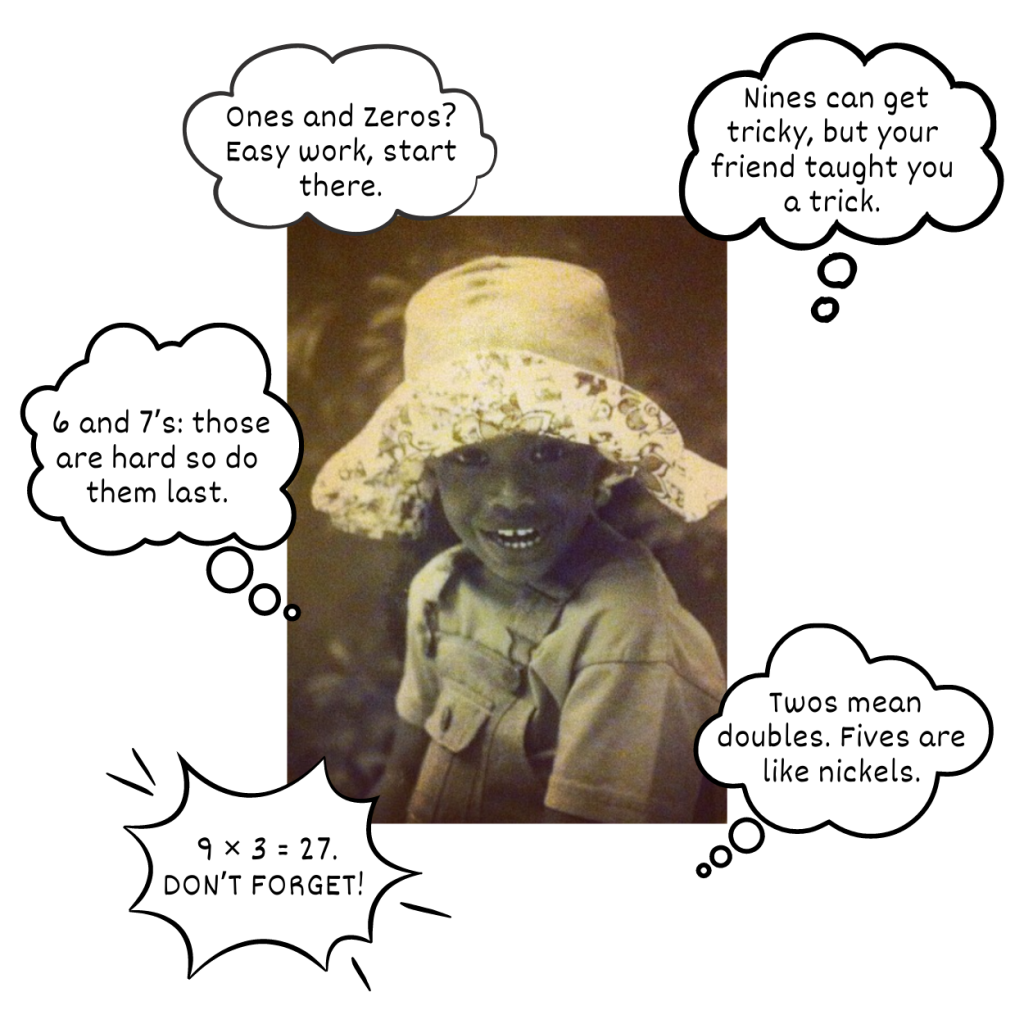
I loved it. To me, math was speed and accuracy. As I went from carrying the one to the Pythagorean Theory, I learned procedures to solve problems with speed and accuracy, hardly registering the numbers. Until I couldn’t anymore.
Eventually, the concepts became too abstract and the procedures couldn’t carry me to any solution – let alone with accuracy and speed. Eventually, I figured that I reached my limit and stopped. As my identity as a ‘math person’ ended, so did aspirations to work in the sciences and anything STEM related. With one course, my plans for my life changed.
Later in life, math and I were reintroduced, this time as a teacher. And I saw that my journey directly conflicted with what we ask of our students: be lifelong learners, persevere, you can do anything you put your mind to. It was then that a thought occurred to me: we’ve been thinking about math all wrong.
So here’s a reframe. The purpose of math class is not to learn numbers and theorems. That’s a byproduct. Instead, the purpose is to learn how to think, problem solve, and investigate our world. Everyday phenomena – natural or socially constructed – are linked to mathematics. It adds data, color, insights, and questions. How we approach a new or difficult math problem informs how we approach challenges that we encounter in our lives. Sure, learning new strategies is an important part of what educators teach in math. But perhaps more powerful is the idea that you can find and use new strategies in creative ways. That we all think differently. That we can build on each others’ ideas. We can aim to support students as they build up their toolboxes and practice being problem-solvers, innovators, and world builders in a variety of circumstances.
We see this shift with the eight standards for mathematical practice, which describe the “processes and proficiencies” that learners will need to be effective in their math education. Simply applied to finding solutions to problems, our learners likely won’t internalize the power of these practices. However, applied as an approach to problem solving, students become empowered in their learning and move toward liberation. When students ask, “Why do we need to learn this math?” We can respond, “So you can change the world.”
This reframe requires safe learning spaces where our students can make mistakes, try new strategies, and explore their world. It requires projects, games, and exploration. Going into next school year, how can we move away from a focus on speed, accuracy, and learning math as a checkbox for the next level of math? How can we move toward liberation?
If we are truly pursuing justice – now and in the future – then we have to change the way we think about math class.

This Guest Blog was written by Envision Education’s Director of STEM, Kala Stepter. Connect with her on LinkedIn.
By Trevor Gardner
The tension between urgency and patience is a constant for educators. On one end we hold high expectations, pushing students to do more than they think they are capable of; we demand their best. On the other end we nurture; we meet them where they are; we remain steadfastly compassionate and understanding.
Paulo Freire first helped me understand this tension when I read what I believe is his most essential texts for school educators: Teachers as Cultural Workers: Letters to those Who Dare to Teach. In his “Fourth Letter: On the indispensable qualities of progressive educators for their better performance,” he frames the tension in this way:
[The progressive educator] must exercise wisdom in experiencing the tension between patience and impatience. Neither patience nor impatience alone is what is called for. Patience alone may bring the educator to a position of resignation, or permissiveness; that denies the educator’s democratic dream. Unaccompanied patience may lead to immobility, to inactivity… Untempered impatience threatens the success of one’s practice, which becomes lost in the arrogance of judging oneself the owner of history. Patience alone consumes itself in mere prattle; impatience alone consumes itself in irresponsible activism. Virtue, then, does not lie in experience either without the other but, rather, in living the permanent tension between the two. The educator must live and work impatiently patiently, never surrendering entirely to either (pg. 211).
If you have spent any amount of time with young people in schools – but especially as a classroom teacher – you have felt the weight of this tension and you have struggled with the layers of complexity that pull you in either direction. And if you currently work with young people in schools, as we emerge slowly from the global pandemic that forced students to endure nearly a year and a half of online “school”, isolated in their homes, their bedrooms, and their computer screens; I imagine you are experiencing the antagonism of this polarity in a way that is heavier, more messy, and more emotionally fraught than ever before.
Ukiah Camping with Students
Moving into my 23rd year as an educator, both as a classroom teacher and a school leader, I find myself struggling more than ever, as I look out at the 28 students in my 11th grade US History class, or when I sit in coaching meetings with my incredible teachers, with the wisdom to locate the equilibrium in this tension.
Belief in the possibilities of education feels like it is at an all time low. Engagement in the classroom feels more challenging to sustain. Desire to struggle through difficult work seems more short-lived.
When attempting to capture the feeling of this dynamic, I have been using the analogy of an athlete whose muscles have atrophied due to being sidelined for a long time due to injury. From March 2020 until August 2021, students (at least those in Bay Area public schools) did not step foot into a school building. They did not engage in small group discussion with their classmates. They did not get up in front of the class to model how to work out a math problem. They did not rotate around the room on a gallery walk, writing their thoughts on small posters and reading the ideas of their peers. They did not rush out the door to find their best friends for lunch.
Of course, after such a hiatus, they are less good at doing school. In this sense, yes, they have atrophied, at least as students in the classroom. But they have also built different muscles. They have learned to navigate the world in a pandemic, a world more complex than we have known before. They have learned to be closer to their families, to care for younger siblings doing online schooling and for elders facing health conditions. They have built muscles of resilience, awareness, and empathy.
Ukiah Camping with Students
What I am realizing more and more is that, if we are exercising the wisdom of our experience, as Freire asks us to do, then we must find ways to turn this incredibly challenging moment into an opportunity. Our urgency must be marshaled not only in support of our students, but also in questioning, transforming, and reimagining how schools (or at least our own classrooms) function.
Do we want our students to build back muscles that help them comply and fit into a box, an institution, a system that can feel disconnected, uninspiring, and even harmful? Do we want them to be better at enduring boredom and passivity? What are the muscles we want to rebuild as we take this long journey together back to an education that truly serves our students and our communities?
What if we add a third point to Freire’s tension between patience and impatience and we call it HOPE – and we allow ourselves to pull equally in the direction of what else is possible? What if we add an element in our lesson plans labeled hope? What if we ask ourselves every day how we are cultivating hope – in our classrooms, in our discipline policies, in our communication with families and caregivers, and in our interactions with our colleagues? Hope that a different way is possible. Hope that what I learn today matters. Hope that we will learn through this difficult moment together.
I know it is not simple. My students will certainly tell you that there have been more than a few US History lessons that have bored them to sleepiness or that did not inspire them to suck out all the marrow of life and use their knowledge of history to transform the world. I have work to do. At times I have let my urgency run over students and lose sight of the myriad struggles they continue to cope with. At other times my patience has left me mired in acceptance of the status quo. I too have atrophied and have questioned my purpose as a teacher and school leader.
But what if I, what if WE, collectively, placed the cultivation of hope as our primary objective? What if we met the challenges with what the incredible Shawn Ginwright calls “radical imagination… the collective dreaming about how things should be.” Imagine what schools could become.
Trevor Gardner has been an educator in the Bay Area for 20 years. He has taught high school English and history and has worked at multiple levels of school leadership and is currently the Director of Teaching and Learning at ARISE High School in East Oakland. Trevor is the author of Discipline Over Punishment: Successes and Struggles with Restorative Justice in Schools and also an alumni of ELP’s Deeper Learning Leadership Forum. Connect with Trevor on Twitter and LinkedIn.
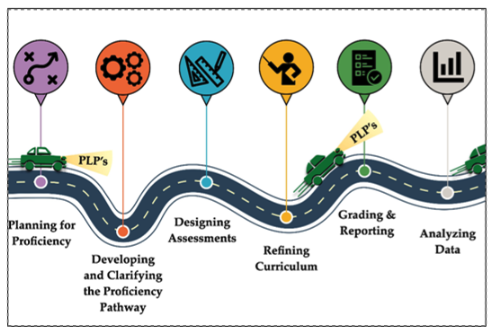
Vermont has been on an ambitious journey to implement student-centered, proficiency-based learning for over twenty years. That journey continues to evolve today, and this blog shares some of the key points along the way.
A publication by the Vermont Department of Education in 2003, “High Schools on the Move,” addressed “the critical issues facing Vermont high schools” and identified principles that remain at the heart of Vermont’s work today. These include:
(A Report to the Vermont Legislature on Career and Technical Education)
The task force recommended a focus on personalized learning environments that would enable students to take risks in a supportive setting and prepare them for life after graduation. The What and Why of Act 77 outlines additional milestones along Vermont’s path towards the Flexible Pathways Initiative, created by Act 77 of 2013 and found in statute under 16 V.S.A. § 941. This Act was “established to encourage and support the creativity of school districts as they develop and expand high-quality educational experiences that are an integral part of secondary education in the evolving 21st Century classroom; to promote opportunities for Vermont students to achieve postsecondary readiness through high-quality educational experiences that acknowledge individual goals, learning styles, and abilities; and to increase the rates of secondary school completion and postsecondary continuation in Vermont.”
The Flexible Pathways Initiative paved the way for the inclusion of proficiency-based learning in Vermont’s State Board of Education Rules, Series 2000, The Education Quality Standards, that went into effect in April 2014. These rules state:

In an effort to develop a shared vision for both proficiency-based learning and college and career readiness, in 2017 the VT Agency of Education began collaborating with the field to develop a statewide Portrait of a Graduate (PoG). Approximately sixty educators from across the state gathered to react to the initial draft. That version was influenced by a blog post, The Graduate Profile: A Focus on Outcomes, from Edutopia by Ken Kay that stated:
Over the next two years, more than three hundred students, parents, educators, and community members contributed to the final version of the Vermont PoG. The PoG provided guidance in the development of proficiency-based graduation requirements and articulates the vision for learners who are prepared for success in college, career, and life. Personalized Learning Plans, a requirement in Act 77 for students in grades seven through twelve, serve as a vehicle for documenting a learner’s progress towards the attributes of the PoG.
Fast forward to 2020. . . Vermont educators had been working hard to implement the expectations within the Education Quality Standards for local graduation requirements, however, a survey that year revealed a wide variation in requirements across the state. Depending upon the supervisory union or district a student attended, there was a range from six to one hundred thirty-five Proficiency-Based Graduation Requirements. This indicated that expectations for graduation, which are determined locally and approved by school boards, were being interpreted in a variety of ways. Educators moved forward with the development of PBGRs with good intentions, however, a collective understanding for these expectations had not been developed. Unintentionally, this range in PBGRS created inequitable expectations for learners across the state.

Concern about this lack of coherence and the impact on students, especially those who move frequently or attend Career Technical Education Centers from several different sending schools, gave “birth” to the Proficiency-Based Graduation Hierarchies. Content Specialists started by determining what it means to be literate in their content area and distilled the essential information into an overarching Proficiency-Based Graduation Requirement. Critical Proficiencies represent the enduring knowledge and skills within a content area and promote high expectations for all students. Priority Performance Indicators represent the skills and knowledge that will be taught and assessed. Finally, Proficiency Scales indicate the progression of learning over time. Once this information was drafted, the Hierarchies went through an internal review process using quality criteria documents as lenses for providing feedback. After an additional two rounds of feedback from the field, the Hierarchies were revised, finalized, and posted on the VT AOE website.
Since Vermont is a local control state, supervisory unions and districts are not required to adopt the PBGR Hierarchies. However, in the spirit of continuous improvement, educators are encouraged to adopt the PBGR Hierarchies, adapt them to fit their context, or use each Hierarchy to refine locally defined PBGRs.
As part of VT AOE’s continuous improvement process, members of the Student Pathways Division are working with educators in SU/SDs to support the processes of adapting, adopting, or refining local PBGRs through Participatory Action Research (PAR).
Numerous resources have been developed over time to support Vermont’s efforts to implement proficiency-based learning. The Vermont Framework for Proficiency: Resources to Support Implementation is composed of stackable documents that enable educators to access the information that is most relevant to the needs of their particular school system. It is organized from a backward-designed perspective so that the initial documents lay the foundation for subsequent work and inform decisions regarding next steps. The resources also demonstrate how different parts of the Framework for Proficiency connect and build upon one another. The hope is that by sharing these resources and Vermont’s journey, others can benefit and join us on the road to proficiency.
Guest Blog written by Pat Fitzsimmons
In this special Guest Blog Video Interview, hear from Alcine Mumby and Laureen Adams, interviewed by Niloy Gangopadhyay and Courtney Katen.
This interview was sparked by Alcine’s recent travel to the Ghana ASCD Educators’ Summit 2024 earlier this year.
Learn about Alcine and Laureen’s history- all starting in Oakland at Envision Academy, what Laureen took away and still carries with her as leader of the Tutu Institute in Ghana, why she believes so deeply in performance assessment, and what’s up next for her work continuing to support educators and systems.
By Roman Stearns
During the pandemic, each individual and organization has been forced to practice unprecedented levels of resilience and adaptability. It’s remarkable really. Workers adapted to new conditions and norms. Students adapted to new places and forms of learning. Parents adapted to some form of homeschooling. Beyond individuals, businesses adapted to new strategies for offering products and services, and nonprofits and government agencies adapted to new and creative methods for providing support. From my observation, everyone, of all ages and across all sectors of society, deserves a badge for resilience and adaptability.
Most of us have grown up with some form of badging to recognize accomplishments. Some remember merit badges awarded during Boy or Girl Scouts. Some work in organizations that award pins for years of service. Of course, gamers are very familiar with endless ways to earn badges and level up. The age-old strategy persists because it works; it draws on our natural desire to improve, to achieve, to win, and to get recognition when we do.
Please indulge me while I reflect on personal experience. I’m a former high school Spanish teacher. My wife is multilingual. We see language as a tremendous asset, and thus are committed to promoting languages among our children. When our eldest son, Eli, was three years old, we enthusiastically enrolled him in a dual immersion preschool, where 100% of instruction was in Spanish. To our surprise, rather than becoming fluent, he emerged after three years with very limited capability. Years later, now at a charter Montessori school, Eli has one hour of Spanish per week – not nearly enough for him to become proficient. I had submitted to the reality that perhaps he would not emerge from his schooling speaking Spanish.
Then came the pandemic and the transition to homeschooling. The school introduced Eli, then 12-years-old, to Duolingo, an online app for learning languages. All of a sudden, he became highly interested, doing Spanish for an hour or more a day! He began learning Spanish at a remarkable rate. I was fascinated by the change and wondered about the cause. Like many other online learning apps (e.g., Khan Academy), Duolingo is gamified, with students earning badges and leveling up. It celebrates progress and accomplishment, motivating users to continue to advance to higher and higher levels of achievement. To my delight, after just a few weeks, Eli was speaking Spanish around the house using full sentences!
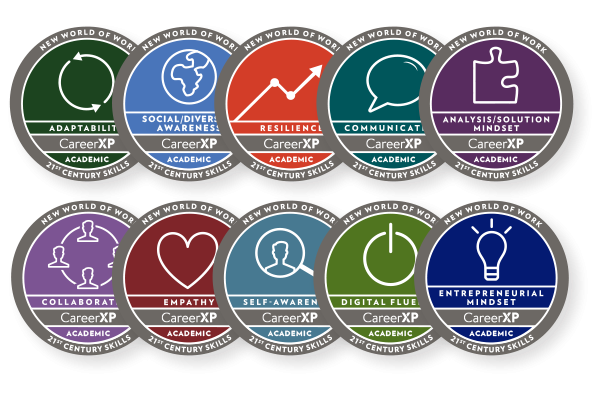
As a school reformer, I’ve always liked the idea of awarding digital badges to students who demonstrate various competencies, whether collaboration, initiative, empathy, creativity, or civic action. I wonder why programs like 21st Century Skills Badging, designed jointly by the Foundation for California Community Colleges and New World of Work, have not become more popular in CA. Is it because the incentives are not in place? Is it that our education system does not adequately value student demonstration of 21st century skills and social emotional learning outcomes? Is it because those competencies have not yet earned a place in our state accountability system? Inherently, we know they are important, and a growing body of research reinforces the benefits to student achievement and success.
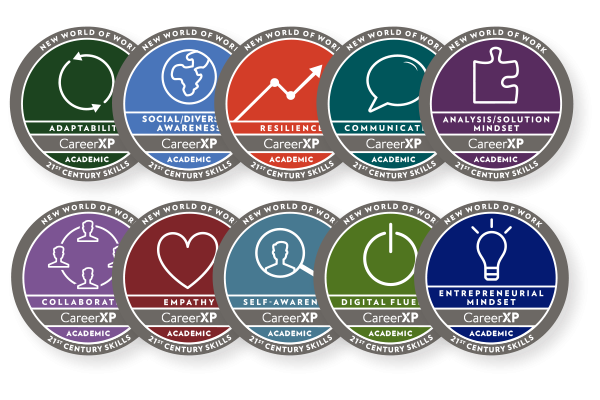
In another blog post, I emphasized that the current circumstances accentuate the need and urgency to embrace success skills and social emotional development as core and central to our education process. As we reflect on what we’re learning – individually, organizationally, and societally – during the pandemic, we must consider how the “new normal” will value the competencies that young people have demonstrated so impressively over the past two years – adaptability, resilience, empathy, compassion, civic responsibility, effective communication across platforms, digital literacy, independence, initiative, resourcefulness, creativity, critical thinking, and more.
Could digital badges help us signal the importance of those competencies? How can we build the capacity of teachers to both demonstrate and measure these skills? Will we add them to report cards? Could more recognition, perhaps through approaches such as badges or gamification, elevate their importance for students? As per another blog post, might it be time for the traditional “currency of education” – the high school transcript – to give way to a newer currency that is more equitable, student-centered, and competency-based? Might digital badges be the best currency as we pivot to a competency-based approach to learning and assessing students?
Fortunately, a group of school districts is already tackling these questions. They are pioneering members of a new community of practice dedicated to educating the whole child. A new California partnership, called Scaling Student Success, works with school districts that have engaged their local stakeholders to create a Graduate Profile – a succinct, one-pager that articulates the skills, competencies, and mindsets young people need for future success. These districts are eager to move “from poster to practice” – i.e., breathing life into their Graduate Profiles, giving each and every student an equitable opportunity to develop and demonstrate the competencies articulated on their Graduate Profile.
One common challenge among the districts in the Scaling Student Success community of practice is how to build coherence around their Graduate Profile and measure and report on the Profile outcomes. They recognize that not all are achievable during 180 school days, from 8:00 am to 3:00 pm. They wonder how they can actively involve their community members in offering opportunities for students to practice and demonstrate competencies beyond the boundaries of the classroom, clock (school day), and calendar (school year). For example, would it be possible to engage families, neighbors, soccer coaches, dance instructors, youth group leaders, internship supervisors, and other youth-serving community members?
While my dream is nowhere near as ambitious nor eloquent as the one expressed by Martin Luther King Jr. in 1963, it’s a dream that I too hope can become reality in the years to come. Let’s create a phone app that allows students, their peers, families and community members to rate student performance on any competence represented on a district’s Graduate Profile.
To understand how this would work, let’s return to my son Eli. Similar to a Graduate Profile, his school has a set of “Whole Child Reflections” that include empathy, independence/responsibility, acceptance of self/others, problem solving, positive risk taking, integrity, organization, contribution, curiosity and initiative, and critical thinking. On report cards each quarter, his teachers rate him on a scale (AC = area of concern, S = sometimes, O = often, C = consistently). But, those ratings are merely teacher observations during class time. They do not include self-reflection, peer assessments, or ratings offered by other adults who interact with Eli both in and out of school.
When COVID forced an end to his soccer practices, Eli insisted on continuing to practice every day. Happy to support his wellness, we drove him each afternoon to a local park. Over time, he became frustrated that he didn’t have goals, cones, hurdles, and other training equipment he was accustomed to. I suggested that he earn some money to buy the items he wanted. He learned during the recent spring break that he can make money washing cars. So, Eli created a flier promoting “Eli’s Car Wash,” printed it, and placed it on a few dozen door steps in the neighborhood (see Eli’s fun flier here). Over several weeks he earned over $500 and bought all the equipment he needed, including a new pair of cleats! Wouldn’t it have been ideal if he had the opportunity to ask the neighbors to rate him on independence/responsibility, initiative, and perhaps problem-solving. The neighbors could download the app, offer a rating, make a comment, and even attach an artifact.
Then, when Eli had received five or more ratings for, say independence/responsibility, he would use the app to submit the ratings for review and approval. His teacher would review the ratings and associated comments and evidence, and determine whether he had met a standard. If met, Eli would be awarded a digital badge representing his demonstration of competence. That badge would become a portable credential that he then could use in multiple ways, i.e., when applying for high school, college, or his first job.
Benefits to Students and Schools
An app like this could have many benefits, including:
Please share your ideas. How can we promote community-based learning opportunities and validate students’ demonstration of essential skills? Are there places where this kind of badging system is already working? What have you seen and experienced? What would you like to see?
Roman Stearns is Founder & Executive Director of Scaling Student Success, a California partnership dedicated to educating the whole child. Envision Learning Partners is an active practice partner, helping to co-design and facilitate community of practice sessions. Roman is also a member of ELP’s 5th Deeper Learning Leadership Forum.
What’s next? Enforcing “time served” is for prison guards, not stewards of genius.
Vinci Daro and Theresa Morris are two razor-sharp colleagues of mine. Among other qualities, they are math curriculum and assessment designers; they also help teachers shift the focus of learning to center students. The teacher works to guide, encourage, and create conditions for unfettering the growth of all students as full human beings, as problem solvers, thinkers, learners, and doers. That’s how I understand it, anyway. It is the opposite of my experience with high school math in particular, and I literally love them for it.
Once I heard Theresa very quickly answer a question about her mission and purpose: “Recovering lost potential.” Another time I saw Vinci’s response to a question about the values and principles she proposes when she is coaching or facilitating, and I think it was the only thing she wrote: “Students are brilliant.”
Think about that. What is happening in a course built on those directives? Let’s explore.
A few years back I heard from two high school students from different schools who designed and prototyped shoes with batteries built into the soles, which recharge via kinetic and solar energy from being used like shoes – walking around, and it helps if it’s sunny. Both students researched previous attempts at such a design. Both devised and revised proposals, plans, designs. Both went into the world to share their inquiries and challenges with professionals, mainly scientists and engineers. One used design thinking and the other used the engineering design process to get to a working prototype, and they did not solve the design challenges in the same way. One of these innovators was acquiring a patent in hopes of a licensing deal and navigating all of that, while the other had a batch of shoes manufactured and shipped to families in Ethiopia so they can be less impacted by rolling blackouts. He raised the money for that, too! They both spoke publicly about their process, challenges, and learning and expertly Both answered a barrage of questions from adults. One shared her story through a professional presentation in a giant auditorium and the other stood by a digital display of his project and walked groups of people through as they approached and investigated his station.
How do we design for that? One answer may strike you as suspiciously familiar.
Schools have found themselves bogged down by inflexible structures at a time when we need flexibility most. Some educators worry about students completing work too quickly and then not having anything to do with the remaining class time.
Rooting conditions for school success in things like seat time ultimately dilutes the data that actually measures student learning. Here are some things we will miss: what students can do now, their strengths and needs, how to support them, and what’s next for them. Pretty important stuff! Once you have them in front of you, how will you use that time to answer those other questions, and teach things that can be learned? Relationships, home visits, personalized interventions, bus passes, carpools, and other creative community support are more effective ways to address the high crimes of absence and tardiness!
Education shouldn’t be like serving a sentence. Let’s instead refocus our approach on what matters most and prepare ourselves to cultivate some genius. Model those transferable skills, bring all students relevant learning experiences, assist them in gaining useful strategies, expressing themselves, creating real things, taking initiative, and generally developing their powers! Let the reality of student brilliance and the high stakes of lost potential set the terms, not “time served.”
In other words, your students are not done yet. They’ve got way more to offer and more to learn. So what’s next for each of them and how will you let them do it?
Exposure and practice to the art of public speaking has the power to deepen and strengthen our connection to self, our education, and our community.
Growing up, I devoted myself to school because it was the one thing in my life whose outcome I knew I could control.
If I did my homework, I got good grades.
If I tested well, I got good grades.
If I met my deadlines, I got good grades.
If I completed my reading log (even if sometimes I skipped reading) I got good grades.
Good grades meant a great report card and that meant that I could eventually go do big things in the world.
My teachers had no complaints by the time parent teacher conferences came, except that they would love it if I “spoke up more and participated in group discussions”. And each time I would tell them that I would work on it, but truthfully, it was the #1 piece of feedback I received for years to come.
I’ll be honest in saying that for this introvert, it was difficult to participate in class. I was afraid of judgment, but more importantly, I needed time to process my thoughts and in some ways, protect my inner voice.
As a first generation, oldest daughter of an immigrant single mother, being the shy, quiet, & reserved Yvonne was simply more comfortable than being in the spotlight. Besides, it had always gotten me the results I “needed”: good grades. And that’s all I needed to help pave the way for my siblings and I to “be successful”.
There were moments I got glimpses of my power as a speaker as the MC for my elementary school graduation & cultural events, but the excitement of those moments were never fully integrated in the classroom.

When I started high school at Metropolitan Arts & Tech (one of the first Envision Education Bay Area schools) I had no idea that my engagement with my education would completely transform. Our curriculum focused a lot on internalizing our learnings through deep reflection, critical thinking, creativity, and talking about it. Every semester we hosted ‘exhibitions’ as a way to share our work with our peers, family, and friends. We were required to present a collection of our work to showcase that we had achieved the learning outcomes of projects across subjects, which made me incredibly uncomfortable and way too nervous. I remember thinking “Why are they making us do all of this extra stuff? Can I just take a test?”
We’d spend hours preparing our talking points, our presentation boards, and even our outfits. Each time, it got easier and I reconnected with my love for public speaking. I say reconnected because I already had it in me. I was just not always in environments that pushed me to step up. The Yvonne that I knew myself to be, could also now fully exist in the classroom. Public speaking opened the door for me to be more authentically myself. To lean into a perceived contradiction where I had a hard time participating in class discussions, but could completely dominate a speech because I had been granted the time to practice and cultivate my art.
And I didn’t do it alone. I had an entire community in my teachers and my classmates. We were all in it together and all bonded over having to deliver presentations so frequently. I grew closer to my classmates because we’d spend hours giving each other feedback or exchanging ideas for how we’d present. We could collectively share our nerves and also work through them to deliver.
No matter who we were or where we came from, when we showed up to the classroom we were given the platform to share our ideas & deeply engage in our education from the lens of our lived experiences.
Presenting in the classroom allowed me to understand myself at a much deeper level, feel empowered by my education, and learn to create community through the art of public speaking.
My hope is that we can all see the power of public speaking beyond simply “taking the stage”, but also recognize its power in helping us reconnect with our most authentic selves, our education, and the collective power of doing things in community with others.
ELPers, Alcine Mumby and Aragon Burlingham speak on camera about their experiences being part of the first Nexus Fellowship. The Nexus Fellowship was developed by the Equity Lab in response to the overwhelming need for race, equity, diversity, and inclusion (REDI) in the learning profession. The Fellowship helps leaders to create long-term organizational change around race and equity.
What experiences brought you into coaching?
I had the incredible experience to be on the team that founded Envision Learning Partners. I was half-way into my teaching career at that point and was offered the opportunity to design and create a way in which we could share some of what makes Envision special with others around the country who were interested. I spent 2 years feeling like I had gone back to grad school as we built ELP, as I was learning so much in the process! Wanting to put into practice for myself all of the rich growth I had experienced, I went back into the classroom at Envision for 5 more years. It was a natural and wonderful return to coaching in 2016 when I was able to re-join the team on this side of the organization.
What do you most enjoy about being a coach?
I feel so inspired by the brilliant educators with whom I get to cross paths and sit shoulder to shoulder while on my coaching journey. I was worried that I would miss the beautiful chaos of teenagers on a daily basis when I left teaching, but coaching provides similarly vibrant relationships with the folks I get to partner with. Coaching offers a bit of a different cognitive challenge as I get to think about units of change larger than my own classroom. This is invigorating and often makes my brain hurt in really cool ways.
What do you like to do when you are not coaching?
When not on a plane or sitting in an airport, you can find me running the trails of the incredible hills and redwood forests in the east bay, talking to every dog I pass on the sidewalk, enjoying the incredible food and wine that we have at our fingertips, traveling to far off magical lands as often as possible, cooking dinner for former students, and stepping out on a dance floor when the music is right.
Hear why our newest Deeper Learning Coach, Morgan Vien, joined ELP and is excited about her new role working with our partners across the country.
What experiences brought you into coaching?
As a student, I loved learning but found school more stifling than unleashing of my love of learning. As a high school teacher, I loved learning from my students and helping them discover themselves and the world around them. As a lead teacher, I always wanted more time to design amazing learning experiences, think about school-wide systems, and learn more about what other great schools are working on.
What do you most enjoy about being a coach?
As a coach, while I miss crazy teenager energy, I love the increased impact my work has on many other people’s students; I love the nitty-gritty of it too: learning, collaborating, and co-designing learning experiences and systems that help schools and districts in their process of transforming teaching and learning from the systems we all inherited.
What do you like to do when you are not coaching?
I am an activist, an artist, and an introvert! A big contradiction of things. I try to maintain space for calm, for creating and appreciating art in many forms, for reflection, and for just existing outside as part of the natural world, as well as fighting the fights that must be fought to make the world a better place.
What experiences brought you to ELP?
I first learned about ELP as a client when working at ARISE High School in Oakland, CA. We were building out new graduate student profiles/senior defenses, as my team

While working with ELP, I am hoping to continue to gain knowledge on how to work with a variety of partners to achieve common goals around bettering the quality of education for our youth. I’ve been on the other side as a client, and I am excited to really dive into the ways of leading this work as an assessment design partner. I am also excited about having the opportunity to lead virtual workshops that can potentially reach the world (s/o to Vinci who had someone from out the country in her last workshop!).
I am SO excited to be a part of this team! Even before I started on my first day, I felt accepted, appreciated, and valued. The fact that I am surrounded by so many knowledgeable and wise educators with a breadth of experience has already begun to excite me even more so about this work. There is a lot of passion and dedication, as well as a strong focus on equity and cultural responsive practice which definitely aligns with my work morals/ethics. And, I’m always excited to grow myself as an educational leader, and I know that’s going to happen here with ELP!
When I’m not working, I’ve been enjoying learning about, and exploring Long Beach/SoCal! I just moved down here in March, and there is so much to do! Aside from exploring, I love to listen to music; sing, dance, zone out, etc. I have been reclaiming my love for exercise, and have been kickboxing and bike riding as well. I just recently got back into art, so I’ve been painting too! Then there’s: time with my family and partner, catching up with friends, sports (playing and watching), watching anime, meditation and breathwork, reading, journaling, amateur photography…I like to do A LOT when I have time!
Fun fact: Current ELPer, Ruth Chung Wei and I discovered that her nephew is my kickboxing coach here in Long Beach! =)
What’s your new role?
I am serving as the Chief Program Officer (CPO) of Envision, a new role for the organization. My job is to steward the overall academic model of Envision Education, which is enacted through our four charter schools in the San Francisco Bay Area and through our nationwide consulting arm, Envision Learning Partners (ELP).
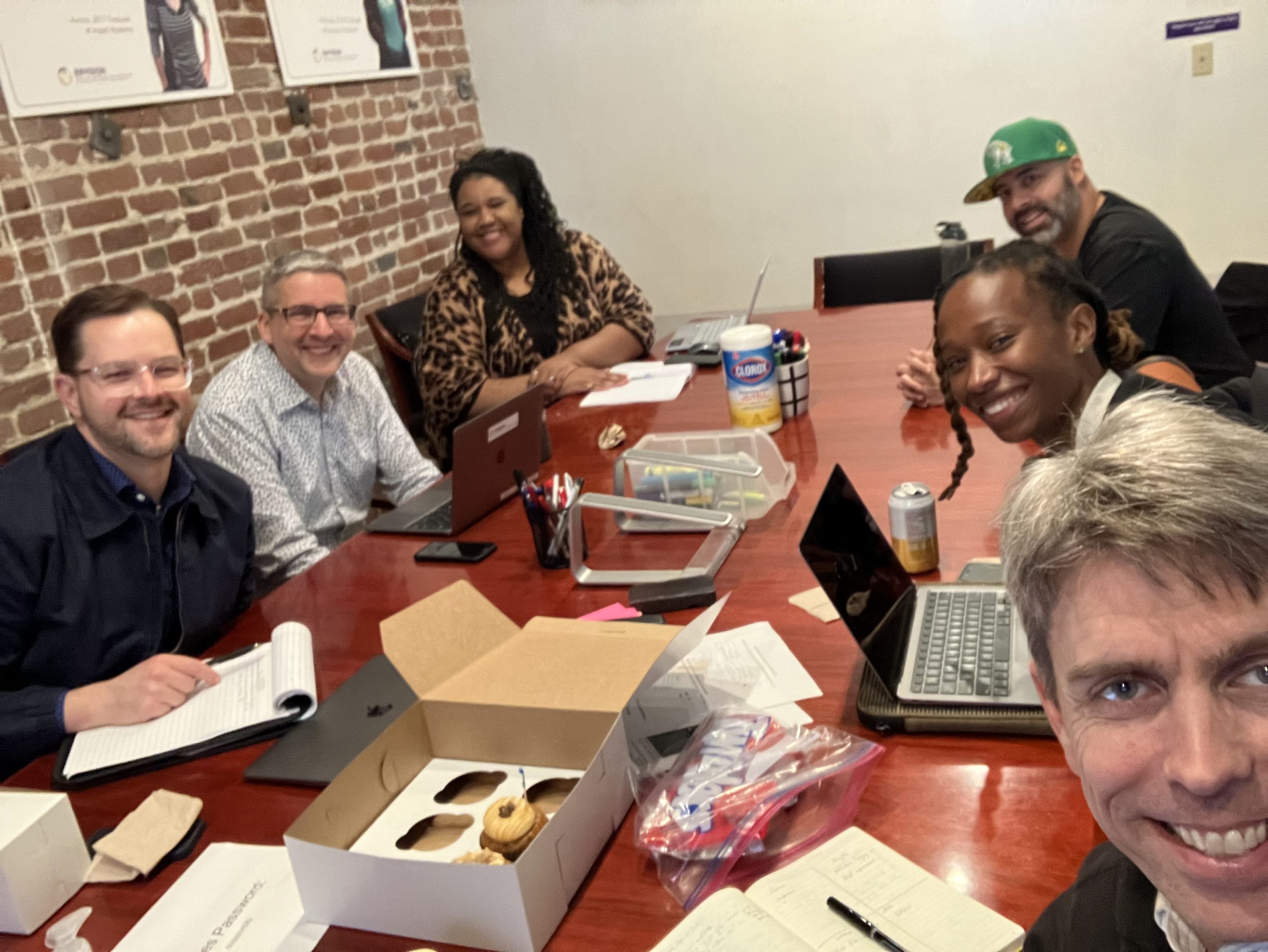
What does Envision Education hope to achieve with this shift?
Before the CPO role was created, the bridge between ELP and our schools ran through the CEO, at the very top of the organization. The intent of my role is to lower the altitude of that bridge and add lanes. I am working to increase the bandwidth of learning between our schools and our nationwide coaching.
How does it support Envision E ducation’s mission and vision?
Since its founding, Envision has been dedicated to the idea that students deserve an education that attends not just to what they know, but also to what they can do and how deeply they can reflect. (See our principles of High-Quality Performance Assessment, or HQPA.) And we’ve always been committed to serving not only students in our own schools but also students everywhere, by sharing our ideas with public schools and advocating for shifts in policy. In that sense, Envision is proud to be living out the original purpose of charter schools: places to test ideas and, if they work, share them. The job of the CPO is to ensure that we live up to that ideal.
What’s your favorite part of your new role?
I am interacting daily with broader swath of Envisioners, including students, teachers, and school leaders. I directly support a team of directors of academics and student services who are brilliant and collaborative. Plus, I still get to hang with ELP!
What are you bringing from ELP that you’re using in your new role?
My decade at ELP taught me that change happens not through mandate but through persuasion and inspiration. That requires communication that is clear, tight, and uplifting. I try to apply those skills every day.
Where do you see yourself and/or your role in the next few years?
I have so much to learn if I am to succeed in my new role, but I remind myself that over my 20 years at Envision, I’ve been here before. I was there when I had to figure out project-based learning as a brand new teacher. I was there when I joined ELP and had to learn how to facilitate learning for educators (a tough crowd!). And it’s where I am and will be for the foreseeable future: climbing a learning curve that’s real steep, pausing now and then to enjoy the view.
Although I have a title of Executive Director (privileged to do work I love with people who inspire me), I still call myself a teacher. I have always been, and remain, completely in thrall to the process of human learning.
Back in 2008, in my sixth year as an English teacher for Envision Schools, I was lucky to be involved in the design and implementation of a multi-disciplinary project that was chronicled by a professional documentarian. Many of you will be familiar with this video of the Campaign Ad Project, but for those who aren’t, it’s a blast-from-the-past glimpse into who I am as a teacher, why I love teaching in a deeper learning culture, and why I am so committed to the overlapping concepts of project-based learning and performance assessment.
Young people deserve learning experiences that are challenging, exciting, supportive, and memorable—what I like to call “learning you can tell a story about.” ELP’s mission is to help learning communities create the conditions for these kinds of experiences to be typical, not extraordinary.
Follow Justin on Twitter @jusowells.
This rounds out our introduction of every ELP team member. In upcoming installments, we’ll pose questions that prompt deeper insights into the ELP team. If you have a question for the team that you’d like answered, please send your question to Courtney Katen for a chance to have it answered in a future newsletter.

Hi I’m Michael, an 11th grade student from Envision Academy, born and raised here in the Bay Area. Interests that I have are the inner workings of cars and what goes into building/modifying them. I’m very interested in the Mechanical Engineering world and would love to pursue a career in it. I look forward to spending the week with the ELP team and learning from them in order to grow as both a person and finding out what makes things work.
I chose to go to Envision Academy in Oakland because I heard great things about the school from my older brother who also attended for the full 4 years. So far I’ve had a great experience at Envision Academy with the school being very inclusive, I never feel out of place.
Here are a few things that I am doing at school: A bridge project in my Physics class where me and a group of students work together to design a bridge that can hold up at least one brick. A satirical piece of writing in my English class where I am pointing out a problem of my choice in today’s world/society while incorporating ideas like irony into the text.
Right now I am looking at colleges which can help the dream of me wanting to become a Mechanical Engineer with a friend of mine contributing to it as well. We have a full list of colleges with each being color coded to indicate how likely we are to be accepted, with green being we are sure to get in and red being a longshot. I am currently looking at Georgia Tech and Stanford University as my top two choices for Mechanical Engineering classes.
What I want to take from this experience of working with the ELP team is how organized and calculated I can get with all my work, but also researching so I can continue to investigate more opportunities that I and others can benefit from.
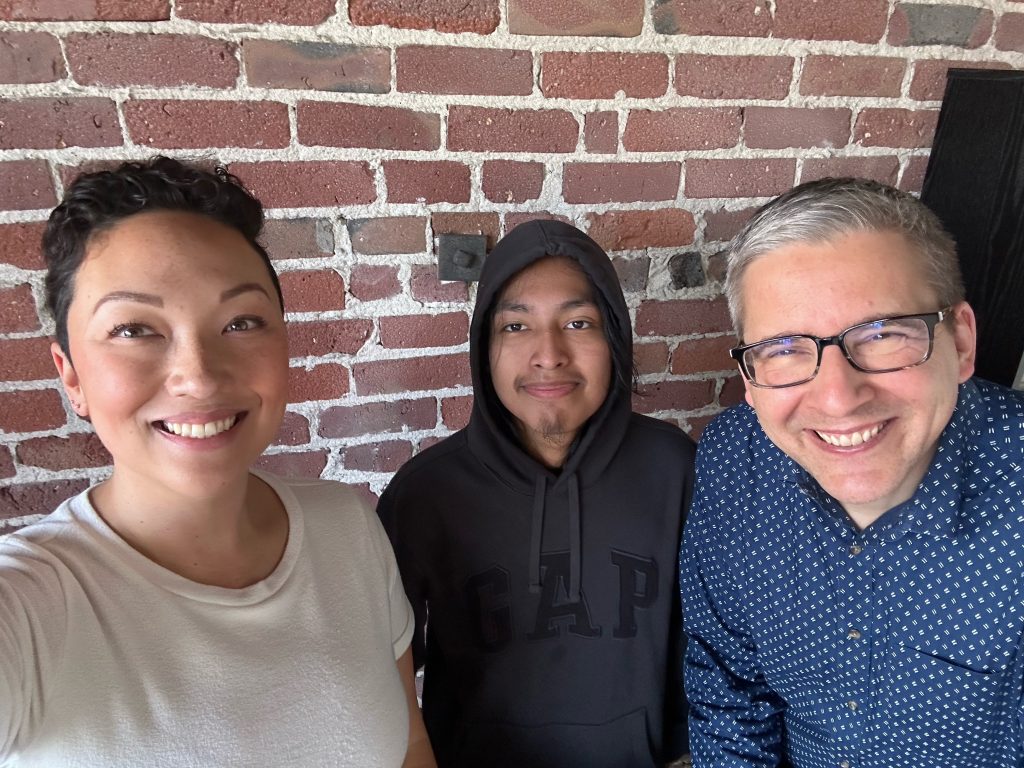
My week here has been amazing. Being able to meet all these amazing people that helped me settle in and feel welcome was exciting. I got to learn what goes on behind the scenes here and also have my share in the conversations not being left out of meetings and being asked for my inputs on a variety of subjects. A skill I improved at was my communication and planning skills. By being able to participate in the meetings I got better at talking with people that are older but also come from different backgrounds than me. Having control over my schedule also gave me a better understanding on how to handle my time in order to get the work I need done but also make time for other things, whether that be meetings or interviews by my fellow peers. I would recommend that other schools also start to implement an internship week of sorts because the opportunities and just overall knowledge that gain from a work environment is different to that of a school one. The amount of connections you can gain would be very helpful for students so that they get a sense of what their future can hold for them and it would also help them narrow what it is they actually want to do.
Cristian: “I chose this because David, my mentor, the senior directive of student services, made me interested in learning more about the school policies and how they work. I want to gain a different perspective of life, although there are many other opportunities, I want one that hears about students and how they feel when it comes to certain activities. I want to improve my communication skills, not just with students but with adults too. I want to become a structural engineer/architect. What interests me about Envision is its cultural theme and how inclusive they are with African American, hispanic, etc, and how they treat them and their months for example black history month, especially with how inclusive they can be. I’m a sports guy. I play a different variety of sports like baseball, soccer, football, etc. I played for the school soccer team this year. I was thinking of going to a college in Boston or Riverside, San Jose State university.”
Jesus: “I chose this internship because it was close to my home and the work seemed interesting to do throughout the week. I want to learn what are the steps that ELP does to work with the school and how the hiring process works here. I want to improve my communication skills. What interested me about Envision was how it was really close to my house and my siblings had already gone to Envision before. I want to pursue a career in real estate. I like to play soccer, baseball, and I’m interested in the process of making music. I also like to play different instruments like the guitar, accordion, and the drums. I was thinking of trying out Sonoma State, UC Santa Cruz, Cal State, and UC Davis.”
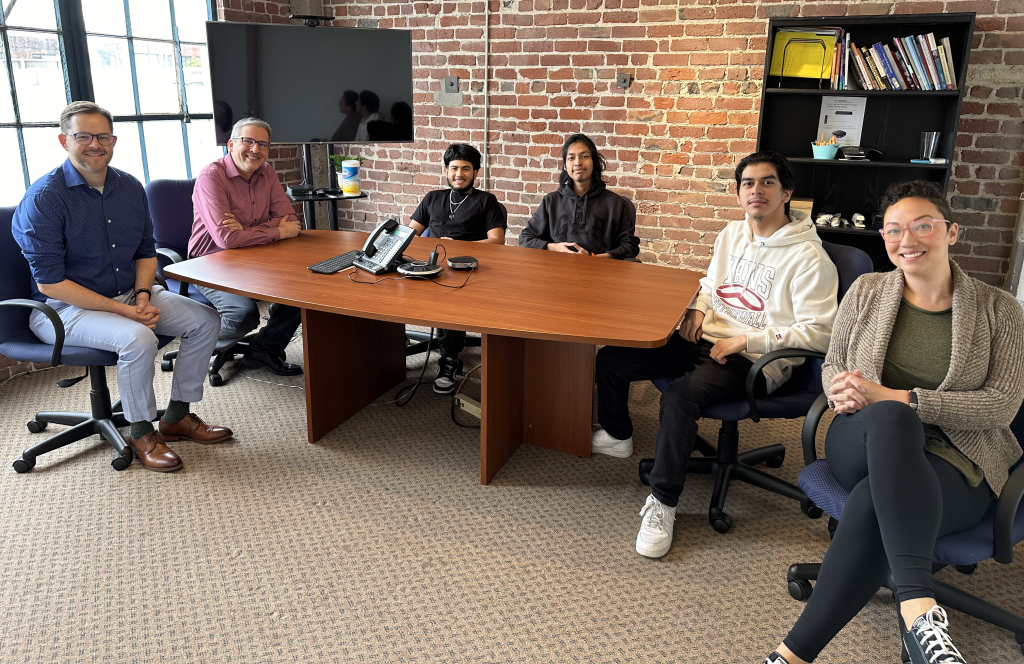
Melanie: “I wanted to go into a medical field assisting but things didn’t work out, but Mr.Viera introduced me to Ms.Kat and the idea interested me because she works with HR and the higher ups, staff, and teachers so I wanted to look more into what goes on behind the scenes at Envision to make things work at the school. I want to learn more about the environment and Ms.Kat’s routine, and what goes on behind the scenes because I didn’t think that all this went on to make the school work. I thought it was just the Principal and the staff at the school. I want to improve my communication skills and hands on work with computers like google docs and sheets. What interests me about Envision is that it’s a small community so you’re able to know almost everybody and with how it is an art and technology school I had an interest in going here when I was coming out of middle school. I’m very interested in the medical field, more specifically the dental industry. I like to explore, hang with my friends, and create memories while also having fun. Some colleges I have on my mind are UC Santa Cruz, UC Santa Barbara, and Cal Poly.”
Cristian: “I learned a lot of communication skills, being able to interview teachers, students, and other staff, all of these being people I do and don’t know broadened my interviewing skills. I got to create more and better bonds with all these people. Other Jobs I did were to attend a lot of meetings. The fun part about that was being able to go out, visiting the office, and getting a lot of new views/perspectives on different topics. My experience here was good. I got to meet new people and learn more about them, their job titles, and all the work they do to make everything happen. I think it’s a good idea to add an internship week for other schools because it’s a valuable learning experience, getting them slowly out of their comfort zone white also giving them knowledge on career paths that they themselves might want to pursue after the week is done.”
Jesus: “My week here went well and I definitely learned about the process of how teachers are hired and what they look for in teachers. A skill I improved on was being able to stay focused on a piece of work since I’m very easy in getting distracted so this internship bettered my focus. I would recommend this internship to other Envision students because it’s an easy job but you gain so much knowledge and you learn a lot from being here. I would recommend other schools to also start doing an internship style week because of the amount of opportunities you gain. For example, I was able to get a letter of recommendation from my mentor here. You also get to actually experience what the working world is like and it’ll give an early opportunity for students to learn about it.”
Melanie: “My week was very flexible and very calm, the first day I got an understanding of what the rest of my week was going to look like. After that I spent my time doing my work and overlooking my mentor to get a better understanding of what she does. I’ve learned that the process of having new people is not just accepting the job on the spot there is so much behind it. It can take weeks looking at them and accepting new staff and what they actually look at for potential staff. I improved my understanding and listening better with one on one talks with my mentor, asking her questions, and also just paying attention better. Just comprehension skills overall. I do recommend for other schools to start an internship like week because of the new environment you can get into and the vast majority of opportunities you can get by just meeting new people. A lot of students might not get the most out of just going to school so it would be very great to also learn about other experiences at other workplaces, while also giving students new jobs to look at that they might be interested in pursuing in their future.”
During the 2019 calendar year, ELP’s Alcine Mumby and Aragon Burlingham participated in the first Nexus Fellowship, a program from the Equity Lab. Nexus was designed in response to the overwhelming need for race, equity, diversity, and inclusion (REDI) in the learning profession.
This was a transformative experience for us and the other 14 Nexus Fellows! Michelle and her talented team curated a deep and personal experience for our new community of equity leaders. Nexus took us into a deep personalized leadership journey based on our identities around three specific design challenges: challenges with people, challenges with processes, and challenges with programs.
Watch the video to hear about the experiences of the Nexus Fellows and Equity Lab’s ED, Michelle Molitor.
Thank you Michelle and your exceptional team for creating this incredible program!
Describe what you do at ELP?
I lead the operations side of Envision Learning Partners. This primarily involves behinds the scenes work to ensure our infrastructure and systems are running smoothly so our coaches can deliver high-quality professional development. ELP’s start-up culture has built our service and systems through many years of relationship building, prototyping, and refining.
What experiences brought you to ELP?
I began my work with Envision as an English teacher at City Arts and Tech [our school in San Francisco]. After stepping out of the classroom, I worked closely with all of our schools in a highly successful reading intervention program. In 2010, I became a founding member of the Envision Learning Partners team. We spent the first several years of ELP figuring out the most high leverage work we could do with our external partners. The journey has been amazing – we’ve grown our service from 3 team members serving 1 partner to 11 team members serving over 60 partners.
What do you enjoy most about working for ELP?
I am driven by the mission of ELP and expanding positive educational impact to all students. I believe deeply in providing access and high-quality learning experiences to all students. At ELP we primarily work with adult learners to refine their teaching practices and educational systems, but my motivation still comes from impacting students’ lives by shifting adult teaching and learning.
What do you like to do when you’re not working?
I spend most of my time on outdoor adventures with my wonderful husband and two children. We like to hike, rock climb, backpack, ski, and camp whenever we have the opportunity. Almost every morning before the sun is up you can find me at a barre class and I always sneak in time to read several novels per month.
have always been incredibly passionate about the work I do with students and families. I started my career as a Special Education Teacher in Philadelphia, Pa. At my core, I will always be a special educator. I transitioned into student services/ special education administrative work which allowed me to have a deeper understanding of the way systemic oppression impacts vulnerable populations. I learned how to center the needs of the community and work alongside those who are most impacted. While working in this role, I developed a passion for inclusive education – it can work when we work it (see article). This led me to another passion of mine – teaching. I work with the Graduate School of Education at Stanford University teaching aspiring general education teachers how to incorporate best practices into their teaching while challenging the narrative of what it means to educate students who learn differently. With my transition to ELP, I am hoping to bring a perspective that allows us to center the most vulnerable populations in the amazing work we do. I am hoping to uphold high expectations for all of the students we serve and, I am hoping that students who learn differently will see themselves reflected in the work we do with districts, organizations, and communities.
What are you hoping to learn while you’re at ELP?
I am hoping to learn how to design high quality performance assessments on a large scale while centering neurodivergent learners. I would like to support districts and school communities with inclusive education as it relates to high quality performance assessments and graduate portfolios. I am also hoping to learn more about research projects on a large scale and how to use that information to improve school outcomes.
What are you most excited about starting at ELP?
I am most excited about working with a team that centers human connection while making an impact on the world of education. I am looking forward to getting to know everyone on the team as well as getting to know our clients and their school communities.
Another project that I am incredibly excited to join is the work ELP is doing with the Oak Foundation. The case study aims to illustrate high-leverage school practices that support the well being and success of Black and LatinX students with learning differences. I am beyond honored to support this work.
What do you like to do when you’re not working?
Roilyn’s Bio:
Roilyn is a trailblazing advocate for inclusive education and has been in this work for the last 20 years. With an unwavering commitment to equality and empowerment, she has dedicated the past two decades to transforming the educational landscape for marginalized students.
Roilyn began her career as a special education teacher for the School District of Philadelphia. After teaching for 10 years, Roilyn transitioned into special education administration and served in schools on the east and west coast in similar capacities. Currently Roilyn works as an Assessment Design Partner and is a course lecturer in the graduate school of education at Stanford University. In her spare time she enjoys cuddles with her dog Sully, chatting with her nieces and nephew, and karaoke (mostly at home).
Learn more about Roilyn in her ELP blog post and/or connect with her on Twitter or LinkedIn.
Hi! My name is Royce Conner, and I recently joined the team as ELP’s Executive Director. In many ways, I feel like I have returned home. While I am new to Envision, my education career began by learning about progressive education from leaders in the field such as Ted Sizer and the Coalition of Essential Schools. Since then I have put students at the center of each of my classrooms and schools. I am thrilled to be part of a team that cherishes the idea that students thrive when given authentic, challenging and rigorous work that is personally meaningful to them and their communities.
A bit more about me…
What experiences brought you to ELP?
A visiting professor from a teacher preparation program once visited my classroom. He observed students deeply engaged in projects that provided them various opportunities to use their knowledge and skills to answer challenging questions about the world and their places in it. Some students led Socratic seminars about the nature of goodness. Others wrote policy briefs for local legislators. A few wrote an original play to be performed along with local actors using interviews the students conducted with immigrants. When the professor left, he said, “This is the way school should be.”
I spent ten years learning the craft of teaching using projects and performance-based assessments. I became a lead teacher in my school, supporting new teachers as they designed projects and aligned performance assessments to local standards. My middle school students, the majority low-income students of color, would often return to my classroom as high school and college graduates sharing gratitude that the work we did in my classroom prepared them for what one student called “the world I almost missed out on.”
After my time in the classroom, I spent two years in the public policy arena, working on statewide and national education issues with Rhode Island Kids Count. I enjoyed policy, but I eventually felt the call to return to education. I moved to California to pursue a degree in educational leadership and policy. After that I spent two years consulting with various school districts, including Oakland USD. I then spent one year leading the recruitment team for San Francisco USD. Following SFUSD I entered the world of school leadership. I served as Head of School for three Bay Area charter schools. One of my schools scored a front page article in Education Week for its innovative blended learning design, and another connected me with Bob Lenz and PBLWorks for its dedication to project-based learning for our students in K-8.
Before joining ELP, my most recent role was as a Fellow with Foster America, a national nonprofit working to improve outcomes for foster youth and develop innovations for the child welfare system.
And this brings me to Envision. While my career has had many interesting turns, I am delighted that I find myself back in an organization that operates and promotes schools that are, like that professor once said, the way schools should be.
What are you hoping to learn while you’re at ELP?
I am going to learn a tremendous amount from our schools! I look forward to seeing how partners in rural, suburban and urban districts rally their school cultures around student-centered design and performance assessments. We know there is no such thing as “one size fits all,” so I cannot wait to learn about how our partners are implementing high-quality performance assessments, graduate profiles, and portfolio defense in their unique contexts.
What are you most excited about starting at ELP?
Truly, it’s the team. I have the great pleasure to work with expert educators, coaches, facilitators, designers, researchers and operations professionals. They are parents, siblings, authors, cooks, readers, adventurers, musicians and athletes. They appreciate a challenge and embrace the power of difficult conversations. As excited as I am to connect with schools, it is the team that brings me the most joy.
What do you like to do when you’re not working?
I would love to tell you that I dive deeply into great works of art and literature, but the truth is that I love my PlayStation and I play it like a teenager guzzling Mountain Dew. I am also a movie fan, especially horror movies. But I also love my outdoor time, especially hiking. In addition, I love to travel. So far I have traveled to 48 states (I’m looking at you, Mississippi and Hawaii!).
Anything else to add?
My favorite quote is “Don’t dream it—be it.” Extra points if you can name the source.
Royce’s Bio:
Royce joined Envision Learning Partners in 2023. A native of Bloomsburg, Pennsylvania, he attended Brown University, where he was first introduced to progressive principles of education through Ted Sizer and the Coalition of Essential Schools. He spent 10 years teaching at Community Preparatory School in Providence, Rhode Island. He then worked on statewide and national education policy with Rhode Island Kids Count, where he was selected as an Emerging Leader by The Children’s Defense Fund. He moved to California in 2007 to attend Stanford University’s Graduate School of Education, where he earned a Master’s degree in Policy, Organization and Leadership Studies. He spent two years consulting with urban school districts and another year leading the recruitment team at San Francisco Unified School District. He then served as Head of School for three Bay Area charter schools. His most recent role was as a Fellow with Foster America, a national nonprofit working across the country to improve the child welfare system and increase opportunities for foster youth. Royce lives in Richmond, California with his husband. He is thrilled to be part of the team at Envision Learning Partners!
Connect with Royce on LinkedIn.