Guest Blog: We All Deserve Badges for Resilience and Adaptability
Published on
January 26, 2022
Heading 1
Heading 2
Heading 3
Heading 4
Heading 5
Heading 6
Lorem ipsum dolor sit amet, consectetur adipiscing elit, sed do eiusmod tempor incididunt ut labore et dolore magna aliqua. Ut enim ad minim veniam, quis nostrud exercitation ullamco laboris nisi ut aliquip ex ea commodo consequat. Duis aute irure dolor in reprehenderit in voluptate velit esse cillum dolore eu fugiat nulla pariatur.
content paragraph for dropdown (this does not appear on staging)
We All Deserve Badges for Resilience and Adaptability
By Roman Stearns
During the pandemic, each individual and organization has been forced to practice unprecedented levels of resilience and adaptability. It’s remarkable really. Workers adapted to new conditions and norms. Students adapted to new places and forms of learning. Parents adapted to some form of homeschooling. Beyond individuals, businesses adapted to new strategies for offering products and services, and nonprofits and government agencies adapted to new and creative methods for providing support. From my observation, everyone, of all ages and across all sectors of society, deserves a badge for resilience and adaptability.
Badges as a Motivation to Advance
Most of us have grown up with some form of badging to recognize accomplishments. Some remember merit badges awarded during Boy or Girl Scouts. Some work in organizations that award pins for years of service. Of course, gamers are very familiar with endless ways to earn badges and level up. The age-old strategy persists because it works; it draws on our natural desire to improve, to achieve, to win, and to get recognition when we do.
Please indulge me while I reflect on personal experience. I’m a former high school Spanish teacher. My wife is multilingual. We see language as a tremendous asset, and thus are committed to promoting languages among our children. When our eldest son, Eli, was three years old, we enthusiastically enrolled him in a dual immersion preschool, where 100% of instruction was in Spanish. To our surprise, rather than becoming fluent, he emerged after three years with very limited capability. Years later, now at a charter Montessori school, Eli has one hour of Spanish per week – not nearly enough for him to become proficient. I had submitted to the reality that perhaps he would not emerge from his schooling speaking Spanish.
Then came the pandemic and the transition to homeschooling. The school introduced Eli, then 12-years-old, to Duolingo, an online app for learning languages. All of a sudden, he became highly interested, doing Spanish for an hour or more a day! He began learning Spanish at a remarkable rate. I was fascinated by the change and wondered about the cause. Like many other online learning apps (e.g., Khan Academy), Duolingo is gamified, with students earning badges and leveling up. It celebrates progress and accomplishment, motivating users to continue to advance to higher and higher levels of achievement. To my delight, after just a few weeks, Eli was speaking Spanish around the house using full sentences!
Scaling Badges in Schools
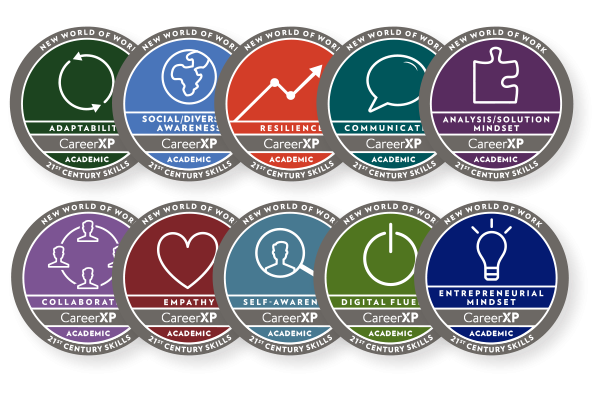
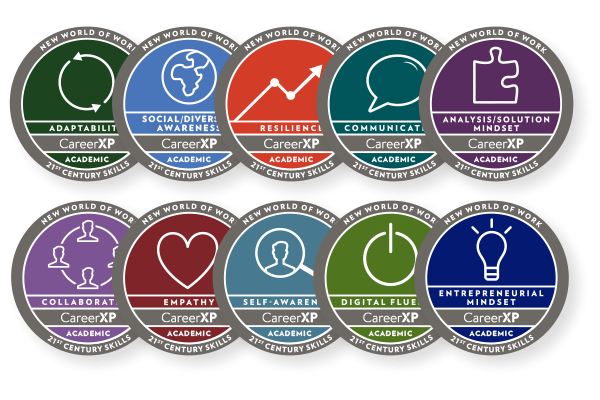
As a school reformer, I’ve always liked the idea of awarding digital badges to students who demonstrate various competencies, whether collaboration, initiative, empathy, creativity, or civic action. I wonder why programs like 21st Century Skills Badging, designed jointly by the Foundation for California Community Colleges and New World of Work, have not become more popular in CA. Is it because the incentives are not in place? Is it that our education system does not adequately value student demonstration of 21st century skills and social emotional learning outcomes? Is it because those competencies have not yet earned a place in our state accountability system? Inherently, we know they are important, and a growing body of research reinforces the benefits to student achievement and success.
Example: 21st Century Skills Badging
Badges could help us focus on what matters
In another blog post, I emphasized that the current circumstances accentuate the need and urgency to embrace success skills and social emotional development as core and central to our education process. As we reflect on what we’re learning – individually, organizationally, and societally – during the pandemic, we must consider how the “new normal” will value the competencies that young people have demonstrated so impressively over the past two years – adaptability, resilience, empathy, compassion, civic responsibility, effective communication across platforms, digital literacy, independence, initiative, resourcefulness, creativity, critical thinking, and more.
Could digital badges help us signal the importance of those competencies? How can we build the capacity of teachers to both demonstrate and measure these skills? Will we add them to report cards? Could more recognition, perhaps through approaches such as badges or gamification, elevate their importance for students? As per another blog post, might it be time for the traditional “currency of education” – the high school transcript – to give way to a newer currency that is more equitable, student-centered, and competency-based? Might digital badges be the best currency as we pivot to a competency-based approach to learning and assessing students?
Leading the charge
Fortunately, a group of school districts is already tackling these questions. They are pioneering members of a new community of practice dedicated to educating the whole child. A new California partnership, called Scaling Student Success, works with school districts that have engaged their local stakeholders to create a Graduate Profile – a succinct, one-pager that articulates the skills, competencies, and mindsets young people need for future success. These districts are eager to move “from poster to practice” – i.e., breathing life into their Graduate Profiles, giving each and every student an equitable opportunity to develop and demonstrate the competencies articulated on their Graduate Profile.
One common challenge among the districts in the Scaling Student Success community of practice is how to build coherence around their Graduate Profile and measure and report on the Profile outcomes. They recognize that not all are achievable during 180 school days, from 8:00 am to 3:00 pm. They wonder how they can actively involve their community members in offering opportunities for students to practice and demonstrate competencies beyond the boundaries of the classroom, clock (school day), and calendar (school year). For example, would it be possible to engage families, neighbors, soccer coaches, dance instructors, youth group leaders, internship supervisors, and other youth-serving community members?
I have a dream
While my dream is nowhere near as ambitious nor eloquent as the one expressed by Martin Luther King Jr. in 1963, it’s a dream that I too hope can become reality in the years to come. Let’s create a phone app that allows students, their peers, families and community members to rate student performance on any competence represented on a district’s Graduate Profile.
To understand how this would work, let’s return to my son Eli. Similar to a Graduate Profile, his school has a set of “Whole Child Reflections” that include empathy, independence/responsibility, acceptance of self/others, problem solving, positive risk taking, integrity, organization, contribution, curiosity and initiative, and critical thinking. On report cards each quarter, his teachers rate him on a scale (AC = area of concern, S = sometimes, O = often, C = consistently). But, those ratings are merely teacher observations during class time. They do not include self-reflection, peer assessments, or ratings offered by other adults who interact with Eli both in and out of school.
When COVID forced an end to his soccer practices, Eli insisted on continuing to practice every day. Happy to support his wellness, we drove him each afternoon to a local park. Over time, he became frustrated that he didn’t have goals, cones, hurdles, and other training equipment he was accustomed to. I suggested that he earn some money to buy the items he wanted. He learned during the recent spring break that he can make money washing cars. So, Eli created a flier promoting “Eli’s Car Wash,” printed it, and placed it on a few dozen door steps in the neighborhood (see Eli’s fun flier here). Over several weeks he earned over $500 and bought all the equipment he needed, including a new pair of cleats! Wouldn’t it have been ideal if he had the opportunity to ask the neighbors to rate him on independence/responsibility, initiative, and perhaps problem-solving. The neighbors could download the app, offer a rating, make a comment, and even attach an artifact.
Then, when Eli had received five or more ratings for, say independence/responsibility, he would use the app to submit the ratings for review and approval. His teacher would review the ratings and associated comments and evidence, and determine whether he had met a standard. If met, Eli would be awarded a digital badge representing his demonstration of competence. That badge would become a portable credential that he then could use in multiple ways, i.e., when applying for high school, college, or his first job.
Benefits to Students and Schools
An app like this could have many benefits, including:
It puts agency in the hands of young people, allowing them a high degree of control over how they learn, who rates their competence and when.
It engages the entire community in the education of our young people.
It promotes equity by allowing any young person to tap a larger network of peers and adults to support their learning.
It moves our education system toward a competency-based approach to learning, a persistent goal of school reformers.
Please share your ideas. How can we promote community-based learning opportunities and validate students’ demonstration of essential skills? Are there places where this kind of badging system is already working? What have you seen and experienced? What would you like to see?
Roman Stearns is Founder & Executive Director ofScaling Student Success, a California partnership dedicated to educating the whole child. Envision Learning Partners is an active practice partner, helping to co-design and facilitate community of practice sessions. Roman is also a member of ELP’s 5th Deeper Learning Leadership Forum.
Insights, partner highlights, guest perspectives, and resources to support your work
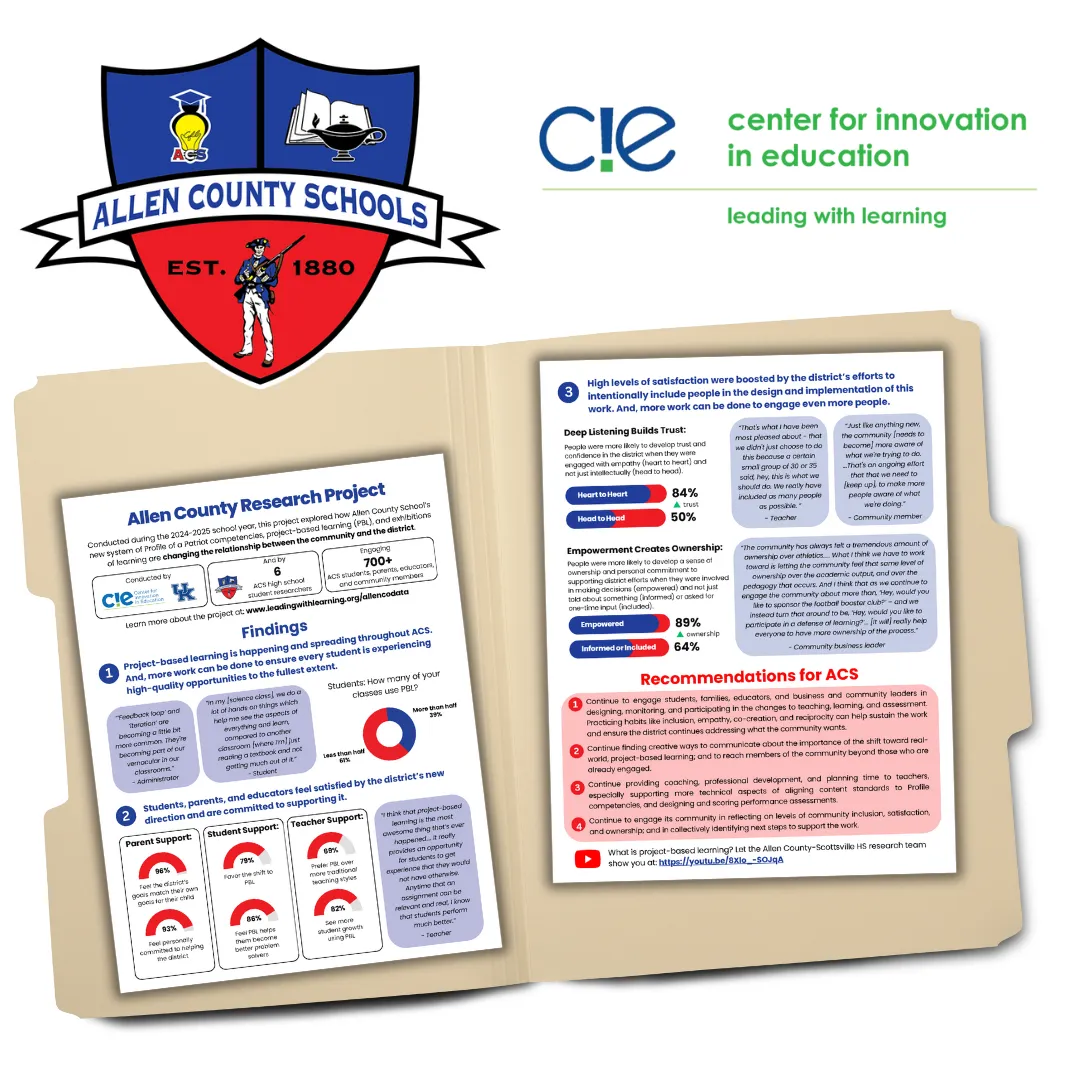
A newly published case study from the Center for Innovation in Education (C!E), featuring Envision Learning Partners in Appendix C, highlights Allen County, Kentucky’s multi-year effort to redesign assessment and accountability through Inclusive Design. The report, Better Together, shows how the district co-created their graduation competencies called “Profile of A Patriot” and embedded project-based learning and performance assessments to place students’ passions and real-world skills at the center of learning.
Envision Learning Partners has been proud to support Allen County in this work, and we’re excited to share C!E’s new case study. We’ve partnered closely with C!E through the Assessment for Learning Project, working together to advance learner-centered assessment practices nationally.
By Michael Viera, Envision Education’s College and Career Pathways Manager
Several years ago the city of Oakland came together to support college and career programming for high schoolers, by advancing and deepening career pathways in alignment with the Linked Learning Alliance standards and methodology. The Linked Learning Alliance hosts an annual conference where educators share best practices and takeaways from school sites around the state. Oakland schools always show out in big numbers at the conference, but this year it took place in downtown Oakland, so the presence was even greater.
I had been to the conference previously, but this time was different. Being my 3rd year at Envision in this role, I felt like I finally understood what it was all about. I had colleagues from Envision Learning Partners in attendance and collaborating with me. I got to connect with colleagues from other Oakland schools. I knew what to look for and who to listen to in order to improve our programming at Envision Academy and across the Envision network.
The conference was motivating, to say the least. It is a breath of fresh air being in rooms of educators who are excited and realistic about their work in schools, and who understand the skills students need to have success in their futures.
I came back from the conference and immediately organized Envision Academy’s first job fair since COVID. We had twelve community partners visit our campus to share information with students on internship opportunities, after school and summer programs, and community resources. Students seemed excited about these experiences that they can be a part of outside of their regular curriculum.
At the end of the event, two students stayed back and pulled me aside. I thought something bad had happened. Instead, one of them simply said, “Mr. Viera, we just wanted to thank you for putting together this event. It’s really inspiring to see all these opportunities we didn’t know about until now.”
After a couple of weeks of back and forth emails and phone calls with partners, planning meetings with administration, and quite literally running around setting up tables and chairs on the day of the event, those students made it all worth it. When students are able to take their learning outside of school walls and make connections with their community, they feel seen and they thrive.
Hear from Michael and ELP Assessment Design Partner, Josette Neal-De-Stanton on their takeaways from the Linked Learning Conference.
I began working at ELP in January 2018 as the Director of Research and Innovation. Since then, I’ve been working on the nationwide team providing direct service and technical consulting to client partners and creating assessment products, as well as directing ELP’s research projects.
I’m excited to share that in July 2025, I stepped into a new role: Senior Director of Assessment for Envision Education. This role encompasses responsibilities for the whole organization – Envision Schools and Envision Learning Partners. Envision Schools runs four charter schools in the Bay Area (in San Francisco, Oakland, and Hayward). My new responsibilities include overseeing the design and implementation of a comprehensive assessment system for the schools, ensuring the use of rigorous, standards-aligned assessment practices that demonstrate student achievement of core academic skills. At the same time, our system aims to provide regular opportunities for students to demonstrate ambitious learning outcomes aligned to Envision’s graduate profile competencies in real-world-relevant, meaningful, and culturally sustaining contexts. We seek to more systematically integrate authentic and high-quality project-based learning and student-led conferences at all grades 6-12, and portfolios + defenses at grades 8, 10, and 12. We want to develop our schools as models of a balanced and comprehensive assessment system that supports student achievement of both foundational academic skills and ambitious, authentic demonstrations of learning. This new assessment system is described more fully in our new Envision Way documents.
In my new role, I also continue to work with my ELP colleagues, supporting the learning and effectiveness of our national team of Assessment Design Partners, and developing new services aligned to the Envision Way as we seek to meet the evolving needs of both external district partners and our own schools. Our long-term strategy is to strengthen our own schools so they are clear models of the quality assessment systems that we are also seeking to strengthen in partnership with districts. We call this the “flywheel” because of the reciprocal nature of our learning and development work as we pilot new practices, collect data, and evaluate their effectiveness in our schools and in partnership with external districts.
I continue to also be involved in exploring ways for Envision Education to gather evidence of its effectiveness through systematic collection of evidence in our own schools (in partnership with John Ericson, our Director of Data & Assessments), and by initiating research projects to collect evidence of the impact of ELP’s work with districts. I am also continuing to coordinate the research project “Pursuing Equity for Black & Latine Students with Learning Differences”. We wrapped up two years of school case study work in July, and are preparing to launch a two-year professional-development pilot and evaluation phase of the project with a large school district. More news to come!
What do you enjoy most about working for Envision?
It’s definitely always been the people. I truly enjoy working alongside colleagues with a similar commitment to our most marginalized students and who are striving so hard to create supportive, inclusive learning environments that lead to equitable learning outcomes. I am learning so much from my ADP colleagues as well as my Academic Programs Team colleagues. They are all so incisive and brilliant and I have so much to learn from them. I truly feel blessed and lucky to have them as colleagues!
I’m also proud to be working in an organization with a commitment to its pro-Black, anti-racist stance, engaging us all in developing a self-awareness of our individual and collective contributions to our cultural norms, and providing the space to engage in productive struggle to begin changing those norms.
Last, I love that Envision honors hard work while also honoring our need for joy, self-care, and rest! The yoga and art breaks, retreats, sound baths, line dancing, karaoke nights, breaking bread together, and other opportunities to take mind breaks are all helpful reminders that we are whole people who also need laughter, rest, and nourishment to thrive. My family always gets a kick out of hearing about the latest fun things I get to do with my work friends!
Explore our diverse events. Enhance your expertise, connect with thought leaders, and broaden your horizons.
A newly published case study from the Center for Innovation in Education (C!E), featuring Envision Learning Partners in Appendix C, highlights Allen County, Kentucky’s multi-year effort to redesign assessment and accountability through Inclusive Design. The report, Better Together, shows how the district co-created their graduation competencies called “Profile of A Patriot” and embedded project-based learning and performance assessments to place students’ passions and real-world skills at the center of learning.
Envision Learning Partners has been proud to support Allen County in this work, and we’re excited to share C!E’s new case study. We’ve partnered closely with C!E through the Assessment for Learning Project, working together to advance learner-centered assessment practices nationally.
By Michael Viera, Envision Education’s College and Career Pathways Manager
Several years ago the city of Oakland came together to support college and career programming for high schoolers, by advancing and deepening career pathways in alignment with the Linked Learning Alliance standards and methodology. The Linked Learning Alliance hosts an annual conference where educators share best practices and takeaways from school sites around the state. Oakland schools always show out in big numbers at the conference, but this year it took place in downtown Oakland, so the presence was even greater.
I had been to the conference previously, but this time was different. Being my 3rd year at Envision in this role, I felt like I finally understood what it was all about. I had colleagues from Envision Learning Partners in attendance and collaborating with me. I got to connect with colleagues from other Oakland schools. I knew what to look for and who to listen to in order to improve our programming at Envision Academy and across the Envision network.
The conference was motivating, to say the least. It is a breath of fresh air being in rooms of educators who are excited and realistic about their work in schools, and who understand the skills students need to have success in their futures.
I came back from the conference and immediately organized Envision Academy’s first job fair since COVID. We had twelve community partners visit our campus to share information with students on internship opportunities, after school and summer programs, and community resources. Students seemed excited about these experiences that they can be a part of outside of their regular curriculum.
At the end of the event, two students stayed back and pulled me aside. I thought something bad had happened. Instead, one of them simply said, “Mr. Viera, we just wanted to thank you for putting together this event. It’s really inspiring to see all these opportunities we didn’t know about until now.”
After a couple of weeks of back and forth emails and phone calls with partners, planning meetings with administration, and quite literally running around setting up tables and chairs on the day of the event, those students made it all worth it. When students are able to take their learning outside of school walls and make connections with their community, they feel seen and they thrive.
Hear from Michael and ELP Assessment Design Partner, Josette Neal-De-Stanton on their takeaways from the Linked Learning Conference.
I began working at ELP in January 2018 as the Director of Research and Innovation. Since then, I’ve been working on the nationwide team providing direct service and technical consulting to client partners and creating assessment products, as well as directing ELP’s research projects.
I’m excited to share that in July 2025, I stepped into a new role: Senior Director of Assessment for Envision Education. This role encompasses responsibilities for the whole organization – Envision Schools and Envision Learning Partners. Envision Schools runs four charter schools in the Bay Area (in San Francisco, Oakland, and Hayward). My new responsibilities include overseeing the design and implementation of a comprehensive assessment system for the schools, ensuring the use of rigorous, standards-aligned assessment practices that demonstrate student achievement of core academic skills. At the same time, our system aims to provide regular opportunities for students to demonstrate ambitious learning outcomes aligned to Envision’s graduate profile competencies in real-world-relevant, meaningful, and culturally sustaining contexts. We seek to more systematically integrate authentic and high-quality project-based learning and student-led conferences at all grades 6-12, and portfolios + defenses at grades 8, 10, and 12. We want to develop our schools as models of a balanced and comprehensive assessment system that supports student achievement of both foundational academic skills and ambitious, authentic demonstrations of learning. This new assessment system is described more fully in our new Envision Way documents.
In my new role, I also continue to work with my ELP colleagues, supporting the learning and effectiveness of our national team of Assessment Design Partners, and developing new services aligned to the Envision Way as we seek to meet the evolving needs of both external district partners and our own schools. Our long-term strategy is to strengthen our own schools so they are clear models of the quality assessment systems that we are also seeking to strengthen in partnership with districts. We call this the “flywheel” because of the reciprocal nature of our learning and development work as we pilot new practices, collect data, and evaluate their effectiveness in our schools and in partnership with external districts.
I continue to also be involved in exploring ways for Envision Education to gather evidence of its effectiveness through systematic collection of evidence in our own schools (in partnership with John Ericson, our Director of Data & Assessments), and by initiating research projects to collect evidence of the impact of ELP’s work with districts. I am also continuing to coordinate the research project “Pursuing Equity for Black & Latine Students with Learning Differences”. We wrapped up two years of school case study work in July, and are preparing to launch a two-year professional-development pilot and evaluation phase of the project with a large school district. More news to come!
What do you enjoy most about working for Envision?
It’s definitely always been the people. I truly enjoy working alongside colleagues with a similar commitment to our most marginalized students and who are striving so hard to create supportive, inclusive learning environments that lead to equitable learning outcomes. I am learning so much from my ADP colleagues as well as my Academic Programs Team colleagues. They are all so incisive and brilliant and I have so much to learn from them. I truly feel blessed and lucky to have them as colleagues!
I’m also proud to be working in an organization with a commitment to its pro-Black, anti-racist stance, engaging us all in developing a self-awareness of our individual and collective contributions to our cultural norms, and providing the space to engage in productive struggle to begin changing those norms.
Last, I love that Envision honors hard work while also honoring our need for joy, self-care, and rest! The yoga and art breaks, retreats, sound baths, line dancing, karaoke nights, breaking bread together, and other opportunities to take mind breaks are all helpful reminders that we are whole people who also need laughter, rest, and nourishment to thrive. My family always gets a kick out of hearing about the latest fun things I get to do with my work friends!

.svg)
.svg)


.svg)
.svg)



.svg)
.svg)

.svg)

.svg)

