Checkout our most recent Resource Corner!
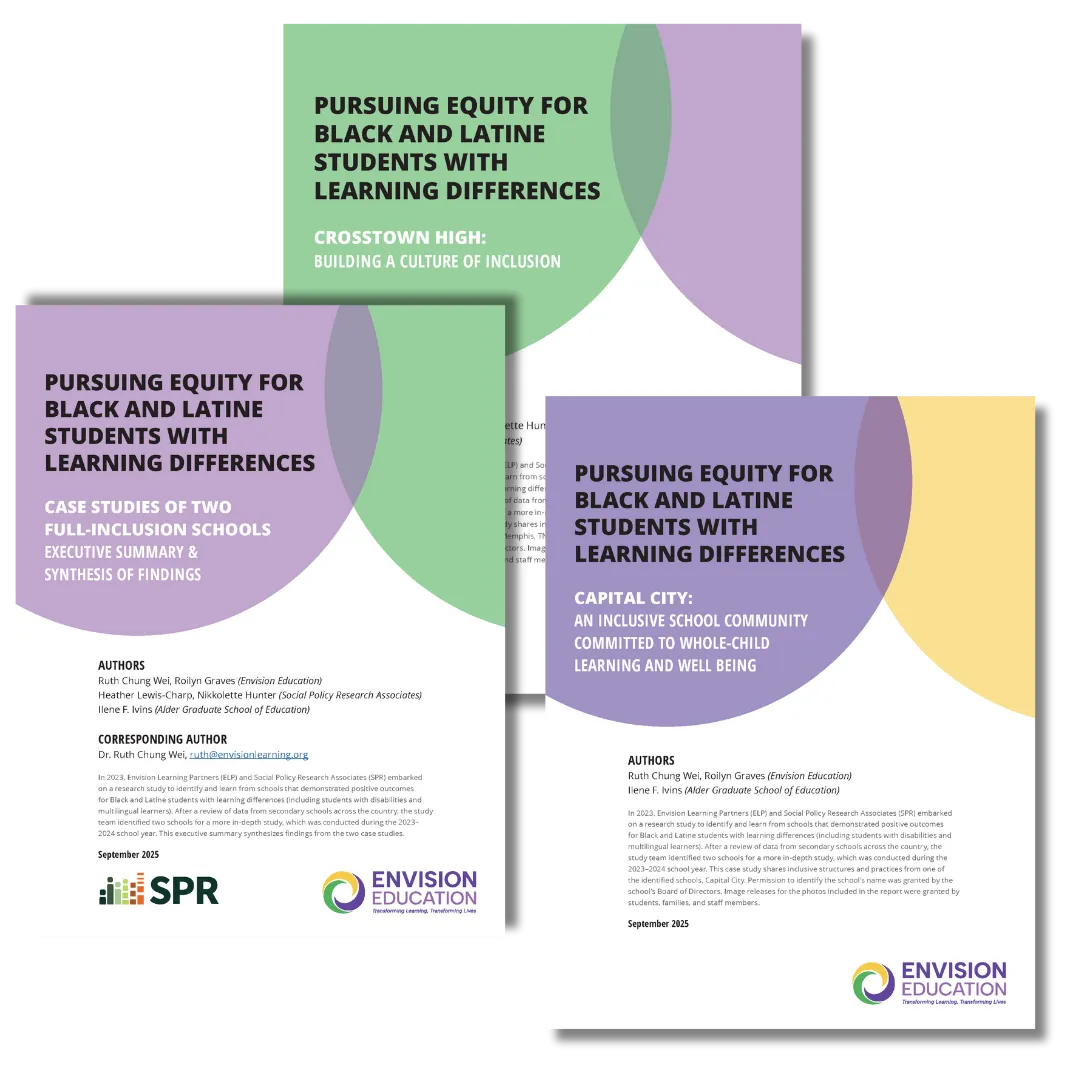
Envision Education is excited to share the culmination of its two-year research project, Pursuing Equity for Black & Latine Students with Learning Differences, which
documents and illustrates the systems, practices, cultures, and supports that are associated with the well being and success of Black and Latine students with learning differences – students with disabilities and multilingual students with disabilities.
In 2023, Envision Learning Partners (ELP) and Social Policy Research Associates (SPR) embarked on a research study to identify and learn from schools that demonstrated positive outcomes for Black and Latine students with learning differences (including students with disabilities and multilingual learners). After a review of data from secondary schools across the country, the study team identified two schools for a more in-depth study, which was conducted during the 2023–2024 school year.
The results of the research are shared through case studies of the two schools that were the focus of the research: 1) Crosstown High: Building a Culture of Inclusion; 2) Capital City: An Inclusive School Community Committed to Whole-Child Learning and Well Being; and 3) An Executive Summary/Synthesis of Findings.
In addition, we have authored four practice briefs based on the findings of the research that provide practical steps that schools can take to create more inclusive environments that support the success of Black and Latine students with learning differences.
- Co-teaching: A Means to Creating Inclusive and Equitable General Education Classrooms
- UDL: Universal Design for Learning in a Culturally Responsive Context
- Culturally Responsive Practices: An Inclusive, Culturally Responsive School Culture That Fosters Relationships
- Competency-Based Learning and Assessment: Assessment and Grading Practices That Support an Inclusive Learning Culture
This research was made possible through the generous support of New Profit, a venture philanthropic organization, and the Oak Foundation.

Resource Corner: Pursuing Equity for Black and Latine Students with Learning Differences Case Studies & Practice Briefs
Over the last three decades, standards-based reforms have attempted to close opportunity gaps – mostly by tapping large scale assessment and accountability systems. But these assessment systems were not designed to provide real-time feedback to support teaching and learning at the classroom level. We also know that systemic racism is deeply ingrained in the history of assessment in our nation. But we can build and envision different ways of measuring learning, especially by centering students in these systems.
In this keynote, Alcine Mumby of Envision Learning Partners discussed how performance assessment can be a key equity strategy – giving students the opportunity to declare what they know, how they’ve learned it, and how they plan on using that knowledge to change the world.

On May 15 and 16th, 2024 educators from across the country came together in Oakland, CA for a two-day Assessment for Learning (AFL) Deep Dive and focused on student demonstrations of learning.
Together, we continued to pursue AFL’s essential question: What can we learn together about how assessment for learning relates to learner belonging, equity and liberation? Specifically, we explored “How do we build aligned and coherent performance assessment systems that promote learner belonging, equity and liberation?”
The event included background knowledge of Oakland education with ELP Assessment Design Partner, Josette Neal-De-Stanton, and longtime Oakland education leader, Gary Yee, school site visits hosted by Envision Academy and ARISE High School where folks experienced student presentations of learning, new tools were presented, and community connections were strengthened.
The AFL Blog will soon have posts from Storytellers about their experience at the event; learn more as those come out and see previous blogs from other AFL events by clicking here.
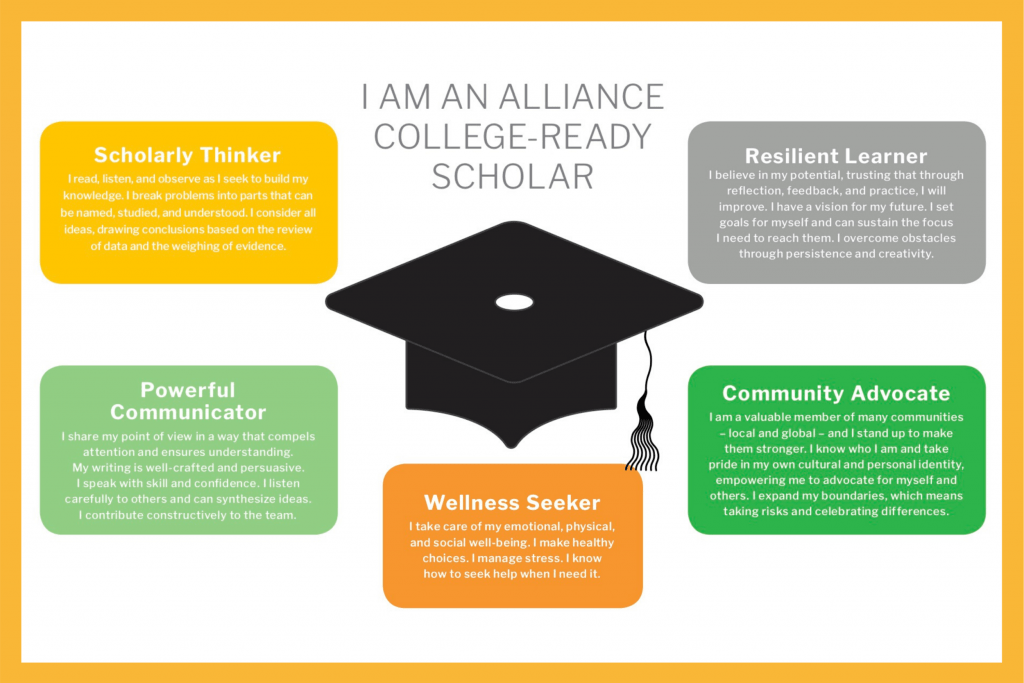
A performance task can make no claim to quality if it is not crystal clear on what skill or skills it is assessing. The same is true for a performance assessment system writ large. This is why ELP cares about, and has become a booster for, the concept of a graduate profile (aka portrait of a graduate, learner profile, schoolwide outcomes, etc.). In order to “elicit learning that matters”—a key principle of ELP’s HQPA framework—a learning community must define what matters. That’s what a graduate profile does, and therefore why a profile, or something akin to it, is foundational to a performance assessment system.
To that end, I am excited to announce that ELP’s first ever online workshop series is devoted to developing a high-quality graduate profile. Although this workshop is already booked up, scroll down to learn more about future opportunities.
The launch of this series marks ELP’s commitment to making our work more widely and frequently accessible to the performance assessment movement. We plan to roll out a number of other online workshops, on various topics related to performance assessment, through 2021 and beyond.
Click here for more details.
To ELP partners and friends,
Envision Learning Partners was established to disrupt the systemic inequities created when students are expected to learn and demonstrate their learning in rote, standardized ways. We know that current systems of assessment do not show or honor the brilliance and talents of Black students. When we support schools, districts, and states to create more balanced systems of assessment, one way we define success is the ability to bear witness to powerful demonstrations of learning by Black students. Humbly, we acknowledge that we have more work to do as individuals and as an organization. And we are humbled by the searing reminder of recent events that improving education is not enough.
At Envision Learning Partners, we are taking this time to reaffirm our commitment to supporting our Black students, Black teachers, and Black leaders. We have explicit anti-racist, pro-black strategic goals. We have specifically invested in training and professional learning by Black-led organizations so that we can embody these ideals. We seek to work alongside our partners, in conversation and collaboration, to center the voices of the most marginalized and continually examine how our work as educators can support rather than impede racial justice in schools.
In that spirit, we urge our partners and friends to join us in engaging or recommitting to anti-racist equity work within your organizations. And we ask you to do it with the guidance of expert individuals and organizations, such as those listed below, that were committed and practiced long before 2020 hashtags and uprisings. Consider learning from and supporting any of the following Black-led organizations:
- 228 Accelerator
- The Black Teacher Project
- Community Equity Partners
- The Equity Lab
- Leadership for Liberation
- The National Equity Project
If you’d like us to make a warm introduction to one of these organizations, let us know.
In solidarity and community,
Abby, Alcine, Aragon, Courtney, Justin, Morgan, Rachel, Ruth, and Vinci
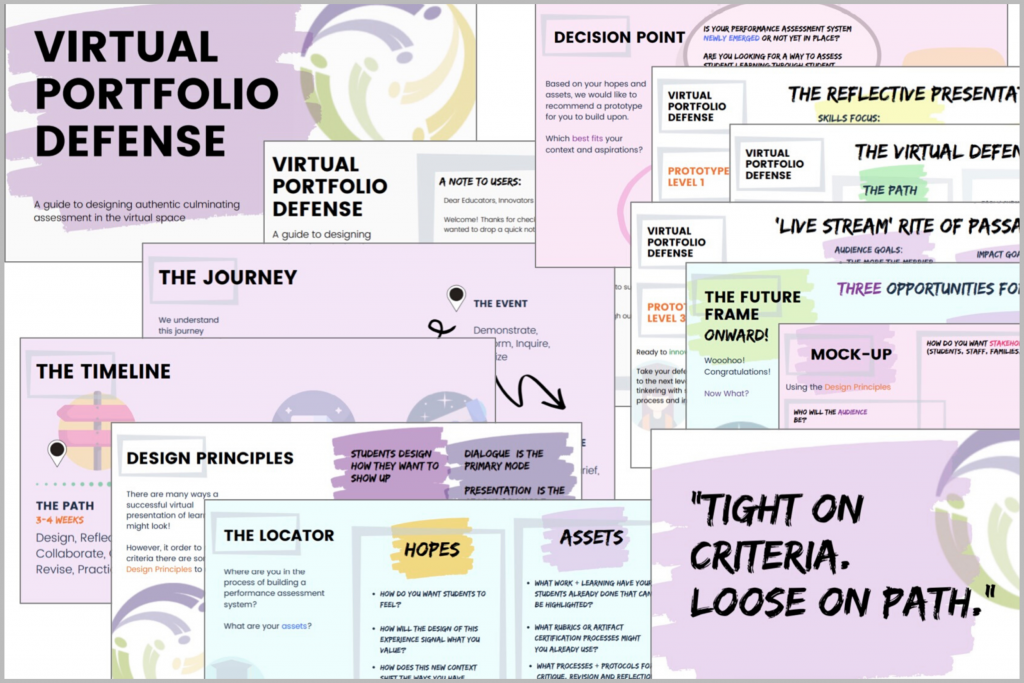
Still hot from the forge, ELP’s Virtual Portfolio Defense Toolkit is hereby released to the world. Click the button below to download the toolkit. Use it and share it widely. We hope that it inspires action, saves you time, and helps you find opportunity within this crisis to put students at the center of their learning.
ELP was galvanized by what we are hearing from our partner schools and districts: Rather than backing off from your performance assessment systems, most of you are leaning into them, understanding that students need this now more than ever. This toolkit is ELP’s first answer to your call for help. It is designed for learning communities at all levels of experience, whether you’ve had kids defending their learning for years or see this as your first opportunity to try.
And know that there are more tools on the way. Before the end of the week, we’ll release an accompanying Student Planning Tool, a student-facing organizer to help them plan for their virtual defenses or presentations. (Update: these tools have been released and are available using the link below.)
Next week, Morgan Vien and Abby Benedetto, chief designers of this toolkit, will host a webinar and some virtual office hours so that you can ask questions and get support for implementation. (Update: use the link below to view the webinar recording.)
There is no better time than now to challenge and honor young people with an opportunity to tell the story of their learning.
Cheering you on,
Justin Wells & the ELP Team
Here at Envision, we frequently use the Driver’s License Test analogy to talk about Performance Assessment: it is a clear and familiar example of showing you are ready for a momentous next step by demonstrating what you are able to do (drive) with what you know (driving rules and regulations).
As a mom, I recently had a chance to consider this analogy from a distinct vantage point: the passenger seat. Helping my daughter learn to drive has given me the opportunity to expand on this beloved Envision metaphor with some key observations related to Performance Assessment.
First, it can be abjectly terrifying to drive with an “emerging” driver. In Lola’s first few forays on the road, I had several white-knuckle experiences that will be familiar to any parent of teens. I had multiple visions of catastrophe. I may have screamed a couple of times. And I realized it was the loss of control that really unsettled me. It is daunting to realize there is NO OTHER WAY for your child to learn how to drive except by LETTING GO OF CONTROL. It dawned on me that it must also be hard for teachers to let go of control in the classroom. Of course, classroom performance assessment does not pose the threat of bodily harm the way hurtling over the Bay Bridge on my daughter’s maiden voyage did. But I found it interesting that I struggled to give up control even though I knew she was ready for this important step. I struggled in safer situations too—complete with pressing on the non-existent, passenger side brake—and sometimes found it hard to articulate instructions. It made me curious about how teachers confront and manage this struggle.
Secondly, teacher-student relationships really do make a difference in student success. Lola took the test twice: she failed the first time. The first instructor was dour, unfriendly, and impatient. According to Lola, she gave the directions (turn left, turn right) with very little time between instruction and execution. She wasn’t receptive to clarifying questions. She did not smile. Two weeks later and the difference could not have been more stark: the second instructor was friendly and engaging, immediately introducing herself to both of us. After the successful test, Lola was effusive about how different this second experience was. This instructor took the time to give Lola a friendly overview of what the test would be like. When she noticed Lola was nervous, she offered suggestions for how to relax a little bit. For Lola, having the instructor see and acknowledge her anxiety helped enormously. Out on the road, when Lola made some small mistakes, the instructor said things like “this is a mistake I make sometimes too, so just keep in mind xyz…”. She also gave directions clearly, with time for Lola to execute on them, and was patient with questions. With that kind of assessor in the seat next to her, Lola was able to drive the way she knew how, and of course she passed.
In the days since Lola has been whizzing around the Bay Area on her own, I have thought often about this woman, her skill at her job, and the way she helped my daughter. It strikes me that performance assessment, at its best, is about not only challenging the learner but also creating conditions for her success. And I’m once again grateful for teachers who are practiced in the art of both supporting students and letting them truly show what they know and are capable of.
For more of Monica’s “parent perspective,” check out this 2018 post in EdWeek: The Gift of Portfolio Defense.
New Envision Learning Partners Projects/Events Page
The ELP team will have a significant presence around the US this Spring. Take a look at this new page on our website to see where we’ll be!
PARB Up & Running with Refresh
Last year, ELP merged with SCALE (the Stanford Center for Assessment, Learning, and Equity) and was given the opportunity to inherit the amazing Performance Assessment Resource Bank (PARB) website. PARB is a free resource that provides high-quality performance tasks, portfolio frameworks, rubrics, and much more.
Last month, the website was temporarily down for maintenance but is now back up and running, refreshed, and quicker than ever. We hope you have some time to explore and take advantage of all that PARB has to offer.
Keep an eye out in future newsletters for site updates and improvements!
The pandemic has thrust assessment into the spotlight. Everyone is talking about testing and grading. In the history of education, this is an opportune time to make things better.
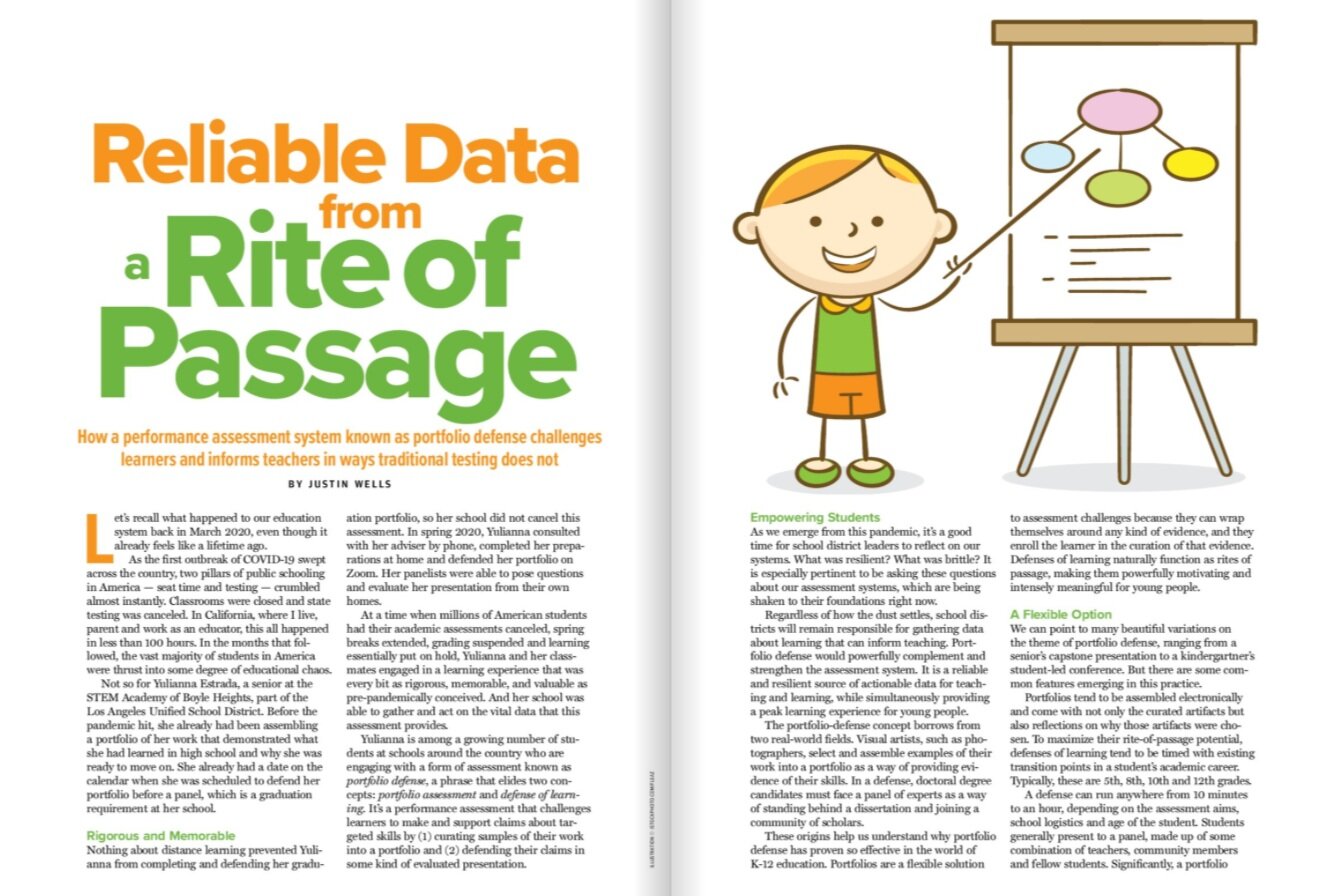
School Administrator magazine has focused its May issue on “Grading Beyond the Pandemic,” and I appreciated the opportunity to contribute an article arguing for portfolio-defense: “Reliable Data from a Rite of Passage.” A number of ELP partners are featured in the piece, including Los Angeles Unified, Pasadena Unified, Jefferson County Public Schools in Louisville, and Kamaile Academy in Hawaii (ELP’s very first client).
In that same issue, you can also read an article by ELP’s longtime partner Susan Dugle, the chief academic officer of Shelby County Public Schools in Kentucky. Shelby has been leading the way in this work for years, and the district’s performance assessment system has proven itself effective and resilient through the pandemic
Turns out that assessment systems built for learning, not for sorting, are not only more just; they also hold up in a crisis. So keep building your system. You are preparing for uncertainty while also doing right by your students.
Your fellow learner
“Inclusive and Personalized School Environments Where Black and Latinx Students with Learning Differences Thrive”
- Led by ELP’s Director of Research & Innovation, Ruth Chung Wei
- Room Bolden 4 at 2:45pm – 3:45pm PT
Students with disabilities and multilingual learners are often subjected to exclusion from robust learning experiences and social disconnection. Participants will dive into the Effective Learning Environments for Learning Differences framework, which summarizes systems and supports implemented by four secondary schools that have a track record of success in supporting the thriving of Black and Latinx students with learning differences. The framework highlights inclusive, personalized, and competency-based practices that promote student belonging, engagement, and growth. Drawing on the framework school leaders and students from two schools will share practices, systems, and supports that support thriving among students with learning differences. Participants will use the framework to reflect on their own school learning environments for students with learning differences, challenges, and implications for their own work in schools serving students with learning differences.
The Effective Learning Environments for Learning Differences framework was developed with a central focus on learning and well-being outcomes for Black and LatinX students with learning differences (students with disabilities and multilingual learners), who represent some of the most marginalized and underserved groups in U.S. public schools. We seek to equip school leaders with greater understanding of the conditions under which these students can be successful and thrive.
The Panel will include two school leaders, two students/graduates of inclusive, competency-based schools, and three researchers responsible for documenting the characteristics of the schools’ inclusive learning environments in case studies completed in June 2024.
Learn more about the full event and register by clicking here.
This workshop will dive deeply into the characteristics of High-Quality Performance Assessment. We know that one area where schools can improve students’ experiences is engaging them in rigorous, authentic assessments that provide students opportunities to lead their own learning experiences. Through performance assessments, students learn how to reflect, revise, and communicate in ways that strengthen teachers’ learning outcomes. Performance assessments also re-engage teachers in the craft of teaching, activating their own creativity and love of learning.
Participants will learn the characteristics of High-Quality Performance Assessments (HQPA). They will observe students engaged in a defense of learning and reflect on how the practice demonstrates the qualities of HQPA. We will also discuss examples of performance assessments and consider what teachers and leaders can do on Monday morning to move towards implementing performance assessments across schools and systems. Participants will leave the session understanding what is required to create outstanding performance assessments and excited to either start building new assessments or revising current assessments.
Learn more about the event here
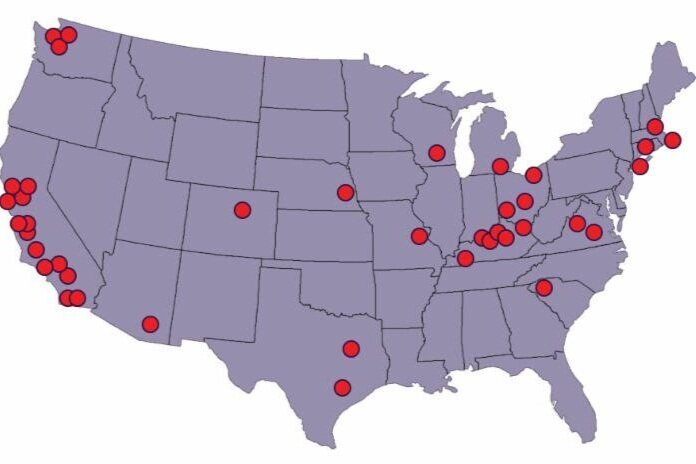
This year, with our seven coaches flying all over the country providing Professional Development to our partners, we decided to take the time to map out the various locations we are serving. Over the coming months, we will continue to profile some of our partners around the country. For now, check out the map below to see the places ELP has active partnerships: we are working with schools, districts, and teachers all over the country, impacting hundreds of thousands of students!
Tuesday, March 28th, 4:30 – 6:00pm PT
This workshop will explore the often problematic relationship many students and educators have with STEM education emerging from traumatic experiences we simply never address. This workshop particularly focuses on the roots of STEM as it relates to white supremacy culture and STEM education, and how that bleeds into the way we see ourselves, or don’t, in in those fields. We will look at ELP’s HQPA principles (1: Eliciting evidence of learning that matters & 2: Tight on its criteria for success) as a means to address healing and thriving in the design of STEM assessments that matter. As 2 educators of color, we will create a learning environment that is safe especially for the most marginalized communities to have a voice, and use our expertise as STEM leaders to begin to change the narrative within our school structures. Participants will: have dialogue opportunities in pairs, and small groups, journaling time, creation of personal STEAM projects to help process their trauma, and leave with a plan created to address how the will disrupt STEM trauma in their lives/workplace.
This is an interactive hands-on workshop where participants will prototype a high quality performance assessment (HQPA) aligned to deeper learning competencies. Through learning stations, participants will explore the what and why of performance assessments and use quality criteria tools to analyze for rigor, learner agency, and authenticity. Then participants will prototype their ideal HQPA, and reflect on their own learning and leadership.
This learning experience is organized around the principle that learning happens when learners’ own ideas are an active focus of the sense-making process. This is true for students who are presented with problems in their math class and being challenged to make sense of the problem, rather than being told an algorithm. This is also true for educators who are being asked to structure learning environments in new ways. This session discusses how one district has redefined what math class is, and how that new definition is framing the ways that students, teachers, and administrators are engaging in learning, including professional learning.This example serves as a focal point for experiencing what a modernized math classroom looks like, sounds like, and feels like. The session begins with a series of questions that encourage participants to reflect on their experiences as mathematicians. Many educators have not experienced learning environments that promote deep learning, therefore, it is important to create safe spaces where participants honestly reflect on how this discrepancy may impact their professional stance. We will explore what matters most in mathematics classrooms and we model how to prioritize deep and robust mathematical understanding. Modern math classrooms seek to both heal the traumas incurred from experiencing systems — math education — designed to sort learners, and establish new routines and practices that center deep and diverse problem-solving. There are a multitude of ways that one could approach the task of healing through teaching and learning, for this session we look closely at mathematics learning environments that allow student ideas to fuel the teaching and learning. We will highlight the ways that this environment supports learners to make their thinking visible, how learners revise their thinking in an iterative sense-making process, and how students use formal and informal mathematical language to communicate their ideas.
Tuesday, March 28th, 5:15 – 6:00pm PT
Funders have felt that PBL + DL is not worth funding when trying to close achievement gaps for majority BIPOC learners. Others feel that BIPOC students MUST demonstrate that they have the basics they know (usually via standardized tests) before they engage in projects. What we have observed is that educators in the system need to know DL from the inside out. So how do we, as Black leaders, create the conditions for our educators (who are often not Black) to engage in deeper learning themselves? What does it mean to build or talk about a DL school system that dismantles racist + oppressive idealogy?
Thursday, March 30th, 9:45 – 11:15am PT
This workshop will explore the often problematic relationship many students and educators have with STEM education emerging from traumatic experiences we simply never address. This workshop particularly focuses on the roots of STEM as it relates to white supremacy culture and STEM education, and how that bleeds into the way we see ourselves, or don’t, in in those fields. We will look at ELP’s HQPA principles (1: Eliciting evidence of learning that matters & 2: Tight on its criteria for success) as a means to address healing and thriving in the design of STEM assessments that matter. As 2 educators of color, we will create a learning environment that is safe especially for the most marginalized communities to have a voice, and use our expertise as STEM leaders to begin to change the narrative within our school structures. Participants will: have dialogue opportunities in pairs, and small groups, journaling time, creation of personal STEAM projects to help process their trauma, and leave with a plan created to address how the will disrupt STEM trauma in their lives/workplace.
This learning experience is organized around the principle that learning happens when learners’ own ideas are an active focus of the sense-making process. This is true for students who are presented with problems in their math class and being challenged to make sense of the problem, rather than being told an algorithm. This is also true for educators who are being asked to structure learning environments in new ways. This session discusses how one district has redefined what math class is, and how that new definition is framing the ways that students, teachers, and administrators are engaging in learning, including professional learning.This example serves as a focal point for experiencing what a modernized math classroom looks like, sounds like, and feels like. The session begins with a series of questions that encourage participants to reflect on their experiences as mathematicians. Many educators have not experienced learning environments that promote deep learning, therefore, it is important to create safe spaces where participants honestly reflect on how this discrepancy may impact their professional stance. We will explore what matters most in mathematics classrooms and we model how to prioritize deep and robust mathematical understanding. Modern math classrooms seek to both heal the traumas incurred from experiencing systems — math education — designed to sort learners, and establish new routines and practices that center deep and diverse problem-solving. There are a multitude of ways that one could approach the task of healing through teaching and learning, for this session we look closely at mathematics learning environments that allow student ideas to fuel the teaching and learning. We will highlight the ways that this environment supports learners to make their thinking visible, how learners revise their thinking in an iterative sense-making process, and how students use formal and informal mathematical language to communicate their ideas.
We look forward to learning with you!

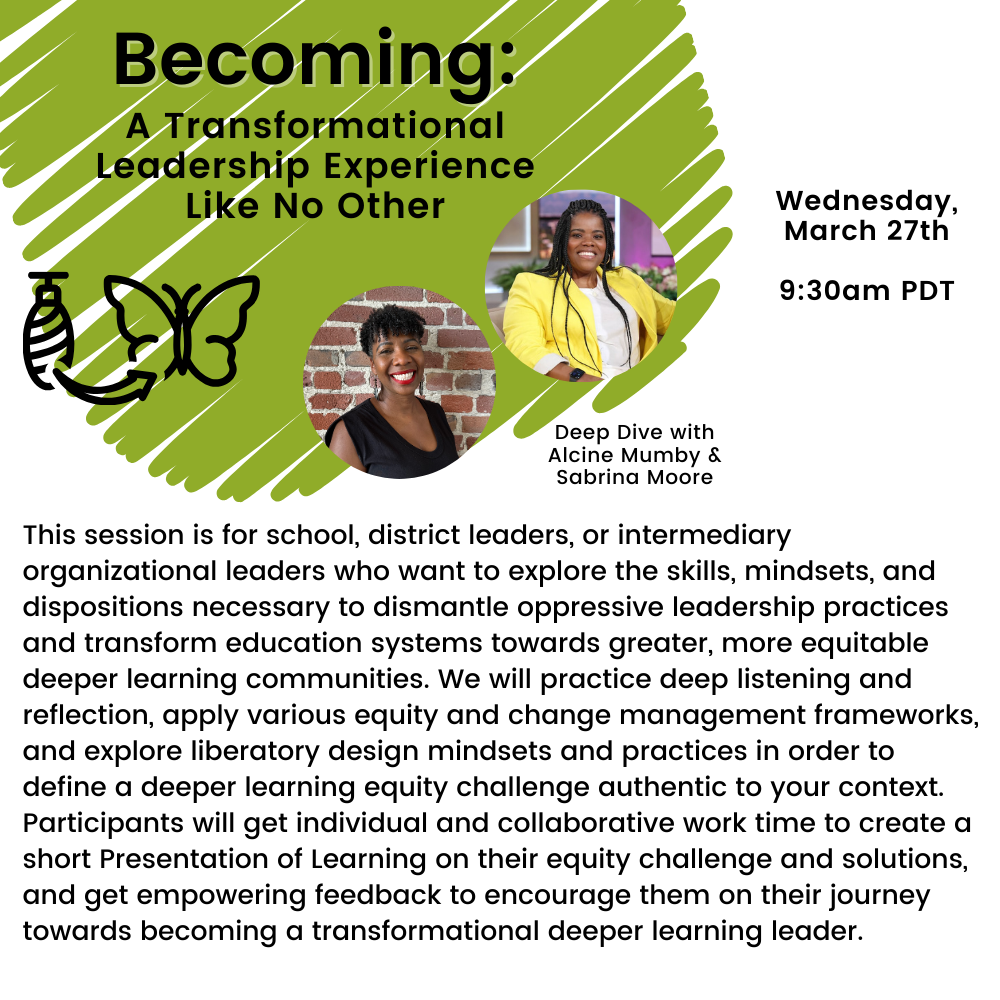
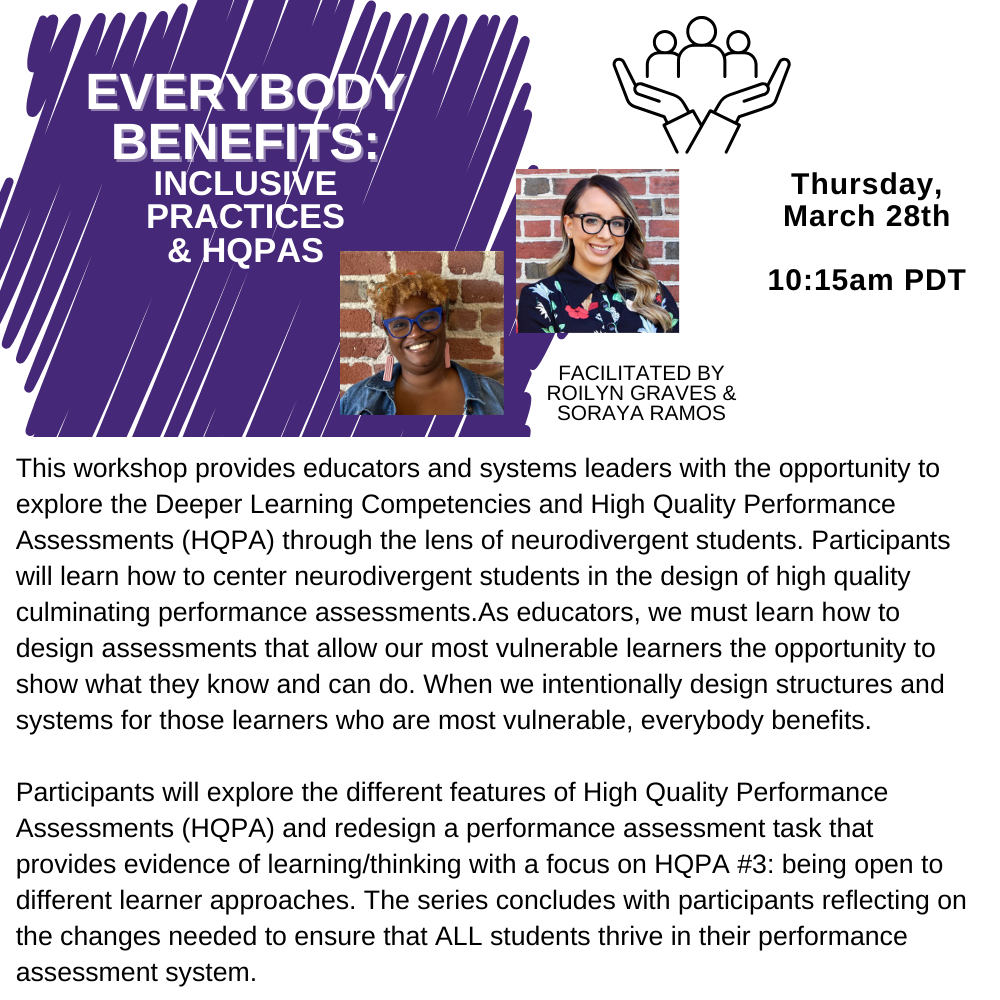
ELP hopes to see you at the Deeper Learning Conference in San Diego this March! Learn more about our Deep Dive and Workshop opportunities!
Click the images below to sign up!
Find the rest of the DL2024 sessions on Sched

[[accordion]]
Heading: Learn about Kala Stepter
Paragraph: Kala is an educator, cultural strategist, and systems thinker, always rooting her practice in community. For over a decade, she has developed her pedagogy for teaching liberation, justice, and joy. With a dual masters in multi-subject and special education, Kala invites all learners – kids and adults of all backgrounds and abilities – to learn, be curious, and think critically about the ways we show up for one another. From her start in DC Public Schools as a STEM educator to working in DEIB strategy work in Oakland, Kala guides and supports institutions and its leaders to rebuild more just educational systems and practices. Today, she designs and supports the transformation of science and math instruction at Envision Education, a charter school network in the Bay Area. As their Director of STEM instruction, Kala develops structures to ensure that STEM is accessible and joyous for Black and Brown kids. She is most excited and energized seeing our youth innovate to shape our future, and is proud to contribute in achieving sustainable change.
[[/accordion]]
[[accordion]]
Heading: Learn about Josette Neal-De-Stanton
Paragraph: Josette is currently an Assessment Design Partner at ELP, Josette has 15 years of experience in education. She has started teaching life science at Elmhurst Community Prep in Oakland, and then spent 6 years teaching, coaching, and leading at ARISE High School in Oakland as well. A highlight, as well as a shift in her career gears came while working at ARISE, as Josette became a Career Technical Education (CTE) Pathway Coordinator and then Coach. With these positions, Josette led the charge to create ARISE’s first Linked Learning Pathway in Public and Community Health. After leaving ARISE, she continued her work in CTE with the West Contra Costa Unified School District, as their District Work Based Learning Liaison. COVID saw Josette transitioning out of the traditional school setting, and needing to feel her work impact a larger audience, which essentially led her to ELP. As a former client of ELP, Josette saw the importance of the work being done, and really wanted to bring her science/CTE background to the organization. Josette is also a part time adjunct professor at Mills College, where she works in the Department of Education, in the teacher credential program as the Math & Science Curriculum and Instruction professor.
[[/accordion]]

[[accordion]]
Heading: Learn about Alcine Mumby
Paragraph: Alcine Mumby is a dedicated educator who has spent that last 25 years teaching and leading traditional and charter public K-12 schools all over the country. She currently supports and coaches district and school leaders to develop high-quality performance assessment systems that center student-led demonstrations of learning and metacognition. Prior to coaching Alcine taught Humanities at one of the first small schools in the Bronx where project-based learning and portfolio defenses served as the foundation of instruction. Afterward Alcine became a founding principal of Envision Academy in Oakland an administrator in several small middle and high schools in Atlanta and DC and a leadership coach in DC Charlotte & Philadelphia. Alcine earned her BA in English Education from NYU and a Master’s in Curriculum Studies and Teacher Education from Stanford University. When she’s not listening to podcasts or catching a flight Alcine enjoys working toward earning BAE (Best Auntie Ever) status with adorable niece and five nephews.
[[/accordion]]
[[accordion]]
Heading: Learn about Sabring "Bri" Moore
Paragraph: Bri currently works for Alameda County Office of Education as a Program Director of Systemic Instructional Review supporting and monitoring the SIR Report for Oakland Unified School District. Sabrina is an Oakland native, and has served as Principal/Instructional Leader for TK-5 in the Oakland Unified School District and is a former teacher. She has a strong desire to lead high-impact initiatives benefiting youth across Oakland, starting in the Sobrante Park community. Her mission is to transform outcomes one neighborhood at a time. She blazed a trail by founding and leading 3Ls Academy. As Executive Director for The 3Ls Academy, she blazed a trail, designing program solutions that focus on technical, relational, social and cultural aspects of complex change efforts focused on educational equity.
[[/accordion]]

[[accordion]]
Heading: Learn about Roilyn Graves
Paragraph: Roilyn is a trailblazing advocate for inclusive education and has been in this work for the last 20 years. With an unwavering commitment to equality and empowerment, she has dedicated the past two decades to transforming the educational landscape for marginalized students. Roilyn began her career as a special education teacher for the School District of Philadelphia. After teaching for 10 years, Roilyn transitioned into special education administration and served in schools on the east and west coast in similar capacities. Currently Roilyn works as an Assessment Design Partner and is a course lecturer in the graduate school of education at Stanford University. In her spare time she enjoys cuddles with her dog Sully, chatting with her nieces and nephew, and karaoke (mostly at home).
[[/accordion]]
[[accordion]]
Heading: Soraya Ramos
Paragraph: Soraya is joining the Envision team as an Assessment Design Partner. With nearly a decade of experience in education, Soraya has worked to promote and support anti-racist teaching and learning practices through her roles as a teacher and as an assessment designer. Before joining Envision, Soraya served as a Senior Associate at the Center for Collaborative Education (CCE). There she worked in partnership with schools and districts in New England and nationally to design high quality assessments systems that promote equity and engagement. In addition to professional learning and coaching, she led a consortium of districts in Massachusetts in their pursuit of designing an alternative assessment and accountability system. Soraya believes that lasting assessment systems need to be in alignment with a community’s vision and coherent to a district and school’s priorities. Soraya holds an Ed.M. in Education Policy and Management from the Harvard Graduate School of Education and a B.A. in Chicana/o Studies and Political Science from the University of California, Los Angeles.
[[/accordion]]
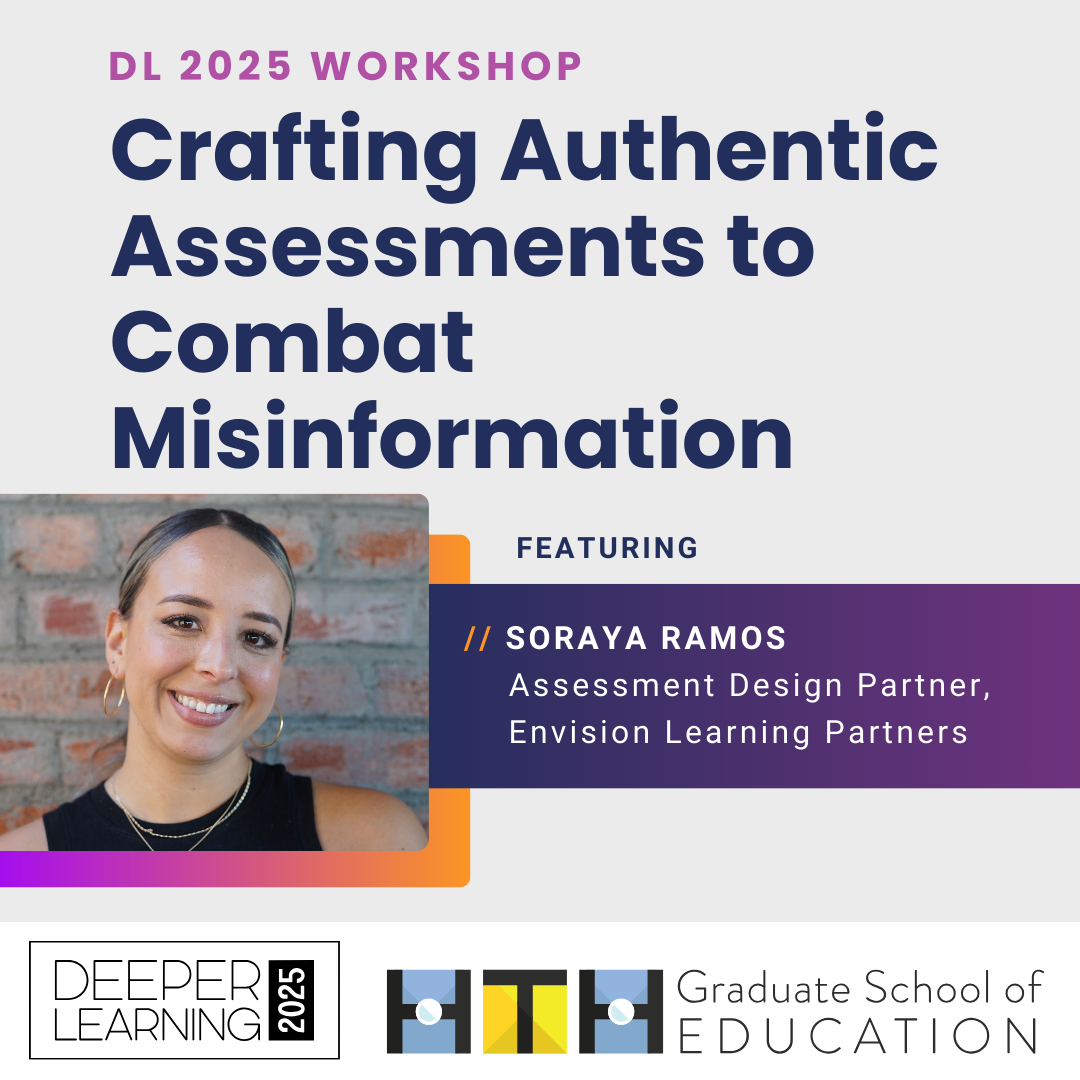
ELP hopes to see you at the Deep Learning Conference in sunny San Diego this April 2025! Learn more about our Den Talk, Deep Dive, and Workshop opportunities!

Click here to learn more and sign up!
When Envision CEO Jillian Juman and Chief Program Officer Justin Wells get on a plane together, they tend to have a deep and lively conversation about assessment. What makes for a comprehensive assessment system, one that truly prepares students to be global citizens that can drive systemic change, and what sustains such a system? Envision Education—known for portfolio-defense and other forms of high-quality performance assessment—has been innovating on assessment solutions for over 20 years. Lately, our talks circle the reflection that our current system is incomplete and not meeting the challenges of the time. Listen in—and join in—as Jillian and Justin bring their ongoing conversation out of the jet stream and into the Deeper Learning Den (to the welcome of Deeper Leaners and to the relief of plane passengers).

Click here to learn more and sign up!
This deep dive addresses the problematic relationship students and teachers often have with STEM education, rooted in unaddressed trauma. It focuses on how white supremacy culture shapes science and impacts individuals’ sense of belonging in STEM. Participants will explore ELP’s HQPA principles 3: Open to different learner approaches and 5: A learning experience in itself to design STEM assessments that promote healing. Through dialogue, journaling, and personal timelines, participants will examine STEM trauma and develop strategies to disrupt it in their lives and work. By the end, participants will have tools to address and prevent STEM trauma transference in their classrooms and assessments. The workshop is split into two sections: naming and releasing trauma, and designing with critical hope.

Wednesday, April 2, 2025 4:30pm – 6:00pm PDT
Friday, April 4, 2025 10:00am – 11:30am PDT
Click here to learn more and sign up!
In today’s world, where misinformation spreads rapidly, it’s crucial to equip educators with the tools to create effective, reliable performance assessments.
This interactive session will explore the “what” and “why” of high-quality performance assessments, emphasizing the importance of authentic assessments that foster critical thinking. Participants will engage in a newsroom activity to examine the impact of misinformation on society by sharing current headlines circulating in our ecosystem and practice critical thinking to evaluate the legitimacy of information sources.
Participants will leave with actionable strategies to enhance their assessments, ensuring they not only measure student understanding but also prepare learners to navigate a complex information landscape effectively.
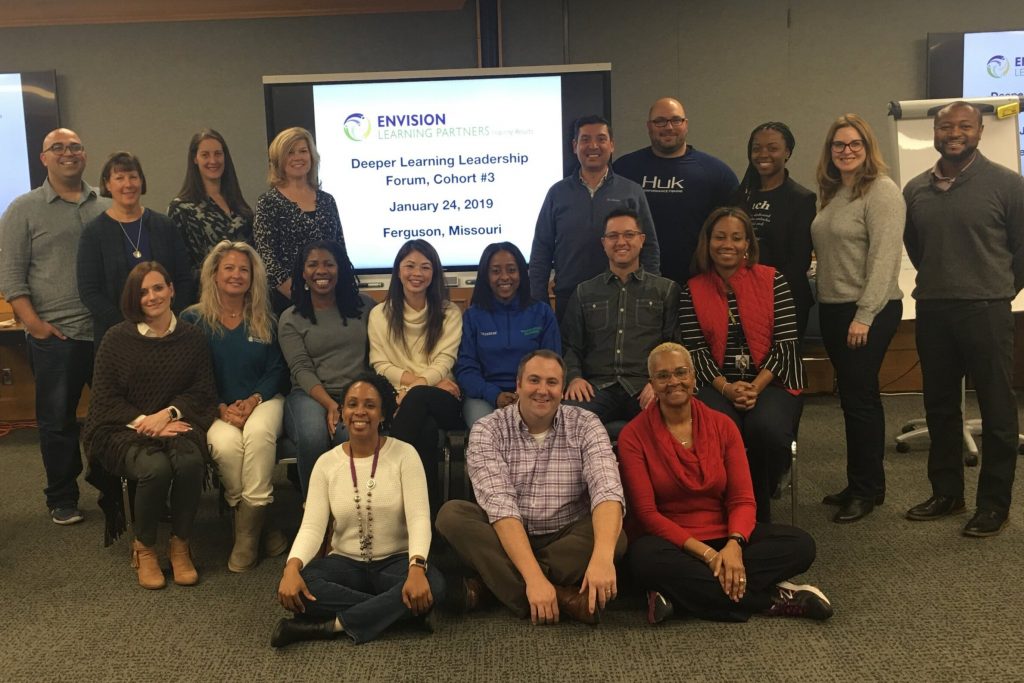
We are delighted to announce the education leaders that have been selected to join Cohort 3 of our Deeper Learning Leadership Forum. The DLLF is a unique leadership experience that aims to develop, strengthen, and sustain a group of well-prepared leaders for the Deeper Learning movement. The DLLF seeks to address the questions and issues of educational inequity, by bringing together education leaders and providing them with learning and networking opportunities to help them lead reform efforts in their local systems and around the country.
Cohort 3 had their first convening in Ferguson, Missouri last week, where they visited schools in the Ferguson-Florissant school district. The purpose was to dive into best practices and get a deeper understanding of the role that their community plays in the learning experiences for students.
Here’s what Adrienne Usher, Assistant Superintendent for Student Learning for Bullitt County Public Schools (Shepherdsville, KY) had to say about the experience:
“The DLLF is already one of the most amazing professional learning experiences I have participated in over my career. This not only inspires me to be a better leader, but also to really push the thinking of all those around me.”
The DLLF consists of leaders who are interested in transforming their districts and networks into centers of deeper learning for every student! Learn more about the Deeper Learning Leadership Forum here.
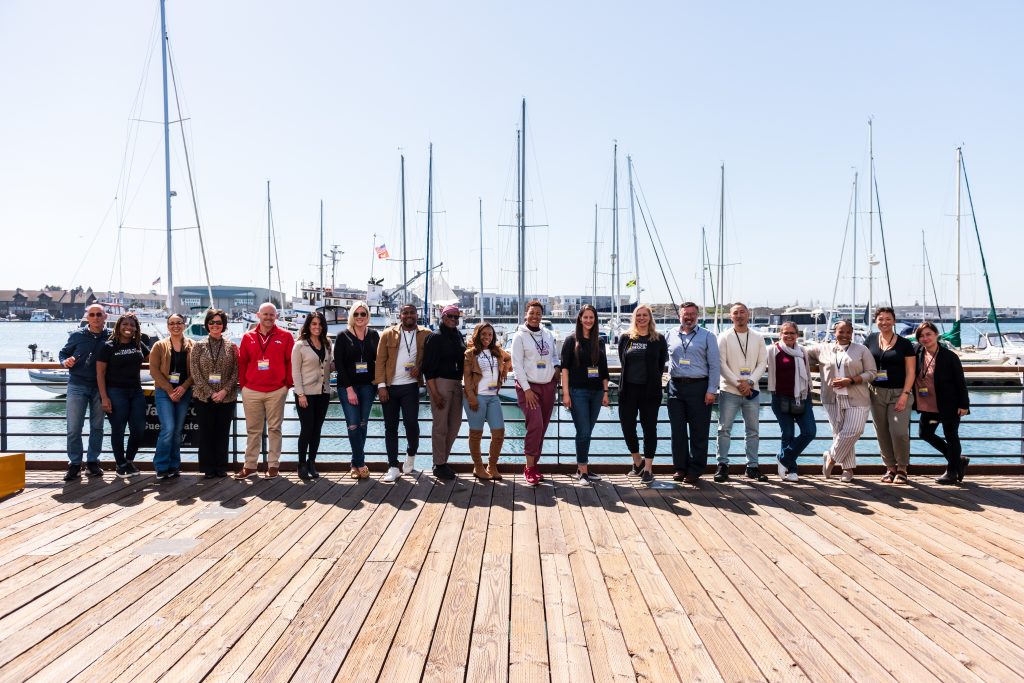
March 15th and 16th, 2022 was ELP’s first in-person Deeper Learning Leadership Forum (DLLF) Cohort 5 convening since Covid began and it was a success! These amazing folks have been working together virtually since June 2021 but it’s hard to believe based on the amazing community and connections they’ve built in that time. We can’t wait to continue this life-changing experience with them!
Below are some photos from our time together, beautifully captured by long-time ELP friend, Thai Chu of Alive by Shooting.
Learn more about the Deeper Learning Leadership Forum here.
ELP’s Director of STEM, Vinci Daro, was joined by prior Deeper Learning Coach and math enthusiast, Jim Malamut, for our second Twitter Chat.
Q1: WHY MIGHT SCHOOLS WANT TO DO DEFENSES OF LEARNING IN MATH? WHAT ARE THE BENEFITS FOR STUDENTS?
Vinci- A1: Defenses put students in charge of what they defend – their own way of understanding something, their own learning.
Jim- A1: One benefit is metacognition. In prepping for defenses, students reflect on what they’ve learned in math and how it fits into everything else they know. They also focus on the processes by which they learned.
@tamyraintech– they also allow students to prioritize and therefore hone their quantitative reasoning skills. Quant skills are key drivers for viability in the ever-changing job market.
@Linked_Learning– Defenses allow students to practice critical thinking skills necessary to thrive in post-secondary. With defenses, students get to practice these skills before they get to college or a career opportunity.
Vinci- Thank you for this point – practice with articulating learning creates opportunities to deepen learning – revising and upgrading understanding so often happens when students communicate what they have learned.
Jim- A1: Defenses in math can also promote coherence for students and educators. Students draw their own connections between math ideas. Educators design for coherence as they work towards a culminating defense event.
Vinci- Learning math for so many students is a long fragmented journey through disconnected topic after topic. What Jim is saying about coherence is especially valuable for bringing coherence to a fragmented journey.
Q2: WHAT KINDS OF MATH ARTIFACTS ARE WORTH DEFENDING?
Jim- A2: Tasks where students had to figure something out, make sense of something in a deep way, something that is already or that becomes meaningful to them. Tasks that are well-scaffolded but not where students are passively following a recipe or prescribed set of steps.
Vinci- Tasks that are open-ended enough set students up to develop and demonstrate agency by choosing tools and representations that are most relevant to the approach that makes most sense to the student. Tasks where students get to flex their mathematical practices (reasoning in and out of contexts, justifying, modeling, etc.)
Vinci- A2: Work that a student is proud of. Work on a problem or project that is connected to a big idea of the math course.
@Linked_Learning– For #LinkedLearning students, they may also defend an artifact connected to their work based learning, internship, or industry pathway, deepening cross-subject connections. Work that a student can identify as a demonstration of their own learning. If a student can name what they learned as they produced the piece of work, it’s a good candidate for defending.
Jim- Yes, and tasks where students can decide on their own questions, how to answer them, what quantities are relevant, and how they are connected.
@tamyraintech– A2: Artifacts that require students to reflect on how key math concepts are applied in relevant and meaningful contexts.
Jim- Yes!! I love how this article talks about possibilities for authenticity in projects: https://www.edutopia.org/blog/authentic-project-based-learning-john-larmer
@Linked_Learning– Love this! We know students work harder and dream bigger when their learning connects with them and connects them to the world.
@DealJT- I’m wondering in what ways you are able to make explicit to students the connection between defense of mathematics and the overall defense of learning.
Jim- Hey thanks for joining and great question! I think about the ways in which students and teachers can make explicit connections between math practice standards and overall critical thinking skills.
@DealJT- Thanks! We are just diving in to defenses of learning , but I’m really excited for the momentum we might build with defenses in math – I’m hoping we can both build capacity to successfully defend learning, and also create rich artifacts to use in the defense.
Vinci- Thanks for your question, Jason. The process of formulating the ingredients of a defense, then rehearsing, then articulating to an audience is the same process across the content areas – and has the same effects: metacognition, coherence, agency.
@DealJT- I love the idea of the math practices as an anchor in that connection.
@DealJT- How do you create buy in with students that that process, specifically in mathematics (but also overall), is a relevant and important process to students’ life-sustaining futures and dreams? –the connectedness between mathematics and defense of learning creates really powerful cohesion, but I want to make sure I’m ready to help students make a strong connection beyond that into their futures.
Jim- I think this speaks to a question of how to help students use math as a tool to read and write their worlds.
Q3: WHAT ARE THE BIGGEST HURDLES TO GETTING DEFENSES OF MATH LEARNING GOING?
Jim- A3: Asking students to defend their use of agentic skills using tasks that didn’t give them enough opportunity to use agency. The urge to design lengthy special artifact-worthy learning events that are disconnected and contradictory to how students are learning math daily.
@DealJT- Would this indicate that the “artifact-worthy” events should change, or that daily learning should change so that students are doing more artifact-worthy things every day? Or somewhere in the middle?
Jim- I think learning should be happening every day so we (Ts and Ss) can find artifacts of it. Still can be special events but only getting to practice something like “justification” once or twice a quarter isn’t enough. What are we doing the rest of the time?
Vinci- Often math teachers feel they must create a separate set of assignments or learning opportunities that are in addition to their regular stream of studying, working and learning together. Ideally, a system gets better — math curriculum gets better and math teachers get better — at creating learning experiences that are worth defending as a regular part of the work that is happening in math class.
Vinci-A3: Another hurdle is the reluctance to put ‘shy’ students in the spotlight – but very often these are the students who benefit most from the experience.
Make sure to follow ELP on Twitter @EnvisionSchools and use the hashtag #ELPCoachChat to join our next Twitter Chat!

This year’s Defense Design Studios (DDS), our annual portfolio defense showcases, are all completed! These events might have been the closing for the students who presented but for a lot of the educators who attended, it’s just beginning. Many of this year’s attendees are looking to implement portfolio defenses into their schools.
Two visitors from The Edge Foundation, based in London, attended the DDS at Envision Academy in Oakland and later wrote about the portfolio defense model and their experience at observing our students. Read their reflection here.
ELP hosts DDS at Envision schools in the Bay Area, as well as partner schools in Sacramento and Dallas. There are even a few schools in LAUSD that hosted their own DDS without ELP’s support this year, for the first time! Texas saw attendees all the way from Missouri, Sacramento had teams from Fresno and Colorado, and Envision schools gladly welcomed groups from Wisconsin, New York, and even the UK. All in all, over 100 educators attended the ELP hosted DDS this year.
We’re highlighting some of the Deeper Learning Leadership Forum (DLLF) alumni who are making moves- achieving goals, serving their communities, and impacting the future of education.
ELP has worked with 58 educational leaders from all over the United States since 2016 and we’re excited to open applications for our fifth cohort early 2021!
Tracie Noriega
“Greetings from San Lorenzo Unified School District, where I now serve as the Assistant Superintendent of Educational Services. I started here in July of this year. Since my time with Cohort 2 of the DLLF, I transitioned from the Director of Assessment and Evaluation to K12 Instruction while I was in New Haven Unified.
I don’t know where to start with what I took away, as there was so much! What I really appreciated was the various processes that we experienced as a cohort, which really helped me to structure PD’s for teacher leaders and administrators. I loved being with like-minded Equity warriors and the knowledge that there are so many of us continues to inspire me. Just recently, I used the d.school’s Design Thinking Process for my committee work in our planning to re-open our schools. I hope everyone is well and I remain grateful for my time with the DLLF!”
Rody Boonchouy, Ed.D.
“Since completing my fellowship from Cohort 1, I have been serving as Associate Superintendent of Instructional Services in the Davis Joint Unified School District. Not only did the DLLF experience deepen my understanding of both self and what it means to promote equitable and progressive learning experiences for all students, but it also connected me to life-long colleagues who are (and will be) collaborators throughout my career.“
Terri Holden
“I am now in my second year of serving as the Superintendent of Yellow Springs Schools in Yellow Springs, OH. My time in the DLLF was perhaps the best professional experience I have ever had, and molded me into the leader I am today. As a member of Cohort 1, I was exposed to individuals and ideas that challenged my thinking, and helped me advocate and work for deeper learning with an equity lens for all students. This has led me to my current position where we are examining how to interrupt the systemic inequity of which we are a part to provide access, power and choice to our students, while prioritizing those youth furthest from opportunity.”
Dan Deguara
“As of July 1, I began as the new Superintendent of Belmont-Redwood Shores School District in San Mateo County. I continue to appreciate our thoughtfulness around systems thinking and the change process. As educators it is important that we continue to develop our systems so that we are able to provide authentic experiences that foster deep and meaningful learning for all students.”
Ellen Dorr
“Since DLLF, I’ve continued to grow my capacity as an equity-focused leader. I am in my final year of the Leadership for Learning doctoral program at the University of Washington and serve as the Chief Technology Officer for the Renton School District. During the pandemic, the need for digital equity, which encompasses so much more than access to devices and internet, has come into sharp focus. We are dedicated to building a humanizing, resilient, and equitable school system in order to provide our students and families with the learning, experiences, and futures they deserve.”
Shannon Terry
“As a result of my participation in the Deeper Learning Leadership Forum, my equity lens crystalized from microscopic to macroscopic to megascopic. Through shared learning experiences with DLLF cohort members, real possibilities for eradicating inequities and disparities became clear. I developed 20/20 equity vision. As we learned and served together as equity energizers, evangelists and engagers, we forged ahead during our DLLF cohort years to positively impact our communities. We also forged lifelong bonds. Despite the passage of time, my DLLF cohort remains at the ready to step into the space to partner in the equity work as active participants, thought partners, and experienced experts. Because of the DLLF support system, the opportunity to co-lead racial equity work in the Dallas ISD became a reality in 2019. Leaning heavily on lessons learned as a cohort member, the design, development, and implementation of a five-year racial equity professional learning plan was achieved. Fast forward to present day, I currently serve as a Division Director at the Texas Education Agency (TEA) and was recently tapped to co-lead internal equity work. To my DLLF family, glad I have you on speed dial. You’ll be hearing from me again soon! The equity work continues…always. Infinitely grateful for the Deeper Learning Leadership Forum! Let’s change the world.”
Click here to learn more about the Deeper Learning Leadership Forum.
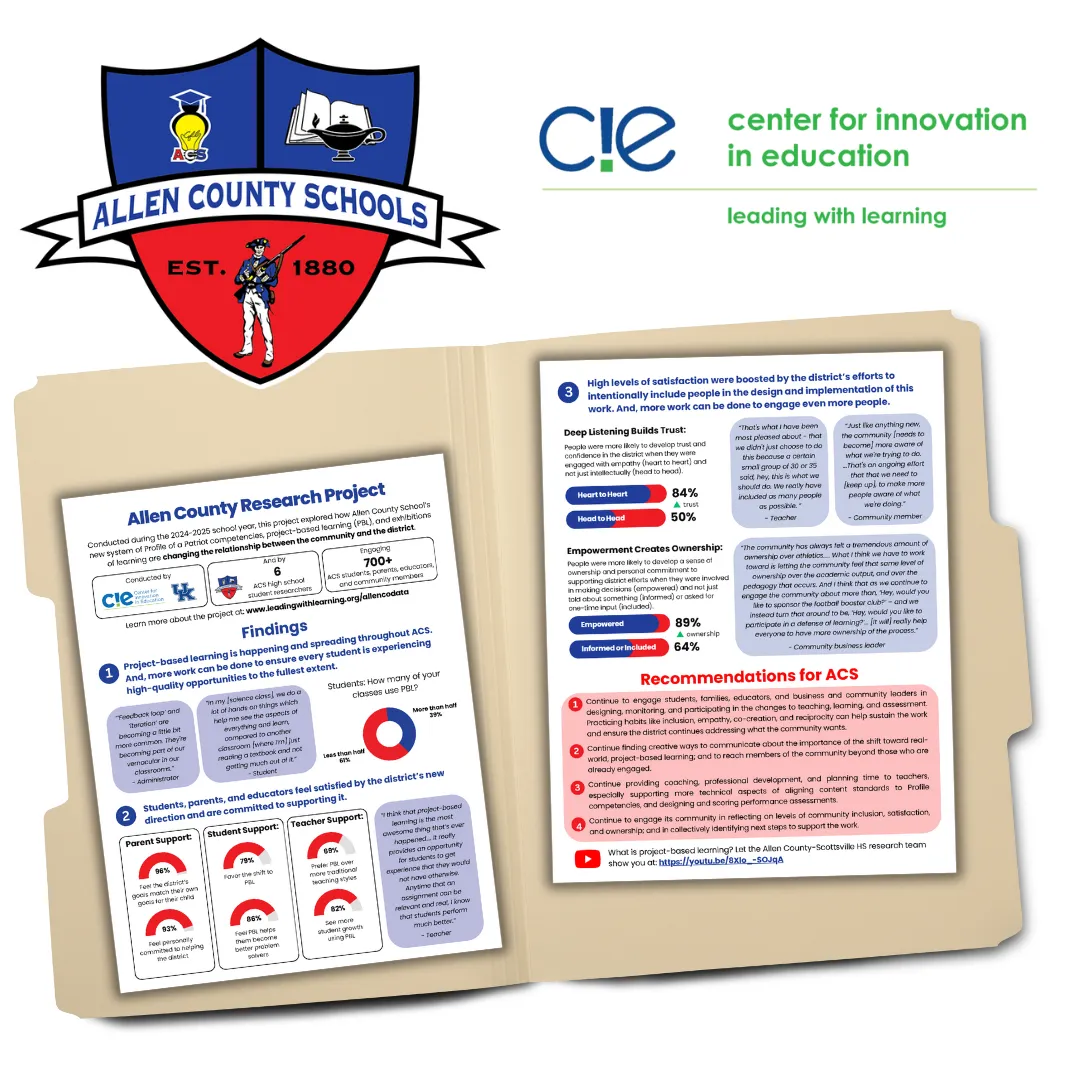
A newly published case study from the Center for Innovation in Education (C!E), featuring Envision Learning Partners in Appendix C, highlights Allen County, Kentucky’s multi-year effort to redesign assessment and accountability through Inclusive Design. The report, Better Together, shows how the district co-created their graduation competencies called “Profile of A Patriot” and embedded project-based learning and performance assessments to place students’ passions and real-world skills at the center of learning.
Envision Learning Partners has been proud to support Allen County in this work, and we’re excited to share C!E’s new case study. We’ve partnered closely with C!E through the Assessment for Learning Project, working together to advance learner-centered assessment practices nationally.

The nonprofit, public media station KQED provides educators and young people multimedia content, experiential activities, and professional tools to create learning environments of the 21st century, by promoting media literacy, civic engagement, creative expression, and problem solving using digital media.This partnership enables ELP and KQED Education to:
- Share each other’s expertise with our communities
- Offer KQED resources to ELP district partners and teachers in service of strengthening skills and tools for performance assessments.
- ELP often works with schools who have selected Digital Literacy as part of their Graduate Profile. ELP will introduce schools that desire to deepen their Digital Literacy learning with KQED and their growing body of resources
- KQED Education and their partner schools has the whole child learning in mind, inline with ELPs approach to student learning. KQED will introduce like-minded KQED partner schools to ELP and their range of resources and services.
Learn more about ELP and KQED, and contact info@envisionlearning.org or avaba@kqed.org if you have more questions about the partnership.

ELP Partners Up with KQED Education
Measuring what Matters, Learning by Doing, and Piloting with Purpose
There is statewide support for Deeper Learning in Colorado, and Envision Learning Partners is playing a key role.
In 2007, the state of Colorado asked districts to choose the ways their students will demonstrate college and career readiness, and therefore readiness to graduate from high school.
This Graduation Guidelines menu lists the options. In the mix of more traditional tests, two options provide a clear pathway for students to graduate by demonstrating their skills through an individualized product or presentation: Capstone Projects and Collaboratively Developed Standards-Based Performance Assessment.
Coaching Deeper Learning in Colorado
Since April 2018, Envision Learning Partners has been honored and energized to work in an accelerated way with educators at every level of the Colorado educational system, to design meaningful and sustainable assessment systems worthy of and accessible to every student in Colorado, strongly aligned to the demands of a wide variety of 21st century college and career options.
This June marks the close of two incredible first-year partnerships between ELP and the Colorado Department of Education, as well as the Colorado Education Initiative; both projects involve educators from every corner of the state to transform education statewide.
Transitions and Opportunities for Envision Learning Partners
Dear ELP Community:
I am writing with news about a transition for Envision Learning Partners. This past year has been eventful for us (as I am sure it has been for you). We onboarded a new Executive Director and a new Assessment Design Partner. We completed strategic plan processes for both Envision Learning Partners and Envision Education org-wide. We are about to finish a 3-month study of our impact and ways to expand it. Now, as we wrap up the school year, we consider the future and make decisions about how to navigate education’s changing times and shifting landscapes.
Royce Conner, ELP’s Executive Director, will be transitioning from his role on June 30th. We are grateful to Royce for the important contributions he has made and projects he has led during his tenure, and we deeply support him as he moves into the next chapter of his distinguished career as an educator. Feel free to connect with Royce on LinkedIn.
Royce’s responsibilities will be distributed across Envision Education as part of a comprehensive org-wide strategy to deepen the integration between our schools (our local impact) and our consulting service (our nationwide impact). Out in the field, our remarkable team of coaches and operations professionals will continue to help school districts build high-quality performance assessment systems. In my role as Chief Program Officer, I am excited for the opportunity and the commitment to make the sum of “One Envision” to be greater than its already powerful parts.
As we head into the summer, when educators often feel a welcome shift in pace, I invite you to reach out to me with questions or wonders. ELP remains your steadfast partner in our movement to bring high-quality performance assessment to all students.
In community,

Justin Wells, Chief Program Officer
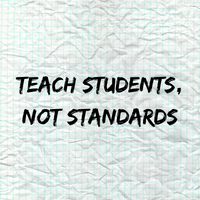
In a recent conversation with fellow advocates of performance assessment, a colleague made the point that our job as educators is not to teach standards but to teach students.
Of course, standards play an important role in guiding teachers’ work. But given the structures and incentives of our system, it’s easy for standards to slip into the position of ends rather than means. Tragically, covering standards—“I taught it; some got it.”—feeds inequities that plague education. When we truly reorient to “teaching students,” we stay focused on those whole human beings in our classrooms. What do our students need to achieve, how will we know they have achieved it, and how do we support their getting there? This is performance assessment system design.
The graduate profile movement is a boon, pushing students into the focal point of our energies. Social-emotional learning (SEL) is trending, reminding us to attend to the whole child. But none of these ideas will translate into lived learning experiences until students are regularly tackling rigorous and real-world challenges that elicit the skills they need to practice and master. Our kids need high-quality performance assessments.
Join us on twitter for more conversation about the importance of teaching students over standards, using the hashtag #TeachStudentsNotStandards
Sincerely,
Justin Wells, ELP Executive Director
During his keynote at last fall’s EdLeader21 Conference, educational thought leader, Tony Wagner, did not mince words. “A graduate portrait without an assessment,” he said, “is useless.”
The audience members—mainly district leaders from around the country—audibly shifted in their seats. Although it’s hard to disagree, it’s also hard to pull off. How can school districts assess skills that are as complex as the ones we see on a typical graduate profile?
Tony followed up his challenge with two recommendations:
- “Every student should have a digital portfolio.”
- “Every student should present or defend their learning.”
He’s right. Portfolio assessment and presentations of learning (which come in many forms, including defenses and student-led conferences) are two effective, customizable, scalable, and actionable ways to move from “poster to practice.”
ELP cheers the graduate profile movement because of its potential to change our society’s conception of education’s purpose. But we also worry for the movement. If we don’t see graduate profiles made visible in the actual work of our students—“show don’t tell,” says this old English teacher—then we’re destined to look back on this as another edu-trend that came to nothing. That’s why Tony Wagner’s admonition is so urgent.
The challenge of assessing graduate profiles is one of the major themes of next month’s Assessment for Learning Conference. I know I will see many of you there, and I am excited for the opportunity to work on this together.

Justin Wells,
ELP Executive Director
ELP is thrilled to welcome Morgan Vien to our team of Deeper Learning Coaches. Fabulously talented and exploding with ideas, Morgan complements our team with her experience in K-8 school leadership (most recently, serving as principal at ASCEND School in Oakland) and facilitating design thinking (as a School Retool Coach for Stanford’s d.school). We, and our client partners, are going to learn so much from her. Please welcome Morgan when you see her out in the field.
In other ELP news, we recently hatched a new strategic plan, our first since joining forces with the Stanford Center for Assessment, Learning, and Equity (SCALE) over a year and a half ago. ELP’s vision—every student in America is learning within a high-quality performance assessment system—is ambitious in scale and generational in scope, so we know we need to set ourselves up for the long haul. In the coming three years, our strategic priorities are:
- to grow our service to American public school districts, the primary agent of educational delivery in this country.
- to expand the ways that we serve our client partners so that they have more pathways to success.
- to ensure that equity is not only the reason for this work but also the process of how we do this work.
- to catalyze research on the impact of high-quality performance assessment systems on student learning.
- to establish the sustainability of our business model so that we can deliver on our mission indefinitely.
As always, we welcome your thought partnership. Let us know what you think about our plan, or ask any one of us to elaborate when our paths cross in the field.
Sincerely,
Justin Wells, ELP Executive Director
The COVID crisis deepens. All of us engaged in the endeavor of learning—students and teachers—now gather ourselves for what we know will be a strange, trying, and unpredictable school year ahead.
As your learning community makes its mad design dash to the start of the school year, with all your contingency plans and spreadsheets and multiple scenarios, don’t forget to keep your graduate profile, or whatever serves as your overarching set of desired learning outcomes, close at hand. Refer often to that list, and keep asking, How are we designing ways for our students to practice these skills?
This pandemic is driving home the pre-pandemic truth that learning is not about seat time or content delivery or testing, all of which crumbled with startling quickness last spring. Learning has always been and will always be about improving one’s skills through practice, guided by coaching. Conceived as such, learning is remarkably flexible. Practice, guided by coaching, can happen at home independently, or on a video call, or in a sparsely desked classroom with children in masks. Establish practice routines for the key skills of your course. Introduce them as early as possible in the school year. Design those routines to be portable, and demonstrate that portability to your students by simulating at-home practice when you have them in your classrooms, and in-classroom practice when you have them on a video call.
I have more to say about elevating the “practice question” in a blog I recently contributed to our friends at Future Focused Education.
We can rise to this challenge, especially if we apply the principles of High-Quality Performance Assessment, and we can make school better than it was before.
In solidarity with educators everywhere,
Justin Wells, ELP Executive Director
Have you had a chance to read Jal Mehta’s piece in Ed Week, “Why Equity Has Been a Conservative Force in American Education—And How That Could Change”? If you haven’t, you should.
Mehta argues that “the effort to close achievement gaps has in practice doubled down on the century-old industrial model of schooling, leaving in place all of the essential elements of its grammar: teaching as transmission, batch processing of students, conventional assessments, tracking and leveling, and all of the rest. Anything that moves away from those assumptions—like project-based learning, problem-based learning, interdisciplinary learning, authentic assessment, or constructivist pedagogy—is seen as ‘risky;’ something that is ‘OK for the privileged kids’ but somehow distracts from the real work of closing achievement gaps on state-sponsored tests.”
We at Envision Learning Partners see deeper learning not as a risk but as a moral imperative, not only because all children deserve it, but also because it’s the right way to make change. I agree with Mehta’s notion of “liberatory design,” which “assumes that teachers and students would like to develop engaging, meaningful learning experiences, and that the problem is not them but the institutional structures and culture of schools that constrains them.” I am fortunate to witness proof of this regularly in my work when, for example, I see the excitement among students and teachers who have designed and implemented a portfolio-defense system.
The teachers and leaders who reach out to partner with ELP have drawn similar conclusions about deeper learning. We are proud to serve their schools and districts, and we are always inspired by their courage to do this work.
Sincerely,
Justin Wells, ELP Executive Director
As you work furiously and heroically to serve your students through the COVID-19 crisis, ELP offers this advice: Don’t forget about your graduate profile. Now’s the time to lean into it.
It doesn’t matter whether your performance assessment system is well established or just getting off the ground, whether you’re currently reaching your students through Zoom or printed worksheet packets. If your learning community has a graduate profile or similar set of learner outcomes, you should use that language to remind your students of their assets and to challenge them to grow. Most graduate profiles were designed to focus us on the skills students need to navigate a fast-changing world with an unpredictable future. Now we get to put them to the test.
Many graduate or learner profiles, for example, target a competency that has to do with being a “self-directed learner.” Let’s admit that it’s a concept more aspirational than operational. In most of our highly-structured learning environments, young people have very little opportunity to practice being self-directed. Guess what? Now they need it. And we need to teach it. So invoke the skill, express high expectations for students to develop the skill during this time, give them ideas for how to practice and demonstrate it, structure opportunities for them to reflect on it, and challenge them to document evidence of their growth. This goes for any skill that’s on your graduate profile.
Stay tuned. In coming weeks, ELP will continue to share suggestions for ways to leverage or advance the elements of your performance assessment system: the use of portfolios, running defenses of learning virtually, building a culture of revision and reflection. There are enormous opportunities in this crisis for students to practice and be assessed on the skills we say are important.
Sincerely,
Justin Wells, ELP Executive Director
The Practice Question
Across education, I see the development of a healthy habit, and the performance assessment movement deserves plenty of credit for it. Educators everywhere, when considering a desired learning outcome, are reflexively asking, “How would we measure that?”
This is good. Asking the measurement question holds us accountable to our goals; answering it points us to actions.
But there’s another question that is just as focusing, should be just as reflexive, and would not hurt to come first: “How will our students practice that skill?”
Answer the practice question, and the measurement answer comes easily. It’s not so easy the other way around.
As a young teacher, I too often measured things that my students didn’t get to practice. I whipped out a public speaking rubric when students presented at the front of the room. I assessed them on their volume and eye contact. But we hadn’t practiced those skills in class.
Collaboration shows up on most graduate profiles. How will our students practice that skill? Answer it honestly. Assigning some group work is not the same thing as practicing collaboration.
Another grad profile meme—critical thinking—is not any kind of thinking. It’s grappling with “How might I be wrong?” How do students practice that skill? If a student has gone through a school year without consciously changing her mind on anything, then I doubt she has really practiced critical thinking.
I applaud what I see announced on graduate profiles all over the country—really important skills that schools can help kids get better at: inquiry, citizenship, creativity, persistence, problem solving, cultural competence, and so on. But it’s not fair to measure things that students haven’t had an opportunity to practice.
A high-quality performance assessment system knows its desired outcomes and its measurements; it also takes responsibility for scheduling practice.
Please share with us one of your favorite ways to help your students practice a key skill!
Sincerely,
Justin Wells, ELP Executive Director
The “yes buts”—the common objections to performance assessment—keep dropping away.
The latest comes with the revolutionary announcement from the UC Board of Regents last week: Going forward, the SAT or ACT test is not required for admission to a UC campus. The requirement will be phased out completely by 2025.
And just like that, there goes the “yes but the SAT” counterargument to performance assessment system building. An institutional practice that had seemed entrenched is now revealed by the pandemic to be fragile.
We can add the SAT to a growing list that includes “Yes but instructional minutes,” “Yes but the end-of-year standardized tests,” and “Yes but the course grade.”
Meanwhile, the concept of a defense of learning has proven resilient in this crisis. ELP is proud to partner with the Learning Policy Institute and the Linked Learning Alliance to launch the “Defending Learning at a Distance” series, which in coming weeks presents multiple opportunities to observe students’ virtual defenses of learning and engage in conversations with the inspiring students and educators who have remained committed to performance assessment despite school closures. (For those of you wondering about ELP’s long running practice of Defense Design Studios, this series is where we are putting that energy this year.)
Watch this web page closely for upcoming dates associated with the “Defending Learning at a Distance” series. There are some events happening later this week. And more will be added as plans get solidified. Students and schools are moving fast. Don’t take it from us: Watch Envision student Dani Martin vlog about preparing for her virtual defense. I can’t wait to witness what students have to say about their learning in the next couple weeks, and to discuss the implications of this with all of you in the months to come.
Stay safe,
Justin Wells, ELP Executive Director
Here at Envision Learning Partners, we believe that every student deserves to learn within a high-quality performance assessment system. That means every student goes to a school where:
- targeted skills are announced (often in the form a graduate profile),
- rubrics are widely shared and regularly used,
- teachers are aligned on the quality of assignments and student work,
- students can explain what they are doing and how they are growing,
- and high expectations are not random or tracked; they are held for every student who attends that school.
If a school does not have these conditions in place, or isn’t actively working toward them, then I hesitate to call it a good school, no matter how high its test scores, shiny its hallways, or champion-like its teachers.
We in the performance assessment movement must clamor for focus on the quality of our students’ work—not proxies for their work, like test scores or classroom observations, but the work itself. How are you focusing on and highlighting your students’ work? Drop us a line to let us know!
I invite you to read more of my thoughts on the subject in “What Is a Good School?,” a short piece I wrote for EdWeek’s Learning Deeply blog.
Sincerely,
Justin Wells, ELP Executive Director
I am excited about the upcoming Assessment for Learning Conference and encourage everyone in the performance assessment movement to join us in San Diego this February (11–13th).
For the past three years, the educators and system leaders of the Assessment for Learning Project have been designing, learning, and innovating together to reimagine what’s possible for assessment. Having learned much from being part of this community, ELP has been hungry to see it grow. So we’re thrilled that the Assessment for Learning Project is stepping up to host its first-ever conference. The event will be populated with some of the most innovative, thoughtful, equity-minded, and visionary educators and system leaders when it comes to assessment.
ELP is proud to be a co-designer of the conference, and it’s shaping up to be a cutting-edge learning experience for attendees, who will be challenged to apply innovative assessment principles to their own 3-day learning journey. This is a conference designed for practicing, not preaching.
There are so many educators around the country who are doing incredible work to transform assessment, and this conference is a chance for us to learn with each other and build on the momentum to create an Assessment FOR Learning movement. I hope you will join us!
For more info and to register, go to www.assessmentforlearningconference.org.
Sincerely,
Justin Wells, ELP Executive Director
A high school principal recently lamented to me that many of his students’ grades are cratering during this time of distance learning. Much of the problem, he observes, is coming from classes whose grades are calculated using points.
Work is assigned, work is not received, and the work gets a zero in the grade book. After that, it’s out of the teacher’s hands. Simple math takes over. Average up the points. Out spits the failing grade.
Keeping our students engaged when we can’t serve them in person has, understandably, proven a challenge. Around the country, teachers are Zooming real hard and feeling disappointed by what they are getting back from students in return. But that problem is compounded by points-based grading systems, which the pandemic has exposed as a pervasive practice in our schools.
Where I see a course that organizes itself around points and percentages, I usually find a learning environment in which the teacher and the students do not share clear answers to simple questions of purpose: What are our learning goals? What are the skills we are focused on improving? What are the ways that students can demonstrate their progress?
Two principles of ELP’s High-Quality Performance Assessment (HQPA) framework are particularly germane here: 1) tight on criteria for success and 2) open to different learner approaches. In a course that is rooted in HQPA, students can describe what success looks like with words, not numbers. And the teacher can point out different paths to success. In such a course, there is no reason why a student cannot, in a single, convincing performance of the targeted skills, redeem a whole semester’s worth of struggle.
If there’s one educational practice that I wish this pandemic would eradicate, it is the use of points for calculating course grades. Its disappearance would be a major advance toward an educational system where assessment is for learning, not for sorting.
With respect and gratitude for the work of educators everywhere.
Sometimes it’s important, in our jargon-loving profession, to put things as plainly we can. That’s certainly true for a concept such as performance assessment.
A word that comes in handy is the word challenge. I use it for two key questions:
The first is, How are we challenging our students?
Schools and districts that are consciously building a performance assessment system tend to have crisp answers to that question: “We challenge our students to do a year-long research project.” “Our 3rd graders plan and facilitate their own conferences.” “11th graders must design and implement a statistical analysis with help from an outside expert.” “Our kids have to defend their learning every two years.”
The second question is then, How are we challenging ourselves and our system to prepare our students for their challenges?
Again, I am encouraged by crisp answers: “We look at student work and calibrate on our rubrics once per month.” “Our grade level teams meet in the summer to design two multi-disciplinary projects per year.” “The science department will be using a Next-Gen-aligned rubric for assessing inquiry projects next year.” “We’re investing in PD so that our teachers can teach public speaking across the curriculum.”
Try it. As you build your performance assessment system, keep asking, “How are we challenging our students?” and “How are we challenging ourselves?” Tighten up your answers. Then live them.
Sincerely,
Justin Wells, ELP Executive Director
One widespread way that schools have adapted to the pandemic, particularly at the secondary level, is a dramatic restructuring of the “bell schedule.” In the virtual and hybrid contexts we’re now operating in, many students are taking, and teachers are teaching, fewer classes at one time, typically made possible by shortening the length of courses or chunking them into alternating modules (which is what we are doing here at Envision Schools).
The challenges are obvious: These new schedules are born of compromise. They are harder to manage for some disciplines than others. Abrupt change is exhausting. But they do present an opportunity for advancing a key element of your performance assessment system—the culture of reflection and revision among teachers.
In a functioning performance assessment system, students’ work (their response to assignments) informs teachers’ work (their design of assignments) in a process that is collaborative and continual. With courses on faster cycles, there are more opportunities to iterate. A semester-long course, if offered twice during the year, doubles the pace of iteration.
Let’s acknowledge that making time for collaborative revision of courses is not easy. Right now, the brute logistics of delivering instruction in the midst of a pandemic are monopolizing our energies. But as we get deeper into the fall, ELP urges educators to dedicate some of your precious PD time, in whatever form it comes, to sharing assessments and analyzing student work, building your system’s muscles for reflection and revision.
Shorter courses demand even crisper answers to the questions that never go away: What do students need to learn, and how will we know they have learned it?
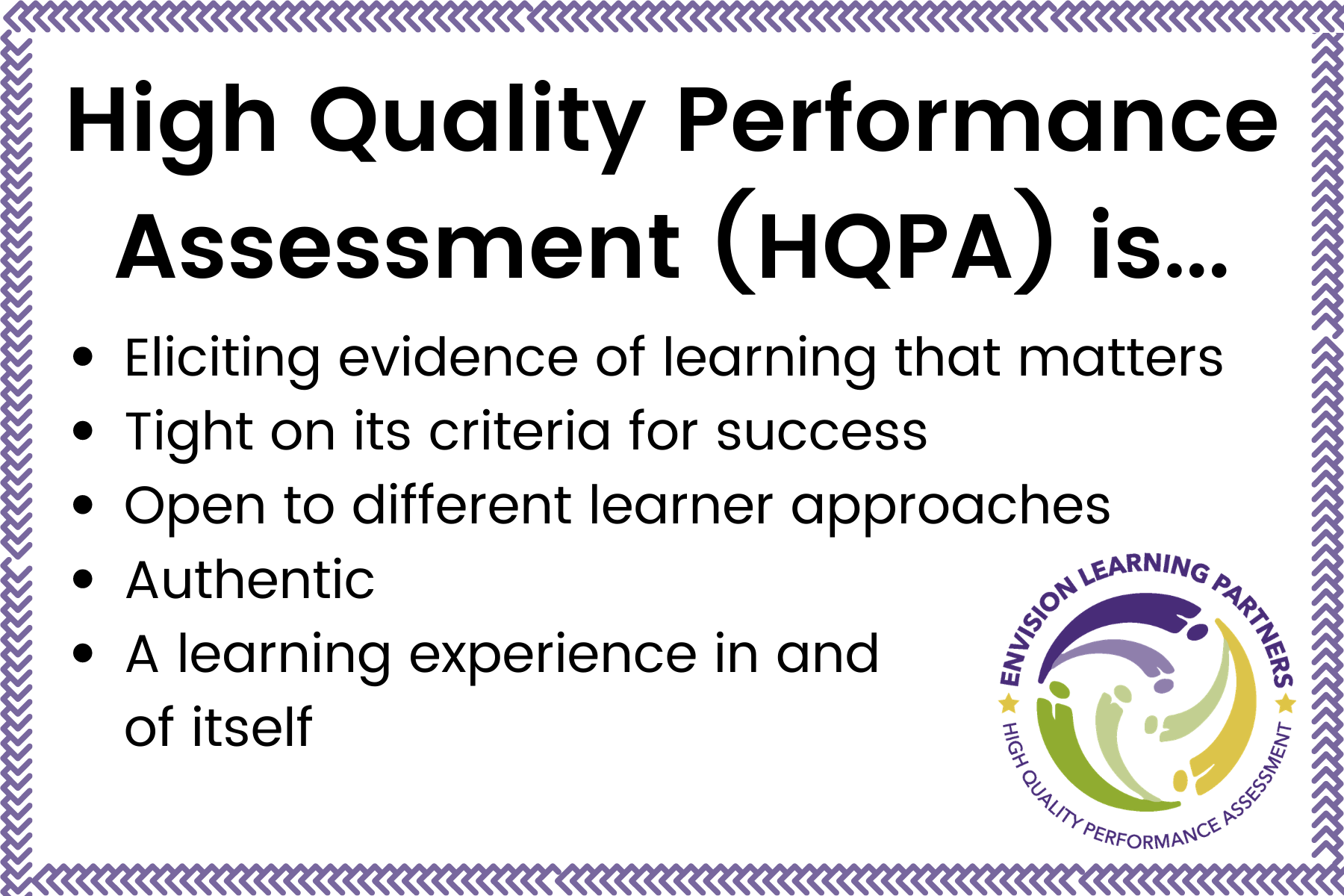
When teachers do have opportunities to share their work with each other, we encourage you to use ELP’s principles of High Quality Performance Assessment (HQPA) as a common language for exchanging feedback. We offer both a set of look-fors and single-point rubrics for each of the five principles. Don’t hesitate to reach out to us with questions on how to use these tools in your learning community.
with respect and gratitude for the work of educators everywhere.
This is an interactive hands-on workshop where participants will prototype a high quality performance assessment (HQPA) aligned to deeper learning competencies. Through learning stations, participants will explore the what and why of performance assessments and use quality criteria tools to analyze for rigor, learner agency, and authenticity. Participants will then prototype their ideal HQPA and brainstorm the potential implications on their school structures and pedagogies. The design experience will culminate with participants sharing their performance assessment tasks, identifying next first steps, and reflecting on their own learning and leadership.
Join us to…
- explore HQPA in relation to the design of a single task/challenge
- prototype or refine a task/challenge that aligns to HQPA and is designed so our most marginalized students can thrive

I am writing to share the news that December 30th marked my final day at Envision Learning Partners. It is impossible to put into words the depth of gratitude and appreciation I have for Envision as an organization, and for all of the amazing humans whom I have met over the past fifteen years(!!!!) – inside and outside of the org. Having spent the last decade and a half learning how to be an educator committed to deeper learning, and learning how to engage in transformative systems change work, there is no way that I can capture the role that Envision has played in my professional and personal evolution.
What did you most enjoy about being a coach with ELP?

I had no idea the profound impact that ELP would have on my life when I said yes to the opportunity to help found the organization and dream up what we wanted to do and be back in 2010. As I look back now, over a decade later, it is… of course… the people who have taught me the most, and whom I hold in my heart as I make my way through the world. Courageous and visionary school leaders from Hawaii to Maine who have invited me in to their most sacred place – their schools. Boundlessly passionate educators who have pushed their own practice with open hearts and open minds in order better support their most sacred people – their students. Brilliant partners who are doing the work in organizations across the country, confronting a complex and entrenched system that we all know can and needs to be better. And the ELP team… oh, the humans who are ELP… I have been held, challenged, taught, supported, encouraged, questioned, and loved by these humans in the most foundational of ways. So it feels quite impossible to describe what I have enjoyed the most about being a coach with ELP because it has been my identity for so long. The enjoyment is just one dimension of all that ELP has added to my life. Mostly, it has been all of you… so, thank you.

Why am I leaving and what am I doing next
It has been a deeply moving decision to say goodbye to these people and this place, and say yes to the unknown. But I feel called to set out on a new challenge, and to see where it takes me. As 2020 unfolded and the world was newly turned upside down because of covid, the persistent and inexcusable murders of unarmed Black men and women, forest fires raging around us, and clear threats to our democracy, I found myself heavy with so many questions of what am I doing? and what can I do? While I don’t feel that I have any definitive answers to those questions at this point, the process has led me to some new lenses of purpose and focus.

I am excited to announce that I have started my own consulting business called Core Shifts (website coming soon). I believe deeply in the power of performance assessment, and will continue to partner with schools and districts to support the work of building systems organized around the skills that young people need in order to go out into the world and create the lives in which they will thrive. I am excited to continue to partner with ELP in this work so that all students can experience the power of owning their own story of learning and growth. Simultaneously, I feel compelled to continue to confront and grapple with the ways in which my identity as a white woman within education has contributed, and still contributes to the oppression of marginalized students and adults. I am committed to doing the ongoing mirror work myself so that I can better explicitly name, analyze, and be an effective co-conspirator in working to reduce and ultimately dismantle the hold that white supremacy culture has on public education. (One way I have been practicing this internal work is through the co-design and co-facilitation of an anti-racist learning experience for white folks in affinity space with another former Envisioner. It is called What is at Your Core and you can learn more about that on the website. Our next course starts this month, if you know of anyone who might be interested).

It is at the explicit intersection of system redesign and anti-racist work that I hope to build Core Shifts. I have a lot to learn, and I am ready to lean into the challenge.
There are no words to capture how much of who I am now is because of my time at Envision Education, and Envision Learning Partners. I continue to be deeply inspired by the passion, the commitment, the vulnerability, and the care with which this organization and all of the incredible clients and partners with whom we work take on the unthinkably complex job of holding our young people at the center of all that we do… especially this year. Please know how grateful I am to have learned with you.

You can find me at abby@core-shifts.com.
Events
ELP continues to have a strong presence at conferences all over the US in 19-20:
- EdLeader21 conference last month in Houston, Texas. Our Executive Director, Justin Wells, facilitated a breakout session (with a district team from Springfield, MO) called Portrait to Performance with Portfolios.
- iNACOL, also last month, in Palm Springs, California. Our Deeper Learning Coach, Abby Benedetto, delivered the latest version of ELP’s Grad Profile 101 workshop.
Upcoming conferences:
- Assessment for Learning (February 2020) in San Diego, California, mentioned in this newsletter’s ED message. For the past three years, the educators and system leaders of the Assessment for Learning Project have been designing, learning, and innovating together to reimagine what’s possible for assessment. ELP will be hosting workshops throughout the conference focused on Student Exhibitions & Defense of Learning.
Announcements
NEW ELP PARTNERS FOR 19-20
Each school year, ELP welcomes new education partners from across the country. Please join us in welcoming:
- East Palo Alto Academy: ELP will be working with EPAA to synthesize a clear vision for their graduates and build teacher capacity to integrate projects with rigorous assessments of content standards and transferable skills.
- Cleveland Metro Schools: ELP will be partnering with John Adams College & Career Academy to design a system of performance assessments that are aligned with their vision of a graduate and lead the graduating class of 2022 through Portfolio Defenses.
- Davis Joint Unified School District: ELP will be prototyping “defense of learning” systems aligned to the Davis USD Graduate Profile and accelerating the implementation of these systems among a cohort of piloting schools in the district.
- Fairfax County Public Schools: ELP will be assisting this innovative district with their student presentations of learning, providing feedback and an outside perspective.
- Purdue Polytechnic High School: ELP will build on the strengths at Purdue to align a cohesive performance assessment system, culminating in a capstone portfolio and defense.
- IL State Board of Ed: ELP worked with ISBE to identify and implement a project around needed resources, guidance, and support for Illinois to best understand how to provide competency-based education, performance-based assessment, and establish a shared culture of innovation to promote equity for all students. (This represents an opportunity for Illinois-based school districts, so please reach out to learn more.)
GATES FOUNDATION PROFESSIONAL LEARNING PARTNERSHIP GRANT
We are delighted to share that ConnectED and Envision Learning Partners are partnering with the San Diego Unified School District to enhance the integrated sequence of the Illustrative Mathematics high school curriculum. This work is funded by a grant from the Gates Foundation. In collaboration with our partners, we will leverage existing curriculum-embedded instructional resources and parent engagement approaches, elevating strategies that close achievement gaps for English Learners.
The Assessment for Learning Conference 2021
ELP is pleased to partner again with the Center for Innovation in Education and Next Generation Learning Challenges on the 2021 Assessment for Learning Conference!
The guiding question for AFL 2021 is: How will the assessment for learning movement lead us through the crises of the moment to a more just, equitable and student-centered future of learning?
AFL 2021 blurs the line between conference and community of practice. Think of it as a series of missions to escape the gravitational pull of our assumptions and to-do lists, so that we can find space for sharing, reflecting, connecting and imagining.
Get a head start on AFL 2021 right now! Join one of the free 75-minute virtual sessions to cut through the space junk, surface challenges and opportunities, share resources, and help us set the priorities for AFL 2021!
The National Geographic Society
ELP had the pleasure of leading the National Geographic Society and members of their global community through a Design Sprint. In facilitating a Liberatory Design Process, the team was able to develop a set of design principles that will be the foundation for future work and a lens with which to understand and refine past work.
DLLF: Where are they now?
We’re highlighting some of the DLLF alumni who are making moves- achieving goals, serving their communities, and impacting the future of education. Click here to read more about some of their achievements.
ELP has worked with 58 educational leaders from all over the United States since 2016 and we’re excited to open applications for our fifth cohort early next year!
Join us TOMORROW in the ELP Lounge!
The ELP Lounge will offer time to share stories, thought partnership with peers, or just the chance to throw up your hands and say, am I the only one experiencing this??? Plan to stop in and slow down to connect, share, learn, & heal. We can’t wait to see you.
Thursday, November 18th, 4:00-5:00pm PT (7:00-8:00pm ET)
Click here to grab your free ticket!
Deeper Learning Conference 2022
Share space with change-makers like you who are in search of a collective experience to highlight current triumphs and challenges, leverage student voice, and move from aspiration to action.Happening in-person and virtually, March 29th-31st, 2021. Get your tickets here.
More details about ELP’s sessions to come!
Envision Learning Partners is delighted and honored to introduce Alliance College-Ready Public Schools. ELP and Alliance kicked off our partnership in the 2018-19 school year. In our first year we worked together to deeply engage around building Alliance’s Graduate Profile (shown below). In 2019-20, we have been engaged with the Alliance team to develop a vertical articulation of the graduate profile.
Fifteen years ago a group of Los Angeles educators, civil rights activists, and community leaders believed in great public schools. They believed all kids could learn, regardless of zip code or background. They believed they could make a difference––and they did. Together, they founded Alliance College-Ready Public Schools to challenge the status quo for public education.
Today, 95% of Alliance seniors graduate high school and are accepted to college; 73% to a four-year college or university. In comparison, when Alliance opened its first public charter school in 2004 at the corner of Western and Martin Luther King Boulevard, the high school graduation rate in Los Angeles was 49%––many Los Angeles high schools were known as drop-out factories.
Eva Luc is the Director of Strategic Initiatives and College Success at Alliance and has shared her thoughts on our work together below.
Alliance Design Team working at a Vertical Alignment Workshop
What have you learnt during this process?
It’s critical to authentically engage the communities we serve and the staff on the ground, because they are ultimately the ones impacted by and carrying out the work, and they deserve to be front and center in the process. Otherwise, you risk creating for and not with folks. We are proud that school leaders, teachers, counselors, parent specialists, families, and scholars past and present co-created the Alliance Graduate Profile, and are also part of the vertical articulation and design teams.
Based on our scholars’ experiences, research and best practices, we know that academic strength is just part of what makes a successful Alliance graduate in whatever their chosen path beyond high school might be. The Graduate Profile provides a north star of the full set of skills (beyond just the academics) that we, as a network, should be focusing on. It allows us to have a cohesive vision of scholar success that we work towards collectively.
Is there one story you can share that illustrates how this work is benefitting your school and your students?
So far, the Graduate Profile has already impacted Alliance scholars in a positive way. Our Graduate Profile emphasized social and emotional learning so much so that Alliance created a new team – Scholar, Family and Community Services – this year to develop a framework for Social Emotional Learning and align resources to support that framework.
Read more about our partnership with Alliance in our January Guest Blog, written by Deeper Learning Coach, Morgan Vien.