Guest Blog: Performance Assessment is Healthy Assessment
Written by
Drew Schrader, M.Ed.
Heading 1
Heading 2
Heading 3
Heading 4
Heading 5
Heading 6
Lorem ipsum dolor sit amet, consectetur adipiscing elit, sed do eiusmod tempor incididunt ut labore et dolore magna aliqua. Ut enim ad minim veniam, quis nostrud exercitation ullamco laboris nisi ut aliquip ex ea commodo consequat. Duis aute irure dolor in reprehenderit in voluptate velit esse cillum dolore eu fugiat nulla pariatur.
Challenge Success-Stanford Survey of School Experiences, our student experience survey with dozens of school teams each year. While the survey covers many topics within student well-being, engagement, and belonging, one of the key metrics we discuss with schools is stress. Across hundreds of thousands of responses and 10 years, assessments, tests, and grades are consistently some of the top sources of stress for middle and high school students.
Productive Stress vs. Unhealthy Stress
Experiencing stress is not negative in and of itself. In fact, learning how to adapt to productive stressors such as a difficult subject or strenuous exercise is how we grow and develop. However, the stress students feel from assessments is too often an unhealthy form of stress. Traditional summative assessments, typically tests and quizzes, are clearly linked in students’ minds to grades, transcripts, and the post-secondary stakes associated with them. In this context, assessment can become a source of fear, anxiety, and dread. Some students respond to this stress by plowing hours of time studying and preparing at the expense of their sleep and other activities, while others might shut down, procrastinate, or resort to last-minute cramming. These strategies might help them score well, but don’t do much for long term learning.
Schools are in a challenging position because they are responsible for promoting student engagement, well-being, and belonging while also preparing them for post-secondary admissions and learning in the higher education system.
How can schools help students engage in rigorous, transferable learning in ways that help navigate this tension?
One promising path is to take a clear eyed look at assessment practices. When schools make time to consider why and how they assess, who their assessments are for, and ultimately what they want their assessments to look like, they often express a desire to make assessment to feel authentic and personally meaningful. They want assessments that inspire effort and growth, that demonstrate high levels of learning and a depth of understanding, and most of all that feel meaningful and important to their students.
In other words, they want more performance assessment.
Performance assessments are tasks where students apply their knowledge and skills to solve real problems, create authentic products, or demonstrate mastery in contexts that mirror professional or real-world situations. Think science experiments designed to solve local environmental problems, history projects creating museum exhibits, or math challenges proposing a redesign of a public park.
While talk of performance assessment often centers around all the ways it is a superior measure of complex, transferable skills, what I want to lift up here is how performance assessment done well is also a major lever for students’ overall well-being, engagement, and belonging.
Better for Well-Being: From Uncertainty to Productive Pressure
One of the biggest stressors for students is the uncertainty surrounding traditional assessments. They worry about what will be on the test, whether they studied the right material, and how their performance will impact their grades. This anxiety is not just about the difficulty of the work—it’s about the unpredictability of the assessment itself.
Performance assessments help eliminate this unnecessary stress by making expectations clear. During high quality performance assessments, students receive rubrics, exemplars, checklists, and guides that outline exactly what success looks like. With excellence made clear, instead of wondering “Will this be on the test?” students can instead start asking “How can I make my work stronger?” There’s still pressure to perform, but it’s a productive pressure, the kind that pushes students to pursue their best rather than paralyzing them with fear.
Additionally, traditional assessments often take a “stop and measure” approach, where the assessment feels like a separate event from the learning. This disconnection positions assessment as an, often high-stakes, judgment rather than part of the learning process. With performance assessments, students have the opportunity to learn through the assessment itself. They reflect on their work, receive feedback, and have opportunities to improve as they work towards a final product. The standards for quality remain high, but the process of pursuing those standards nurtures effort through emphasis on quality, revision, and growth rather than relying on high stakes for high, stressful effort.
Better for Engagement: From “Doing School” to Full Engagement
A common complaint from students is that schoolwork feels meaningless. They don’t see how what they’re doing in class connects to the world outside school or their future goals. In our Challenge Success Survey data, our most consistent finding is that students are mostly “doing school” when it comes to their engagement. They are working hard, paying attention, and turning in assignments, but they don’t have a strong sense of purpose, let alone interest in their work. Traditional assessments reinforce this disconnect, as they often emphasize memorization and rote recall rather than deep understanding and application.
Performance assessments change this dynamic by making learning more relevant. Instead of filling out study sheets to prepare for taking multiple-choice tests, students can be asked to tackle complex projects, solve real-world problems, and create authentic artifacts that mimic the kind of work professionals do. When students see that their work has real-world applications, they are more likely to find it meaningful and stay engaged.
Another key component of performance assessments is choice. Students have more agency in how they demonstrate their learning, whether that means choosing different materials, exploring unique lines of inquiry, or deciding how to present their findings. This autonomy increases motivation and makes learning more enjoyable. Plus, when students are able to tap into their strengths in their particular approach to the task, the assessment becomes more personally meaningful and enjoyable.
Better for Belonging: From One-Size-Fits-All to Each Voice Matters
Belonging is a crucial element of a healthy school experience, and performance assessments can play a major role in building a strong classroom community and individual excellence.
Belonging starts with connection, and performance assessments create space for meaningful teacher-student interactions. Because these assessments often involve complex work and ongoing feedback, teachers have more opportunities to connect with students one-on-one. These conversations help build trust and rapport, reinforcing the idea that teachers are there to support learning, not just evaluate performance.
Additionally, performance assessments encourage peer collaboration. Unlike traditional tests, which often promote competition and isolation, performance-based tasks allow students to collaborate, give each other feedback, and share ideas. This fosters a sense of shared purpose and community, shifting the classroom culture from “every person for themselves” to “we’re in this together.” The result? A stronger sense of belonging and a more positive learning environment.
Belonging is also related to our sense of identity. As we seek to inspire all learners to high levels of personal excellence, performance assessments provide opportunities to embrace a broader vision of excellence. Traditional high-stakes tests tend to privilege certain test-taking skills and a narrow range of talent, while performance assessments allow multiple ways to demonstrate understanding, empowering students from different backgrounds or with different strengths to succeed. Additionally, when students are able to make individually meaningful choices in their work, they are able to bring more of their full selves to their learning and to the classroom community.. This not only enriches their personal experience, it creates greater opportunity for connection and relationship building with teachers and peers.
It’s also important for students to see examples of successful work from people with diverse backgrounds, especially in fields where certain groups have been historically underrepresented. For example, young women of color in science classes can and should see examples of women of color thriving in those fields through exemplars, stories, and real-world models. Seeing themselves reflected in the work they’re being asked to do can build both belonging and ambition.
The Takeaway
Shifting toward more performance-based assessment is no small task. It requires thoughtful planning, sustained effort, and, often the guidance of experienced experts like the team at ELP. But the rewards make it worth the investment. Students’ well-being, engagement, and sense of belonging are deeply interconnected, shaping their entire experience of school. High-quality performance assessments are one of the most effective tools we have as educators to nurture these dimensions of student thriving. By integrating them into our practice, we can create learning environments that challenge students intellectually while supporting them emotionally, socially, and developmentally.
Learn more heading
content paragraph
Blogs and News
Latest Stories and Resources
Insights, partner highlights, guest perspectives, and resources to support your work
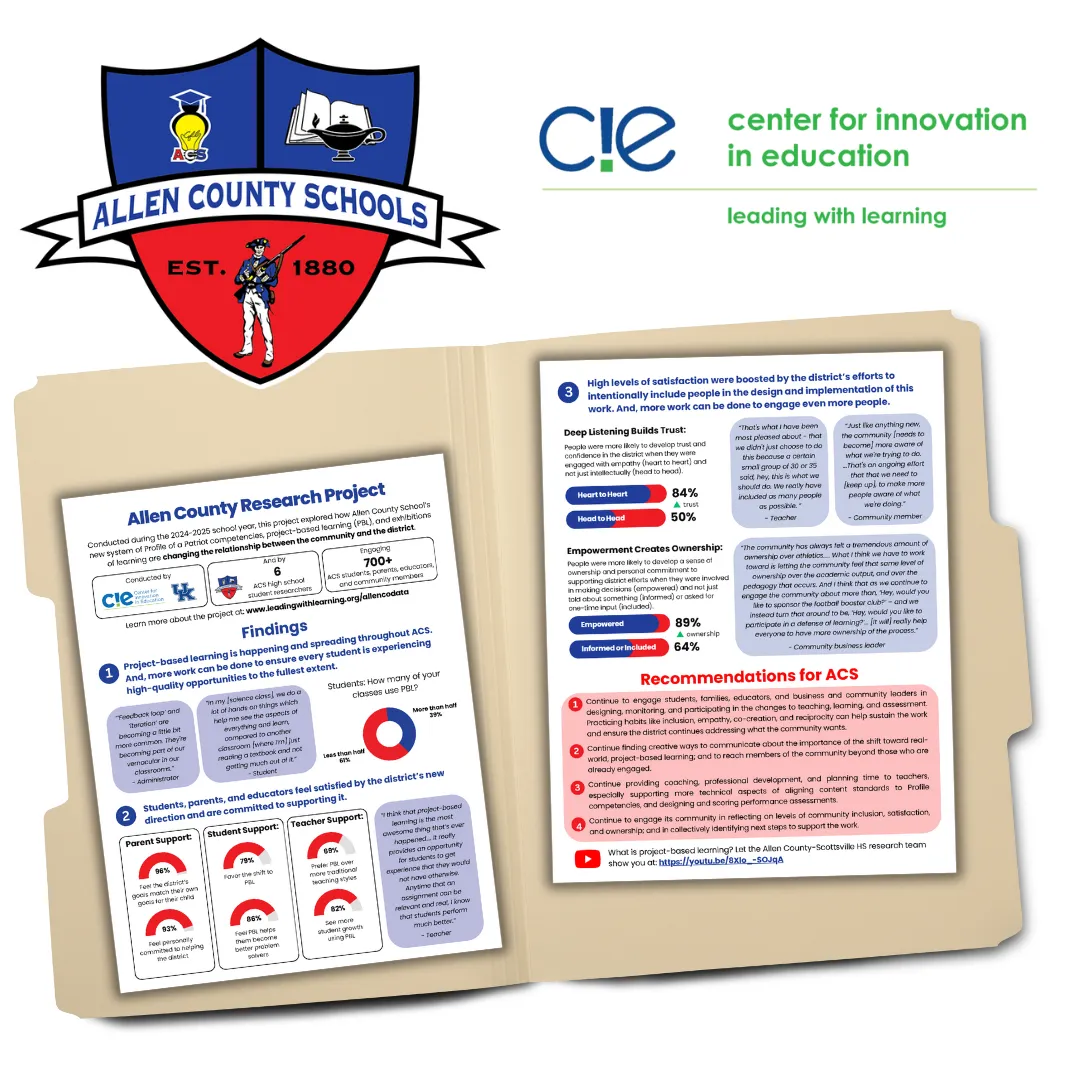
A newly published case study from the Center for Innovation in Education (C!E), featuring Envision Learning Partners in Appendix C, highlights Allen County, Kentucky’s multi-year effort to redesign assessment and accountability through Inclusive Design. The report, Better Together, shows how the district co-created their graduation competencies called “Profile of A Patriot” and embedded project-based learning and performance assessments to place students’ passions and real-world skills at the center of learning.
Envision Learning Partners has been proud to support Allen County in this work, and we’re excited to share C!E’s new case study. We’ve partnered closely with C!E through the Assessment for Learning Project, working together to advance learner-centered assessment practices nationally.
By Michael Viera, Envision Education’s College and Career Pathways Manager
Several years ago the city of Oakland came together to support college and career programming for high schoolers, by advancing and deepening career pathways in alignment with the Linked Learning Alliance standards and methodology. The Linked Learning Alliance hosts an annual conference where educators share best practices and takeaways from school sites around the state. Oakland schools always show out in big numbers at the conference, but this year it took place in downtown Oakland, so the presence was even greater.
I had been to the conference previously, but this time was different. Being my 3rd year at Envision in this role, I felt like I finally understood what it was all about. I had colleagues from Envision Learning Partners in attendance and collaborating with me. I got to connect with colleagues from other Oakland schools. I knew what to look for and who to listen to in order to improve our programming at Envision Academy and across the Envision network.
The conference was motivating, to say the least. It is a breath of fresh air being in rooms of educators who are excited and realistic about their work in schools, and who understand the skills students need to have success in their futures.
I came back from the conference and immediately organized Envision Academy’s first job fair since COVID. We had twelve community partners visit our campus to share information with students on internship opportunities, after school and summer programs, and community resources. Students seemed excited about these experiences that they can be a part of outside of their regular curriculum.
At the end of the event, two students stayed back and pulled me aside. I thought something bad had happened. Instead, one of them simply said, “Mr. Viera, we just wanted to thank you for putting together this event. It’s really inspiring to see all these opportunities we didn’t know about until now.”
After a couple of weeks of back and forth emails and phone calls with partners, planning meetings with administration, and quite literally running around setting up tables and chairs on the day of the event, those students made it all worth it. When students are able to take their learning outside of school walls and make connections with their community, they feel seen and they thrive.
Hear from Michael and ELP Assessment Design Partner, Josette Neal-De-Stanton on their takeaways from the Linked Learning Conference.
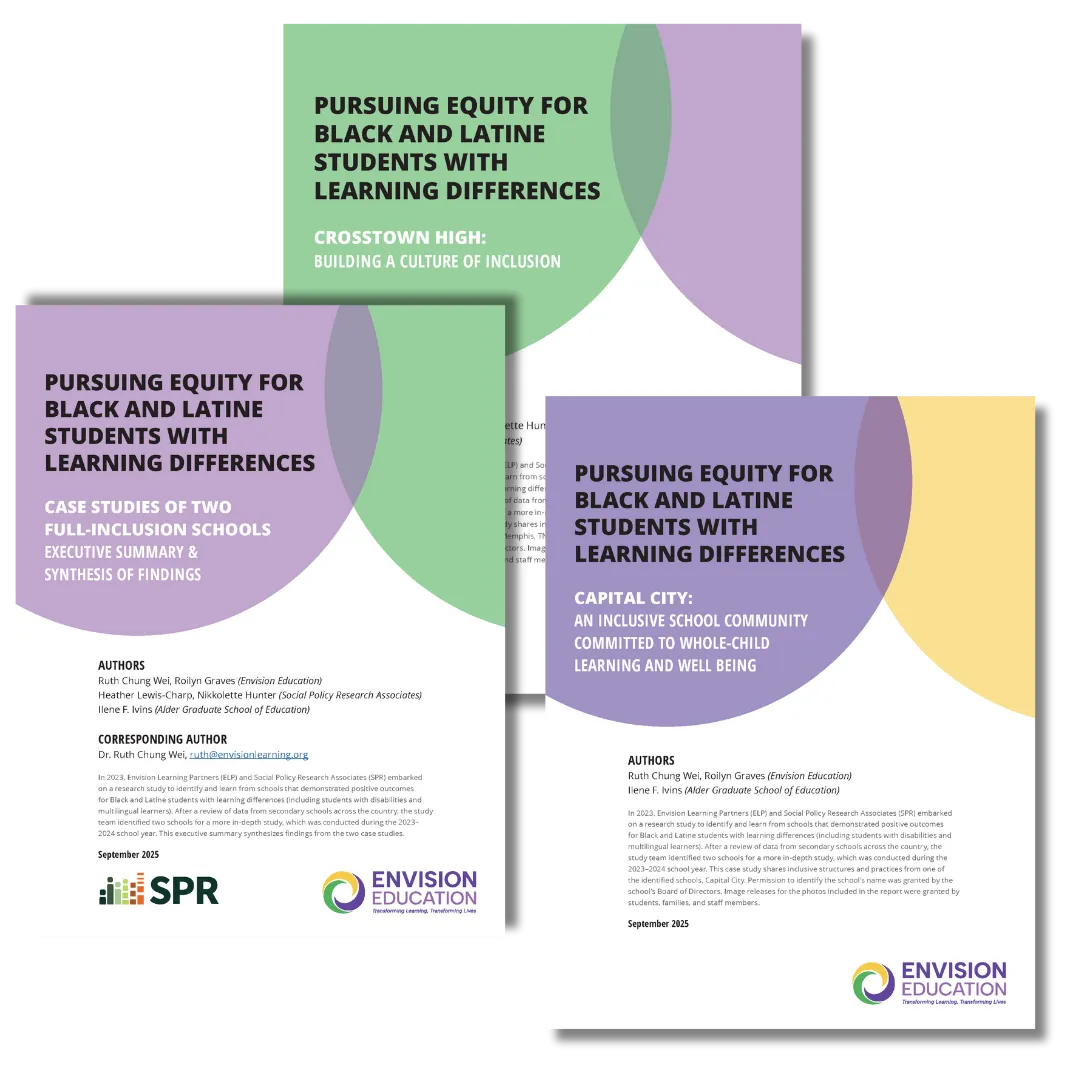
Envision Education is excited to share the culmination of its two-year research project, Pursuing Equity for Black & Latine Students with Learning Differences, which
documents and illustrates the systems, practices, cultures, and supports that are associated with the well being and success of Black and Latine students with learning differences – students with disabilities and multilingual students with disabilities.
In 2023, Envision Learning Partners (ELP) and Social Policy Research Associates (SPR) embarked on a research study to identify and learn from schools that demonstrated positive outcomes for Black and Latine students with learning differences (including students with disabilities and multilingual learners). After a review of data from secondary schools across the country, the study team identified two schools for a more in-depth study, which was conducted during the 2023–2024 school year.
The results of the research are shared through case studies of the two schools that were the focus of the research: 1) Crosstown High: Building a Culture of Inclusion; 2) Capital City: An Inclusive School Community Committed to Whole-Child Learning and Well Being; and 3) An Executive Summary/Synthesis of Findings.
In addition, we have authored four practice briefs based on the findings of the research that provide practical steps that schools can take to create more inclusive environments that support the success of Black and Latine students with learning differences.
Co-teaching: A Means to Creating Inclusive and Equitable General Education Classrooms
UDL: Universal Design for Learning in a Culturally Responsive Context
Culturally Responsive Practices: An Inclusive, Culturally Responsive School Culture That Fosters Relationships
Competency-Based Learning and Assessment: Assessment and Grading Practices That Support an Inclusive Learning Culture
This research was made possible through the generous support of New Profit, a venture philanthropic organization, and the Oak Foundation.
Explore our diverse events. Enhance your expertise, connect with thought leaders, and broaden your horizons.
A newly published case study from the Center for Innovation in Education (C!E), featuring Envision Learning Partners in Appendix C, highlights Allen County, Kentucky’s multi-year effort to redesign assessment and accountability through Inclusive Design. The report, Better Together, shows how the district co-created their graduation competencies called “Profile of A Patriot” and embedded project-based learning and performance assessments to place students’ passions and real-world skills at the center of learning.
Envision Learning Partners has been proud to support Allen County in this work, and we’re excited to share C!E’s new case study. We’ve partnered closely with C!E through the Assessment for Learning Project, working together to advance learner-centered assessment practices nationally.
By Michael Viera, Envision Education’s College and Career Pathways Manager
Several years ago the city of Oakland came together to support college and career programming for high schoolers, by advancing and deepening career pathways in alignment with the Linked Learning Alliance standards and methodology. The Linked Learning Alliance hosts an annual conference where educators share best practices and takeaways from school sites around the state. Oakland schools always show out in big numbers at the conference, but this year it took place in downtown Oakland, so the presence was even greater.
I had been to the conference previously, but this time was different. Being my 3rd year at Envision in this role, I felt like I finally understood what it was all about. I had colleagues from Envision Learning Partners in attendance and collaborating with me. I got to connect with colleagues from other Oakland schools. I knew what to look for and who to listen to in order to improve our programming at Envision Academy and across the Envision network.
The conference was motivating, to say the least. It is a breath of fresh air being in rooms of educators who are excited and realistic about their work in schools, and who understand the skills students need to have success in their futures.
I came back from the conference and immediately organized Envision Academy’s first job fair since COVID. We had twelve community partners visit our campus to share information with students on internship opportunities, after school and summer programs, and community resources. Students seemed excited about these experiences that they can be a part of outside of their regular curriculum.
At the end of the event, two students stayed back and pulled me aside. I thought something bad had happened. Instead, one of them simply said, “Mr. Viera, we just wanted to thank you for putting together this event. It’s really inspiring to see all these opportunities we didn’t know about until now.”
After a couple of weeks of back and forth emails and phone calls with partners, planning meetings with administration, and quite literally running around setting up tables and chairs on the day of the event, those students made it all worth it. When students are able to take their learning outside of school walls and make connections with their community, they feel seen and they thrive.
Hear from Michael and ELP Assessment Design Partner, Josette Neal-De-Stanton on their takeaways from the Linked Learning Conference.
Envision Education is excited to share the culmination of its two-year research project, Pursuing Equity for Black & Latine Students with Learning Differences, which
documents and illustrates the systems, practices, cultures, and supports that are associated with the well being and success of Black and Latine students with learning differences – students with disabilities and multilingual students with disabilities.
In 2023, Envision Learning Partners (ELP) and Social Policy Research Associates (SPR) embarked on a research study to identify and learn from schools that demonstrated positive outcomes for Black and Latine students with learning differences (including students with disabilities and multilingual learners). After a review of data from secondary schools across the country, the study team identified two schools for a more in-depth study, which was conducted during the 2023–2024 school year.
The results of the research are shared through case studies of the two schools that were the focus of the research: 1) Crosstown High: Building a Culture of Inclusion; 2) Capital City: An Inclusive School Community Committed to Whole-Child Learning and Well Being; and 3) An Executive Summary/Synthesis of Findings.
In addition, we have authored four practice briefs based on the findings of the research that provide practical steps that schools can take to create more inclusive environments that support the success of Black and Latine students with learning differences.
Co-teaching: A Means to Creating Inclusive and Equitable General Education Classrooms
UDL: Universal Design for Learning in a Culturally Responsive Context
Culturally Responsive Practices: An Inclusive, Culturally Responsive School Culture That Fosters Relationships
Competency-Based Learning and Assessment: Assessment and Grading Practices That Support an Inclusive Learning Culture
This research was made possible through the generous support of New Profit, a venture philanthropic organization, and the Oak Foundation.

.svg)
.svg)


.svg)
.svg)





.svg)
.svg)

.svg)

.svg)

