Blogs

Checkout our most recent Resource Corner!

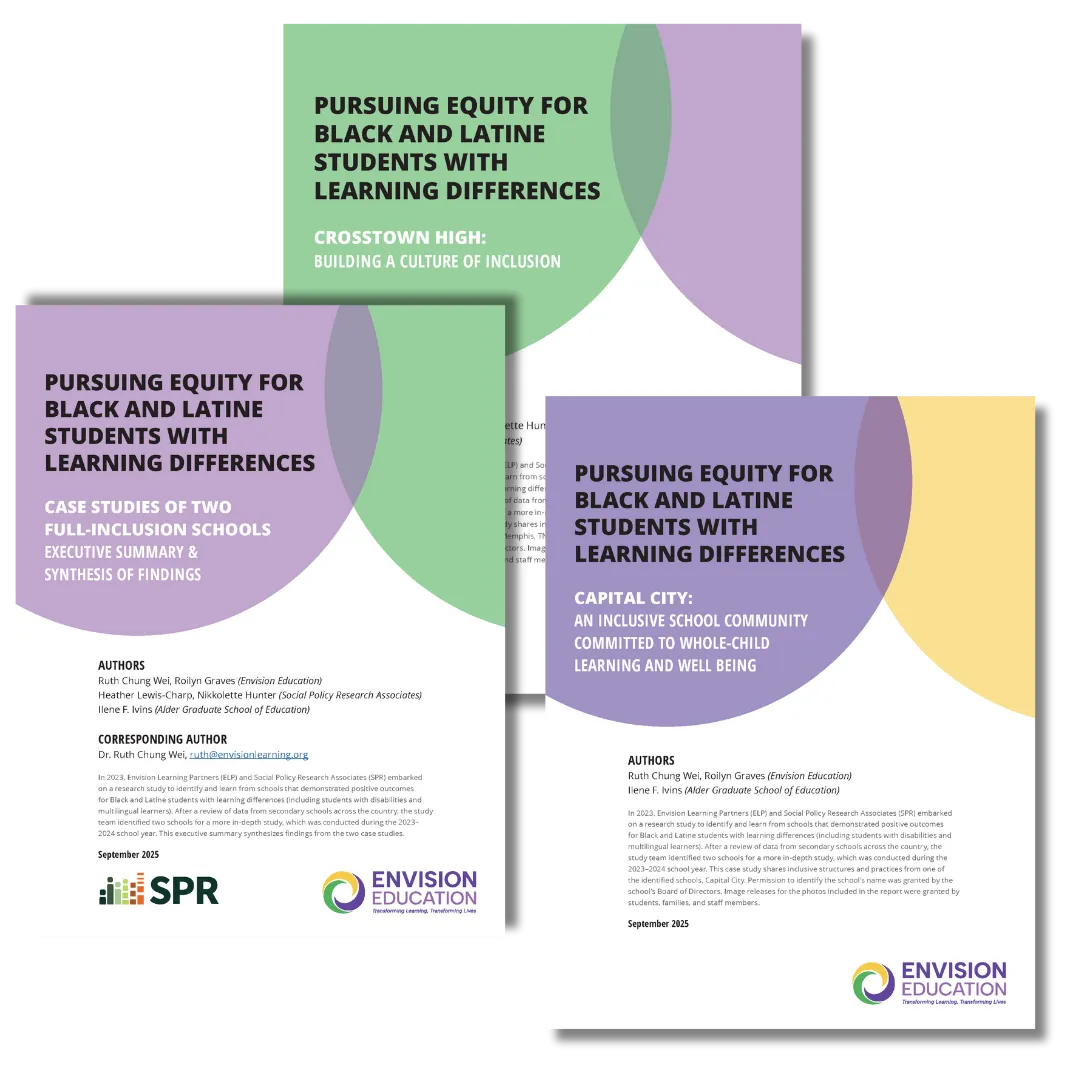
We're excited to share the culmination of a two-year research project, Pursuing Equity for Black & Latine Students with Learning Differences, which documents and illustrates the systems, practices, cultures, and supports that are associated with the well being and success of Black and Latine students with learning differences – students with disabilities and multilingual students with disabilities.

Thank you! Your submission has been received!
Oops! Something went wrong while submitting the form.
Thank you! Your submission has been received!
Oops! Something went wrong while submitting the form.

Envision Education has long been proud that we not only serve students directly through our Bay Area schools but also commit to serving public school students everywhere through our consulting division, Envision Learning Partners. Our understanding of our past and potential future is even clearer now, thanks to A Pragmatic Playbook for Impact: Direct, Widespread, and Systemic, which offers an illuminating framework for analyzing how mission-driven ed organizations work to spread the change they seek.

To help illustrate the framework, Bellwether Education Partners, in partnership with New Profit, conducted a case study on Envision Education, based on a series of interviews with longtime Envision teacher and now ELP leader, Justin Wells. For us at Envision, the case study was a chance not only to reflect but also to learn. We came out of the experience with a better sense of who we are and where we are headed as an organization, and we are grateful to Bellwether and New Profit for the opportunity.

On August 11th, Bellwether is hosting a webinar where you can hear ELP and other educational organizations discuss their various approaches to scaling impact.

ELP was honored to partner with so many other incredible organizations to develop this resource.

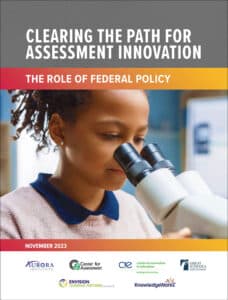
Beyond the Horizon: Blazing a Trail Toward Learner-Centered School Quality Systems includes recommendations for education leaders at every level of the system, mapping the course for the future of assessment and accountability.

Created in collaboration with leaders in K-12 student-centered learning from across the country, these recommendations support a learner-centered accountability system that would:

  • Create to conditions that honor local context while ensure the quality of every learner’s educational experience
  • Utilize holistic indicators that include school inputs and a range of student outcomes
  • Place emphasis on mastery of academic knowledge and assessment of essential skills
  • Focus on growth, not grades
  • Use data to calibrate for progress and pace

Realizing the full potential of student-centered learning requires transformation of traditional approaches to assessment and accountability. To truly move to student-centered learning at scale, education systems must be redesigned.

Envision Learning Partners is honored to have co-authored a new paper alongside the Aurora Institute, the Center for Assessment, the Center for Innovation in Education, the Great Schools Partnership, and KnowledgeWorks.

__wf_reserved_inherit

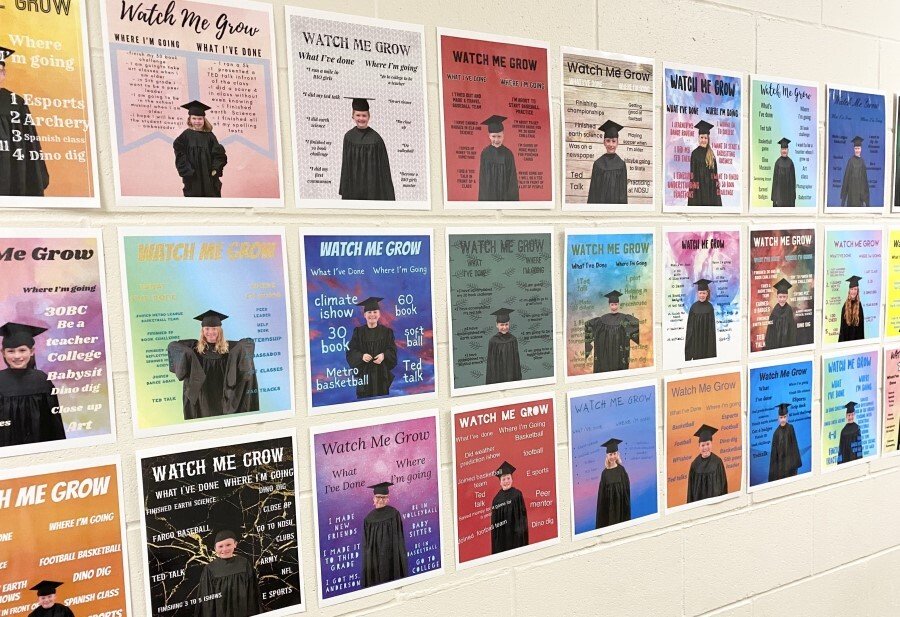
We recently read an article by NGLC’s dynamite Knowledge Officer, Kristen Vogt. The piece shares an observation that many of us have seen in the field: graduate profiles are often discussed as something meant for high school students, with little clear connection to elementary and middle schools. Kristen shares examples of schools across the country aligning instruction across K-12 to graduate profiles, including elementary and middle schools (you will be particularly impressed by Megan Margerum in North Dakota). We love the recognition that portraits of a graduate are, among other things, a journey map, and these journeys are most successful when they are seen not just as standalone endings, but part of a student’s experience in elementary and middle school as well.

Interested in launching or revising your Graduate Profile? We can help.

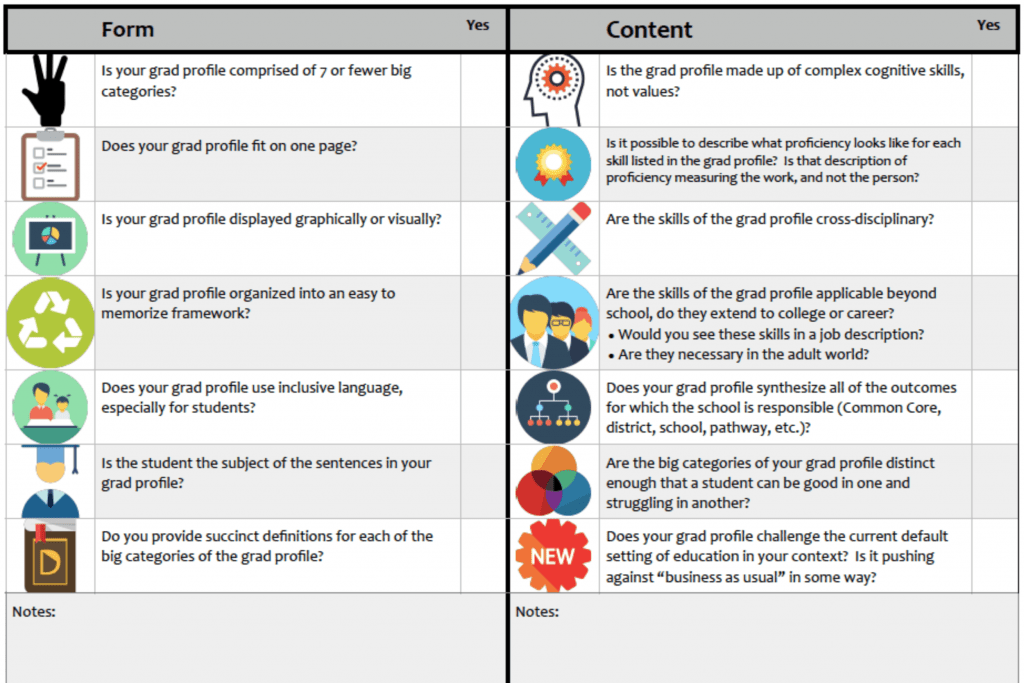
Is your Grad Profile made up of complex cognitive skills, not values? That’s one of the 10+ questions we ask with our Graduate Profile Quality Criteria Check Tool. We have been delighted to see the surge in Graduate Profiles developed by school systems across the USA over the past year but have noticed the need for an important next step: check whether your new grad profile meets these important quality criteria that we’ve developed over the past decade working with hundreds of schools.

Click the resource button to download the PDF.

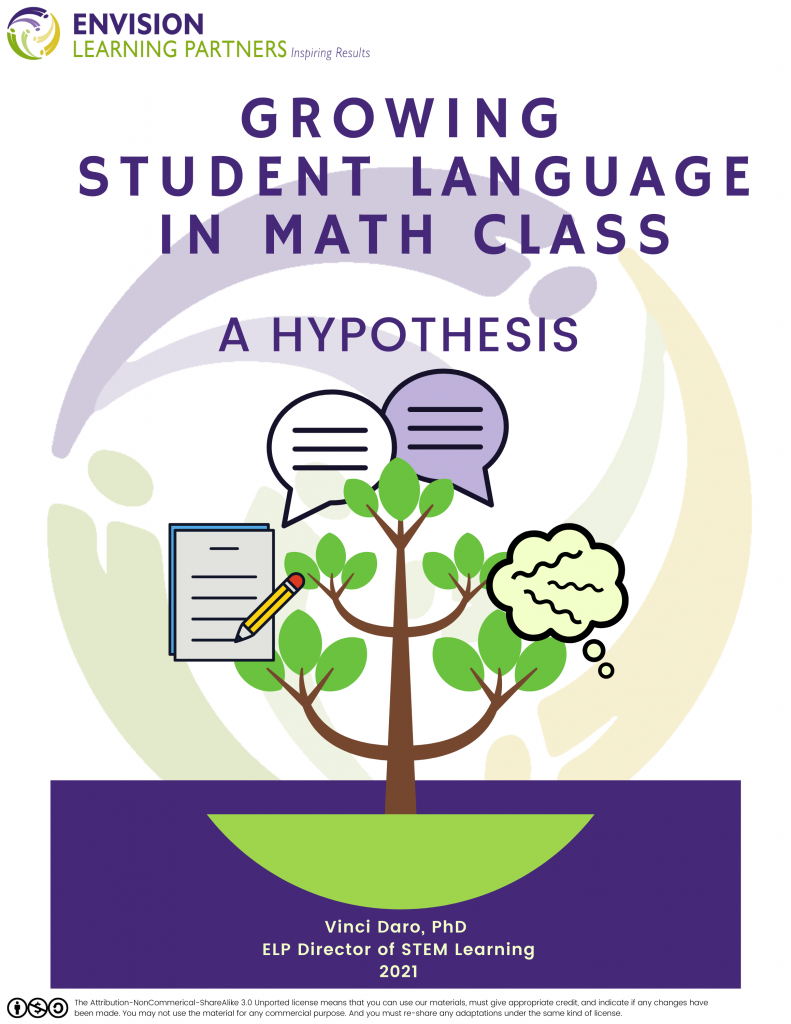
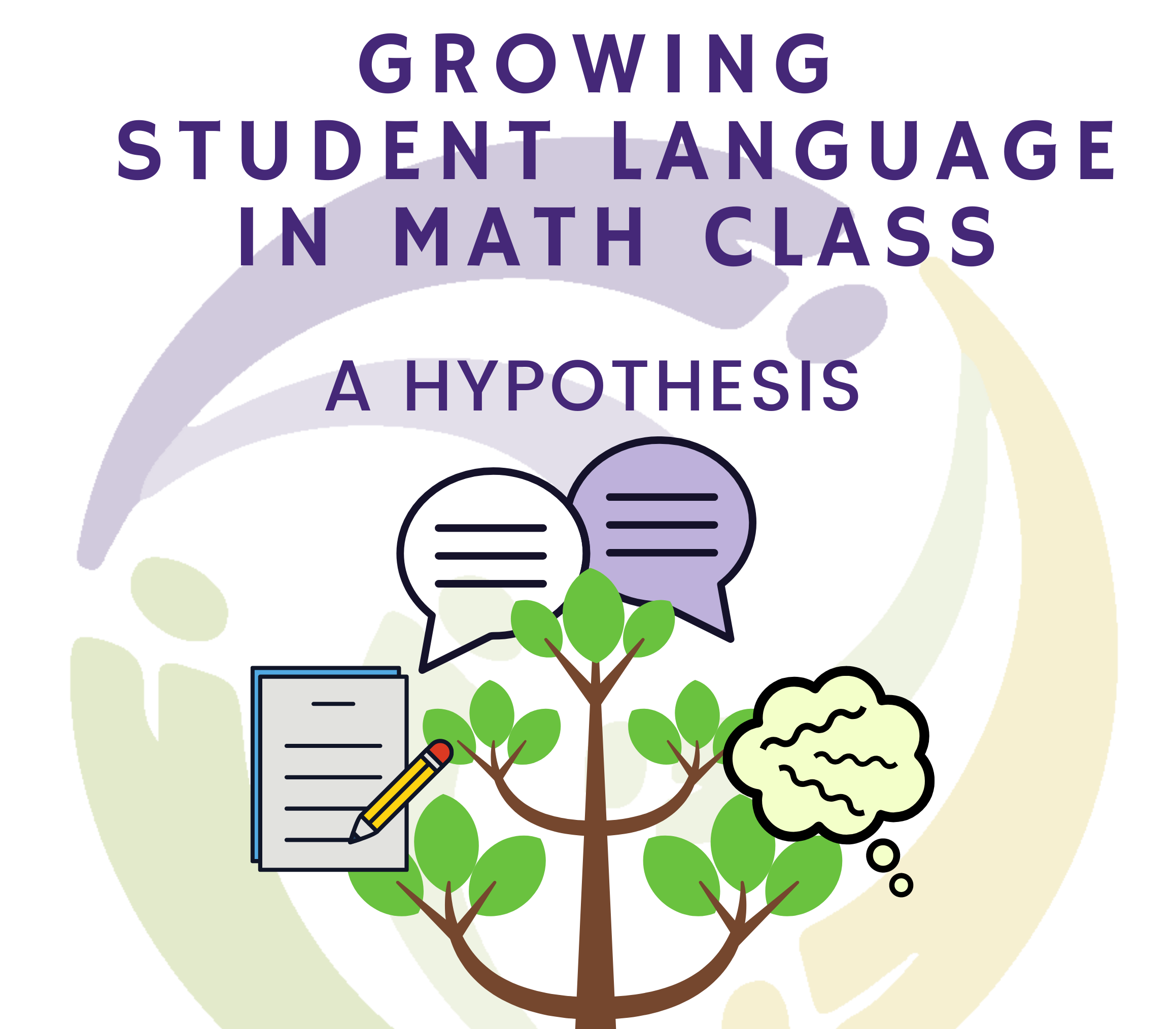
This resource was developed for math teachers looking for a pathway into developing Student language (disciplinary language, English language, and academic language).It serves as an invitation to be intentionally experimental with three processes that students experience often in school, but not as often in math class: students revising their work and their thinking; students interpreting the writing of other students; and students interacting with each other.

Click the resource button to download and explore this resource tool!

This resource is one that ELP has adapted from the School Reform Initiative Colorado Center of Activity and has been previously used in a Deeper Learning Leadership Forum (DLLF) session.

Holding a Kiva Panel allows a larger group of listeners to highlight and learn from the voices of the selected panelists and can be adjusted for the virtual world.

Click here to download this tool.

Click the resource button to download the PDF.

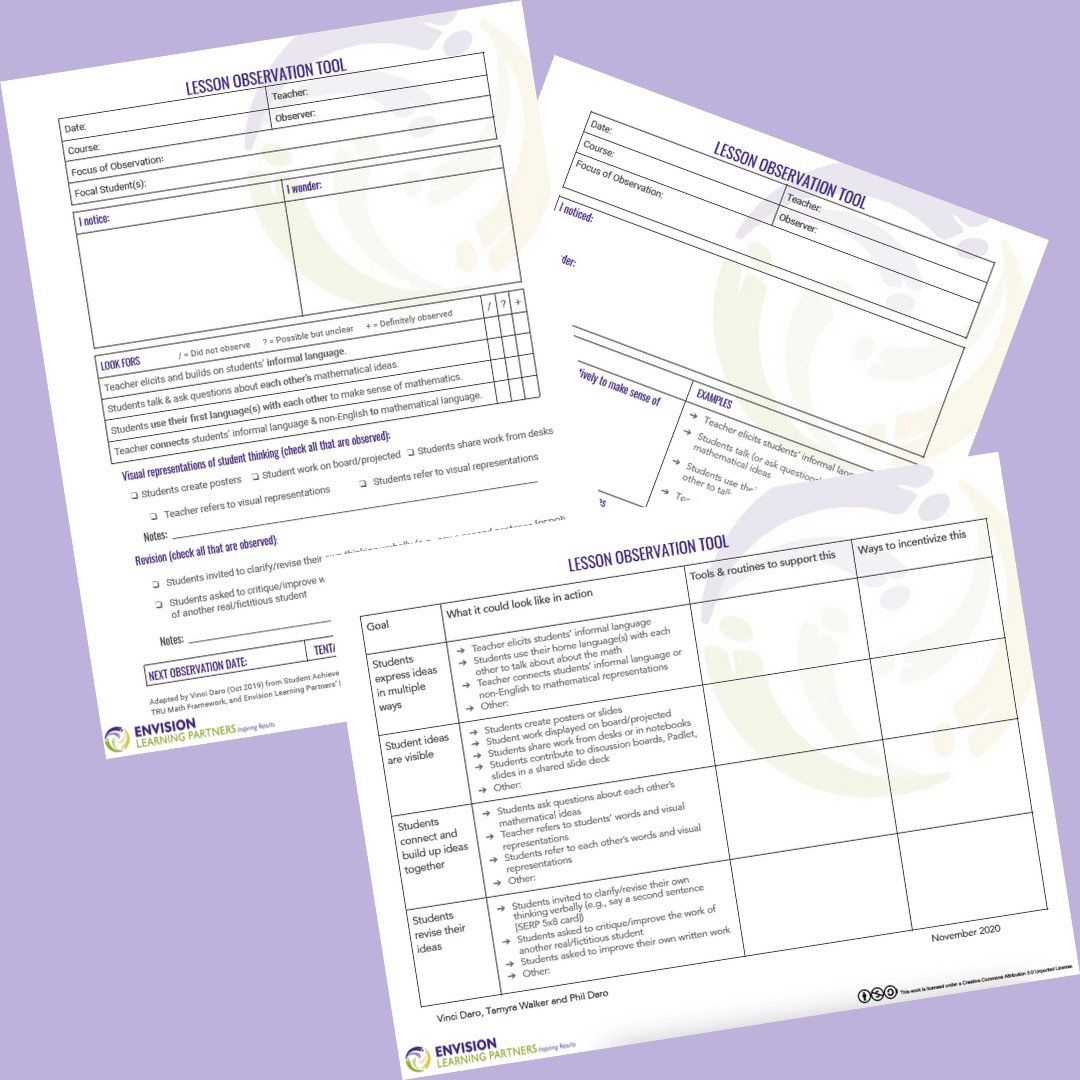
These three observation tools are intended to support ‘minimal-prep’ lesson observation in classrooms where student ideas, language, and interaction are at the center of the learning process. They were specifically designed for mathematics classrooms, but may also be useful in other contexts.

The two Lesson Observation Tools are meant as note catchers and as a manageable list of student and teacher actions to look for. In using these tools, it is important to agree with the teacher on the focus of the observation, for example: Use of instructional routines to surface and develop student ideas and language. 

The Language-Rich Classrooms: Observation & Planning Tool is meant for a coach and teacher, or teacher peers, to use together for linking an observation with a conversation about planning next steps. It, too, has a list of example student and teacher actions to look for.

Click the resource button to download the editable PDFs.

Looking for even more resources?  Visit the ELP blog for all past newsletter content.

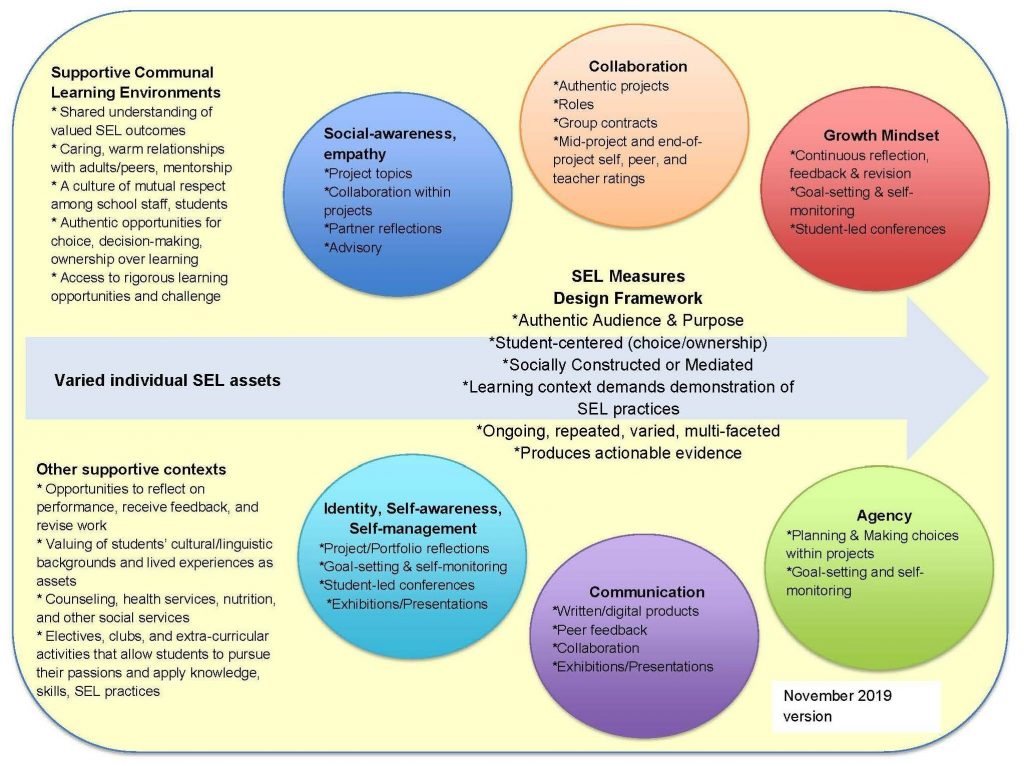
Can we develop valid, instructionally useful, educative, and equitable ways to measure social-emotional learning?

ELP’s Director of Research and Innovation, Ruth Chung Wei, had the opportunity to direct a research study with a team at the Stanford Center for Assessment, Learning, & Equity (SCALE) and ELP called “Measures of Social-Emotional Learning.” The Executive Summary of this three-year project provides an overview of the findings and can be downloaded by clicking on the image below.

Learn more about Ruth in her “I am ELP” highlight, by clicking here.

This resource comes from the 2022 Deeper Learning Conference and is a conversation about modernizing mathematics: perspectives from the classroom and beyond. This panel discussion explores the topic of mathematics teaching and learning in the current age and for the future. ELP Director of STEM Learning, Vinci Daro, is one of the four amazing panelists.

We know that we want students engaging deeply with rigorous content, but knowing what to look for in a classroom where students are struggling productively with rigorous mathematics content is a challenge among many of our partners.

Click the resource button to download!

Take a look at the Productive Struggle Observation Tool our STEM team has developed for observers to use to look for and capture relevant student and teacher actions in math classrooms. Clare Green, principal at Envision Education’s Hayward high school, Impact Academy says this about the tool: “The productive struggle rubric helps to drive a conversation about what high-quality, student-centered instruction looks like. This conversation now happens not only between coaches, teachers, and administrators but also with students.”

Let us know what you think – is the observation tool something that might be useful in your context? What do you look for in classrooms when you want to know if students are struggling productively with meaningful material?

ELP is excited to announce that we have published five new performance task resources in the Performance Assessment Resource Bank (PARB), an online resource that ELP has stewarded since 2018.

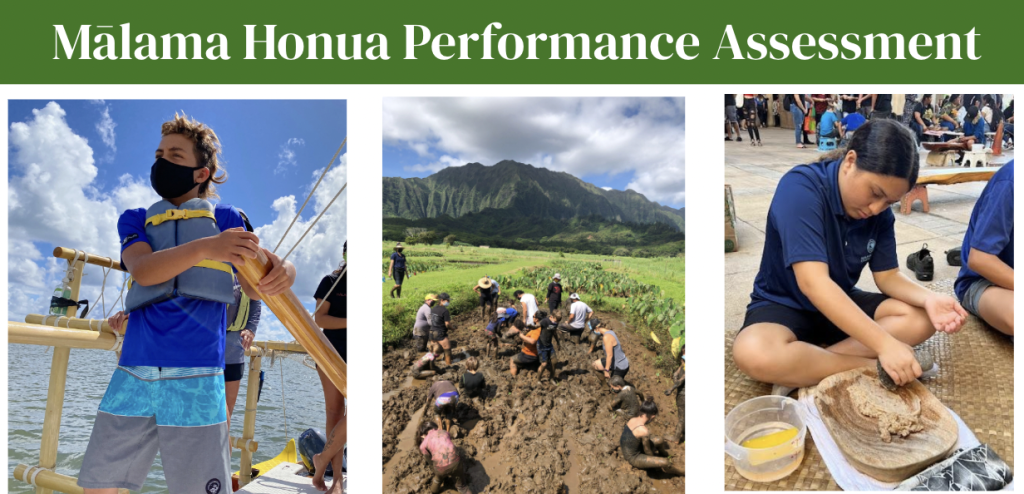
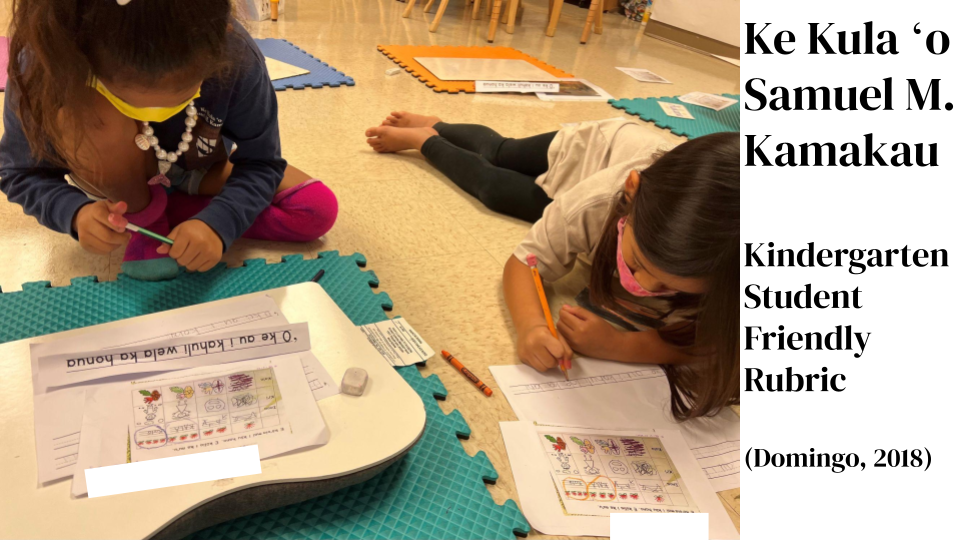
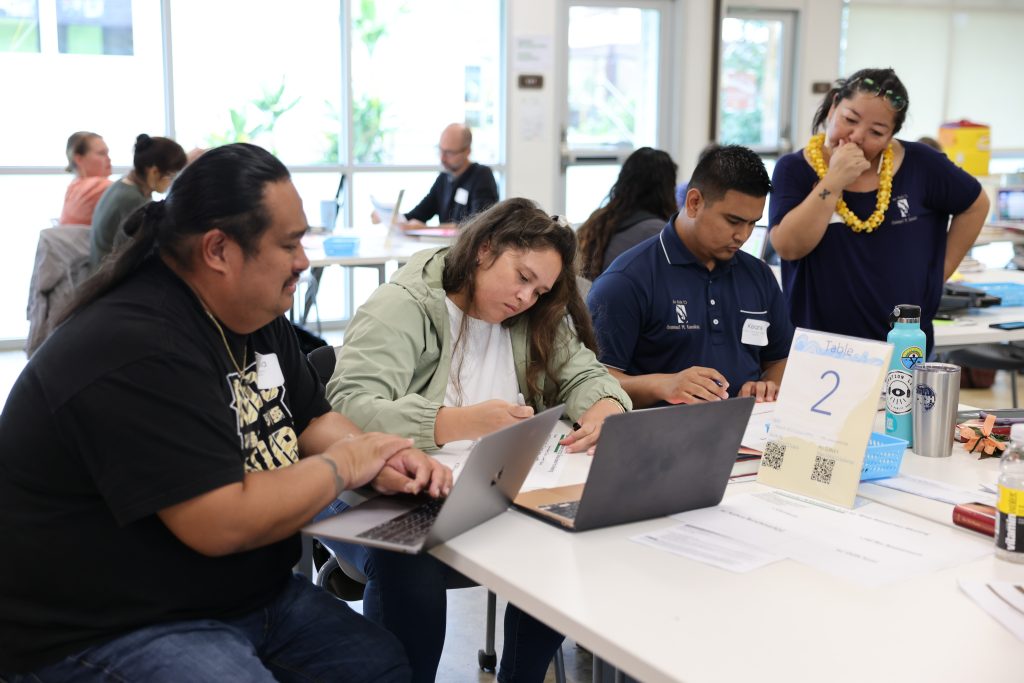
The five new resources are capstone portfolios, projects, and/or portfolio defenses from a consortium of schools in Hawai’i – the Hawaiian Focused Charter Schools (HCFS), which has been developing and implementing culturally sustaining curriculum, instruction, and assessment strategies to cultivate and preserve the language and culture of native Hawaiians. As part of its Culturally Relevant Assessment project, four HFCS schools and an additional charter school submitted capstone projects, ranging from Kindergarten through 12th grade capstones, for review and feedback from ELP during the 2022-23 academic year. Included among these five capstone projects is a Hawaiian-language kindergarten capstone project, the first non-English project to be included in the PARB. The revised projects were then submitted for a formal review process by performance assessment experts for inclusion in the Performance Assessment Resource Bank (PARB), using a hybrid review instrument, “ELP High Quality Performance Assessment Criteria + PARB/ILN Quality Criteria for Performance Assessments,” that combines ELP’s HQPA criteria and the PARB/ILN Quality Criteria developed by SCALE to vet submissions for the PARB.The instrument was adapted to include ʻāina (land)-based learning outcomes. All five of the submitted projects from the HFCS schools met project certification criteria after one or two cycles of review and feedback. ELP benefited from the experience of reviewing these submissions to deepen our understanding of culturally sustaining performance assessment and broadening our practice to be more inclusive of the diverse learners that our nation’s schools serve. This project was completed with the funding and support of the Kamehameha Schools, a private educational institution in Hawaiʻi that aims to improve the capability and well-being of Native Hawaiians through education.

To learn more, check out a recent ELP Partner Profile: Hawaiian-focused Charter Schools & Kamehameha Schools!

We encourage you to peruse these resources and reach out to learn more!

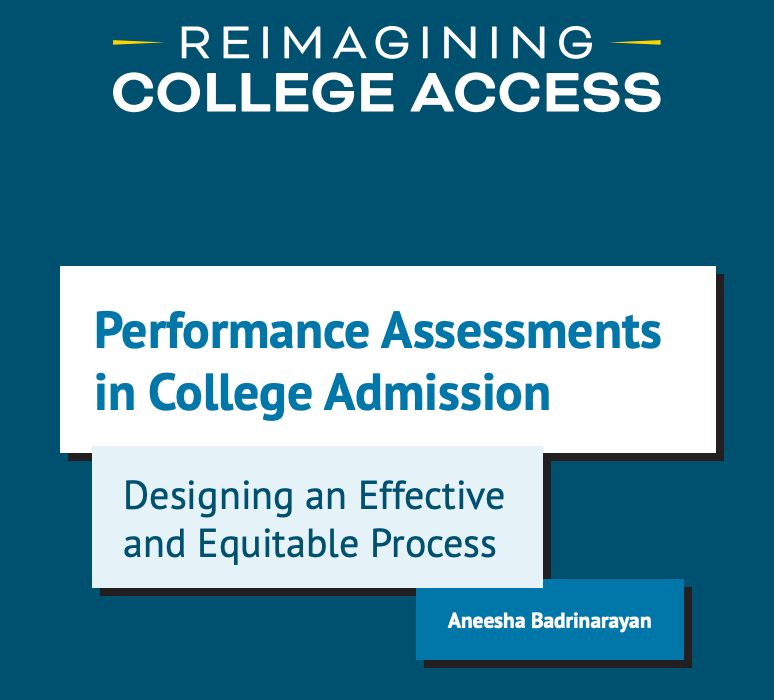
The Reimagining College Access initiative recently released a guidance document, authored by Aneesha Badrinarayan, aimed at colleges interested in integrating performance assessments into their college admission systems: Performance Assessment in College Admission: Designing an Effective and Equitable Process.

Although the tool is designed for admission officers, it can also be used by K–12 educators to gain a better understanding of the considerations that colleges must take into account in the use of performance assessments in admissions. The tool defines performance assessment and then provides concrete guidance on how admission officers can incorporate information about students’ K–12 performance assessments into their application and review processes.

Read more in our Partner Profile: Designing a Common “Record of College Readiness Evidence” for Integrating Performance Assessment Evidence into College Applications: A Partnership of Reimagining College Access and Envision Learning Partners.

Click the image below to download this tool.

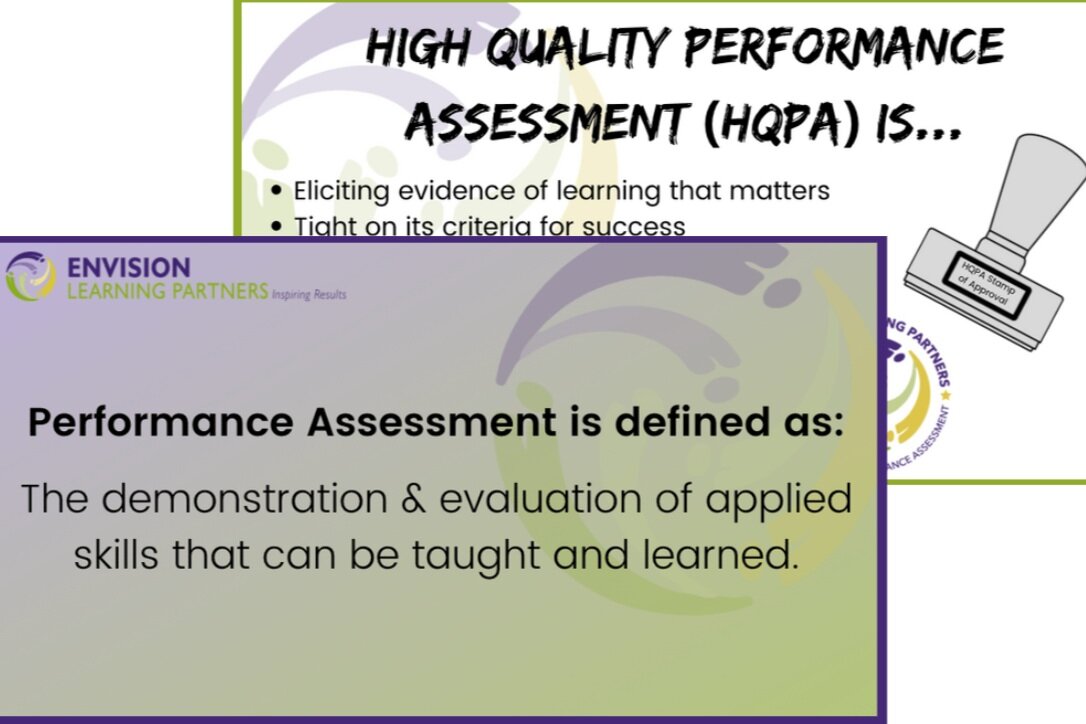
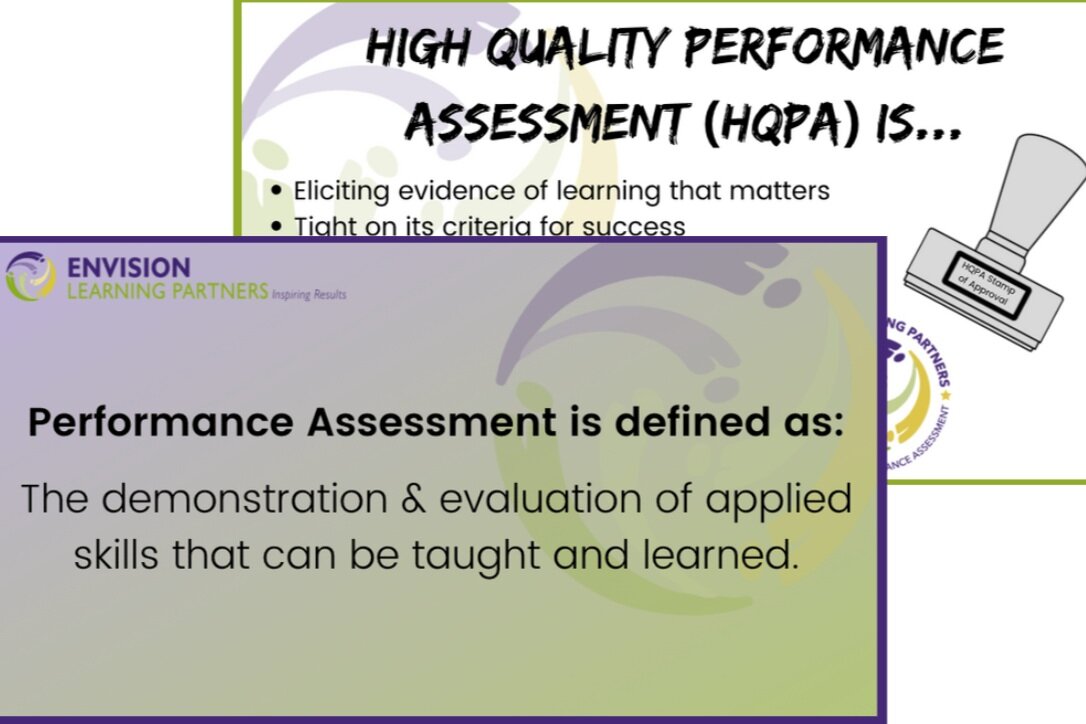
When we meet with a potential school partner, we are often asked: What does the process of evolving into a school with a High-Quality Performance Assessment System (HQPAS) look like? We have worked with thousands of educators serving hundreds of thousands of learners since our inception in 2010 and have developed a Theory of Action that consistently drives the transformation to a HQPAS:

Click the resource button to download!

  1. Start by developing a graduate profile with your stakeholders,
  2. design performance assessments that measure that graduate profile, and finally,
  3. implement pedagogies and school structures that lead to student success on the performance assessments.

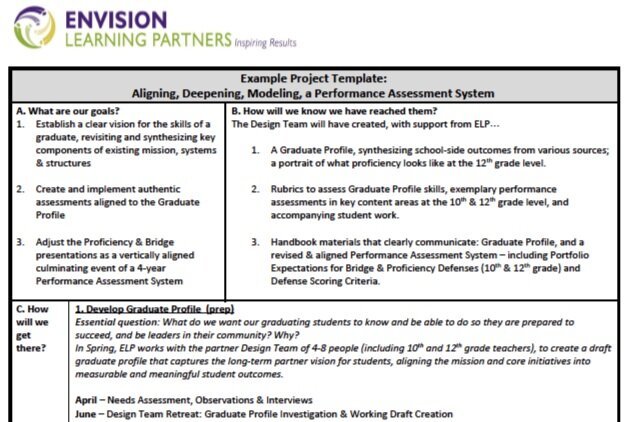
These three phases, done in that order, lead to a successful implementation of a High-Quality Performance Assessment System. A second common question we hear is focused on implementation steps and timeline. As you can imagine, each partner takes a unique path on its implementation journey, but over the years, we have seen some common elements. This month, we share a simplified project template to give you a better idea of potential steps involved. Enjoy reading and don’t hesitate to reach out with any questions.

Envision Education is excited to share the culmination of its two-year research project, Pursuing Equity for Black & Latine Students with Learning Differences, which

documents and illustrates the systems, practices, cultures, and supports that are associated with the well being and success of Black and Latine students with learning differences – students with disabilities and multilingual students with disabilities.

In 2023, Envision Learning Partners (ELP) and Social Policy Research Associates (SPR) embarked on a research study to identify and learn from schools that demonstrated positive outcomes for Black and Latine students with learning differences (including students with disabilities and multilingual learners). After a review of data from secondary schools across the country, the study team identified two schools for a more in-depth study, which was conducted during the 2023–2024 school year.

The results of the research are shared through case studies of the two schools that were the focus of the research: 1) Crosstown High: Building a Culture of Inclusion; 2) Capital City: An Inclusive School Community Committed to Whole-Child Learning and Well Being; and 3) An Executive Summary/Synthesis of Findings.

In addition, we have authored four practice briefs based on the findings of the research that provide practical steps that schools can take to create more inclusive environments that support the success of Black and Latine students with learning differences.

  1. Co-teaching: A Means to Creating Inclusive and Equitable General Education Classrooms
  2. UDL: Universal Design for Learning in a Culturally Responsive Context
  3. Culturally Responsive Practices: An Inclusive, Culturally Responsive School Culture That Fosters Relationships
  4. Competency-Based Learning and Assessment: Assessment and Grading Practices That Support an Inclusive Learning Culture

This research was made possible through the generous support of New Profit, a venture philanthropic organization, and the Oak Foundation.

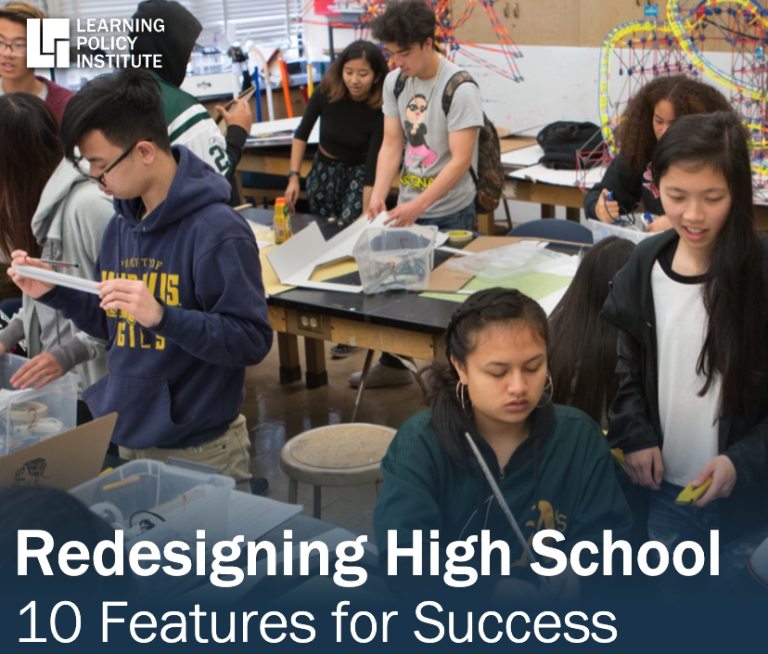
Earlier this year, Learning Policy Institute (LPI) released this resource that outlines 10 features from effectively redesigned high schools and highlights examples of schools that are putting the features into practice to create powerful learning opportunities for youth.

ELP was honored to be listed under the Additional Resources. If you are interested in a redesign or have any questions, contact the ELP team to schedule your free consultation.

Click here to download this resource.

9 Tips for Writing Effective Rubrics – Adapted from the important thinking of our partners at SCALE, this tool attempts to capture the quality criteria of solid rubric design. The tool is helping our partner schools all over the country to develop performance indicators that serve to define proficiency for their Graduate Profile skills. Take a look and share with us any quality criteria you’ve found effective!

Click to view the document!

Resource Corner: Scaling Student Success Briefs & Policy White Paper

For educators and educational leaders seeking to bring your Graduate Profile to life, Scaling Student Success has released a series of Practice and Policy Briefs to support this journey! The Briefs tell the story of five different districts across California that are successfully integrating their Graduate Profiles (or Learner Portraits) into their curriculum, culture, and classrooms, and seeing a positive impact on student success. They’re a valuable learning resource for any school interested in redefining student success! Learn more and access the briefs here.

Scaling Student Success also recently authored a white paper focused on statewide policy recommendations that support many of the transformation systems we want to see in schools (graduate profiles, authentic assessments, etc.). ELP has offered to be listed as one of the organizations to officially “sign on” to the paper. Click here to read: A Student-Centered Approach to Education.

Resource Corner: Student Innovation Edition

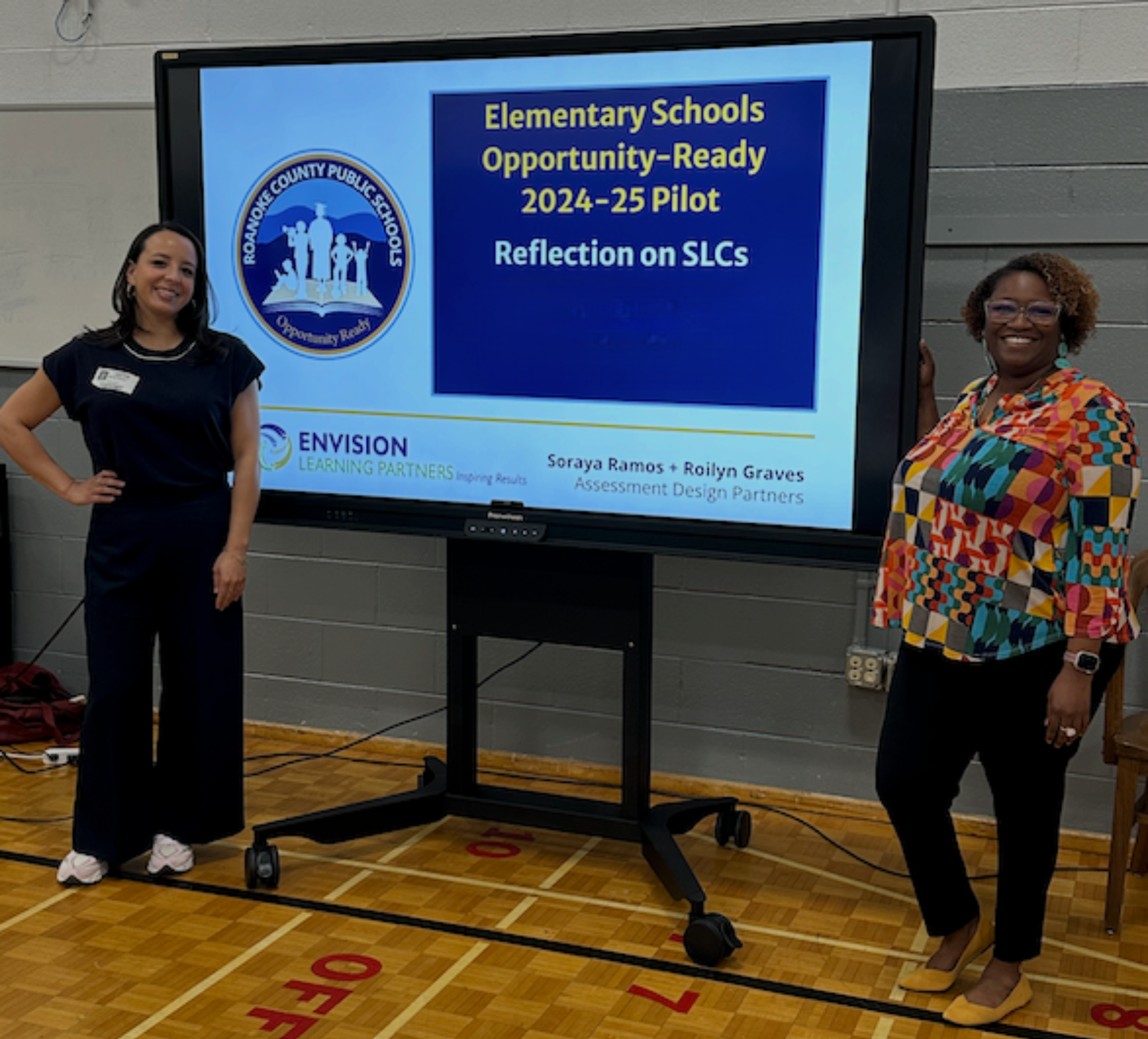
Earlier this spring, Assessment Design Partners Roilyn Graves and Soraya Ramos spent time in Roanoke County Public Schools in Virginia, collaborating with district and school leaders to refine and pilot a culminating performance assessment system aligned to the district’s Opportunity-Ready Skills.

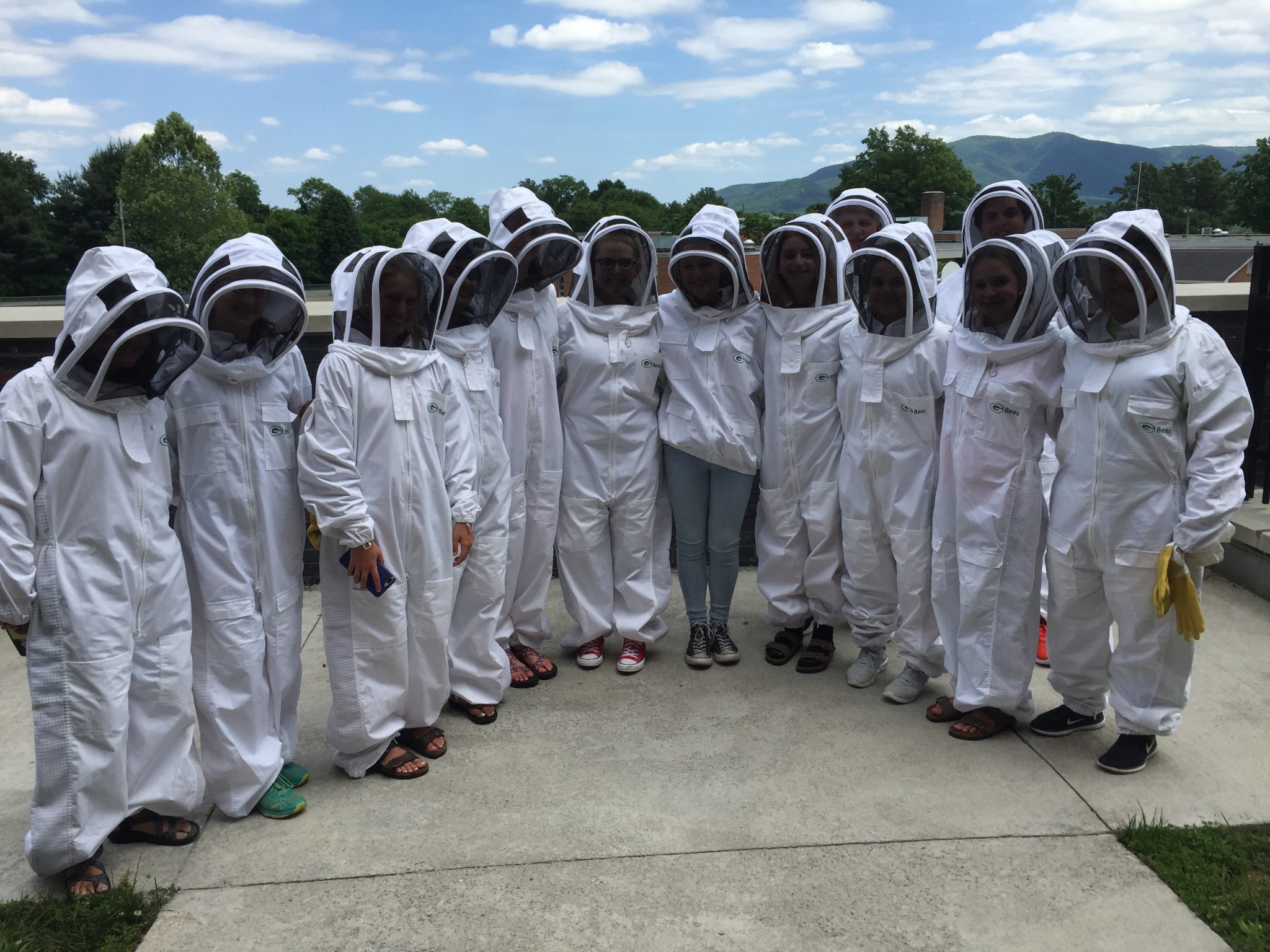
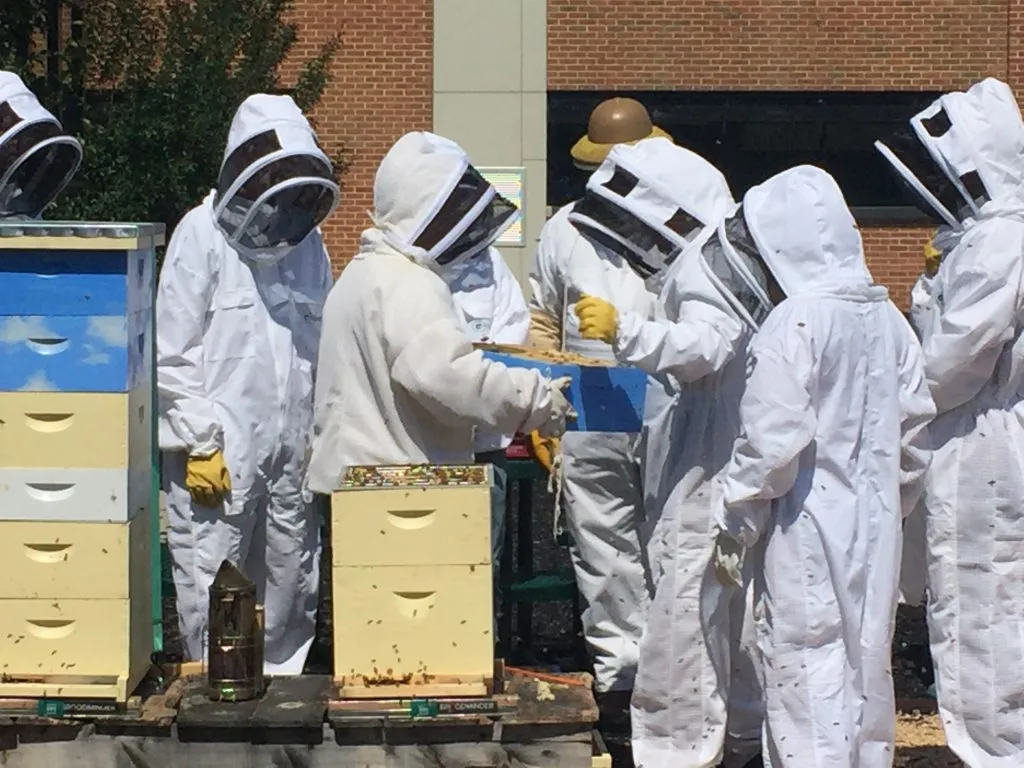
During their visit, they had the opportunity to tour Glenvar High School—and were inspired by an incredible student-led initiative: the G-Bees. This club involves students in every aspect of beekeeping, from hive maintenance to harvesting honey, and even crafting a range of products like lip balm, soap, candles, hot honey, and more.

Through this hands-on work, students are not only gaining valuable entrepreneurial experience, but also raising funds for outdoor education and scholarships. It’s a powerful example of student-centered, purpose-driven learning at its best.

The G-Bees program is truly performance assessment in action—students applying their knowledge and skills in meaningful, real-world ways. While online sales aren’t available, we’re excited to share their story as a model of what authentic, engaged learning can look like.

Learn more about the program through this link.

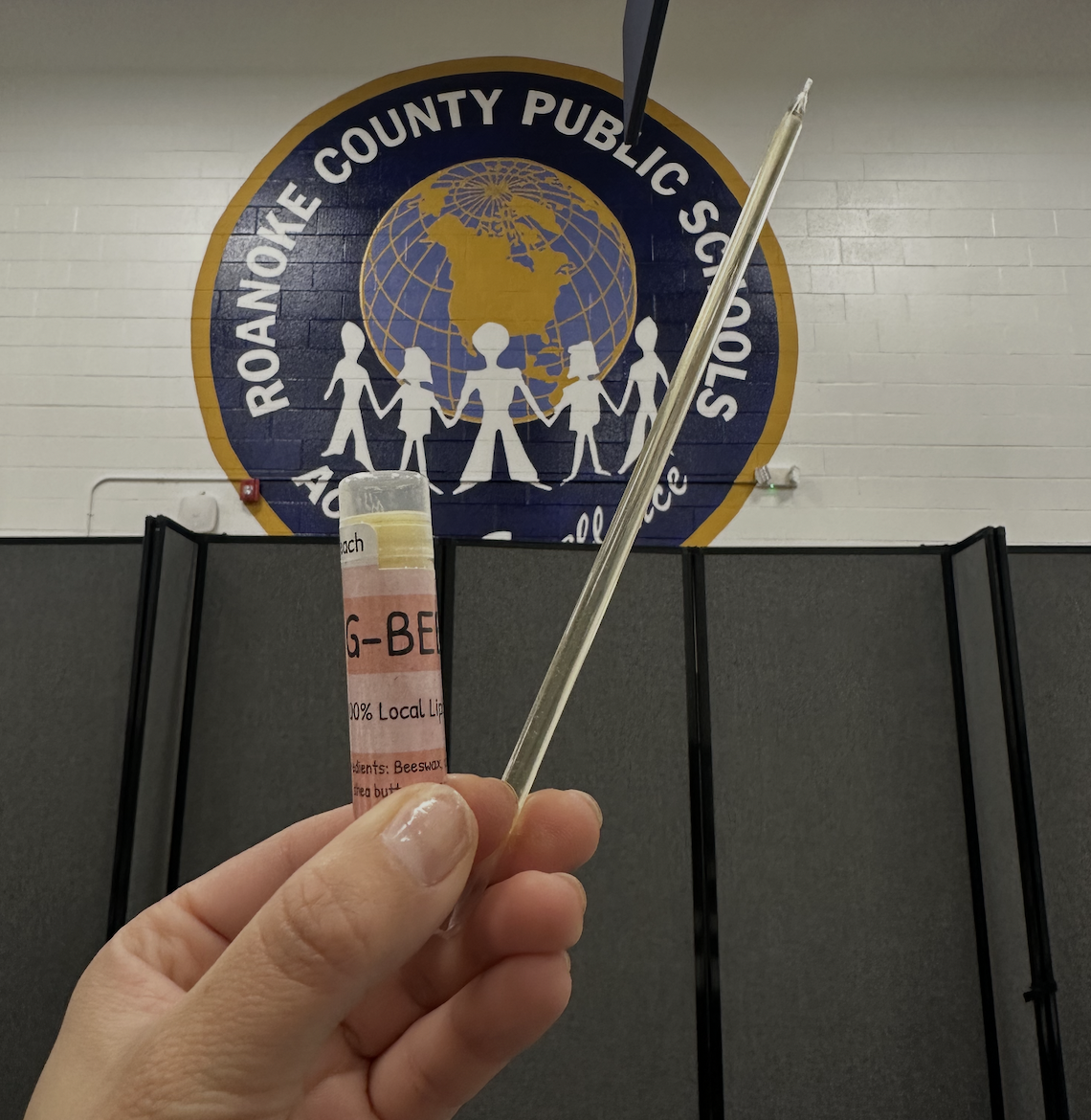
Gifted fresh lip balm and honey.
Assessment Design Partners, Soraya Ramos and Roilyn Graves.

This month, watch ELP STEM assessment specialist, Jim Malamut, share his ideas on Proximity of Evidence to student thinking.

Looking for more resources? Visit the ELP blog page for all past newsletter content.

Envision Education has long been proud that we not only serve students directly through our Bay Area schools but also commit to serving public school students everywhere through our consulting division, Envision Learning Partners. Our understanding of our past and potential future is even clearer now, thanks to A Pragmatic Playbook for Impact: Direct, Widespread, and Systemic, which offers an illuminating framework for analyzing how mission-driven ed organizations work to spread the change they seek.

To help illustrate the framework, Bellwether Education Partners, in partnership with New Profit, conducted a case study on Envision Education, based on a series of interviews with longtime Envision teacher and now ELP leader, Justin Wells. For us at Envision, the case study was a chance not only to reflect but also to learn. We came out of the experience with a better sense of who we are and where we are headed as an organization, and we are grateful to Bellwether and New Profit for the opportunity.

On August 11th, Bellwether is hosting a webinar where you can hear ELP and other educational organizations discuss their various approaches to scaling impact.

ELP was honored to partner with so many other incredible organizations to develop this resource.

Beyond the Horizon: Blazing a Trail Toward Learner-Centered School Quality Systems includes recommendations for education leaders at every level of the system, mapping the course for the future of assessment and accountability.

Created in collaboration with leaders in K-12 student-centered learning from across the country, these recommendations support a learner-centered accountability system that would:

  • Create to conditions that honor local context while ensure the quality of every learner’s educational experience
  • Utilize holistic indicators that include school inputs and a range of student outcomes
  • Place emphasis on mastery of academic knowledge and assessment of essential skills
  • Focus on growth, not grades
  • Use data to calibrate for progress and pace

Realizing the full potential of student-centered learning requires transformation of traditional approaches to assessment and accountability. To truly move to student-centered learning at scale, education systems must be redesigned.

Envision Learning Partners is honored to have co-authored a new paper alongside the Aurora Institute, the Center for Assessment, the Center for Innovation in Education, the Great Schools Partnership, and KnowledgeWorks.

__wf_reserved_inherit

We recently read an article by NGLC’s dynamite Knowledge Officer, Kristen Vogt. The piece shares an observation that many of us have seen in the field: graduate profiles are often discussed as something meant for high school students, with little clear connection to elementary and middle schools. Kristen shares examples of schools across the country aligning instruction across K-12 to graduate profiles, including elementary and middle schools (you will be particularly impressed by Megan Margerum in North Dakota). We love the recognition that portraits of a graduate are, among other things, a journey map, and these journeys are most successful when they are seen not just as standalone endings, but part of a student’s experience in elementary and middle school as well.

Interested in launching or revising your Graduate Profile? We can help.

Is your Grad Profile made up of complex cognitive skills, not values? That’s one of the 10+ questions we ask with our Graduate Profile Quality Criteria Check Tool. We have been delighted to see the surge in Graduate Profiles developed by school systems across the USA over the past year but have noticed the need for an important next step: check whether your new grad profile meets these important quality criteria that we’ve developed over the past decade working with hundreds of schools.

Click the resource button to download the PDF.

This resource was developed for math teachers looking for a pathway into developing Student language (disciplinary language, English language, and academic language).It serves as an invitation to be intentionally experimental with three processes that students experience often in school, but not as often in math class: students revising their work and their thinking; students interpreting the writing of other students; and students interacting with each other.

Click the resource button to download and explore this resource tool!

This resource is one that ELP has adapted from the School Reform Initiative Colorado Center of Activity and has been previously used in a Deeper Learning Leadership Forum (DLLF) session.

Holding a Kiva Panel allows a larger group of listeners to highlight and learn from the voices of the selected panelists and can be adjusted for the virtual world.

Click here to download this tool.

Click the resource button to download the PDF.

These three observation tools are intended to support ‘minimal-prep’ lesson observation in classrooms where student ideas, language, and interaction are at the center of the learning process. They were specifically designed for mathematics classrooms, but may also be useful in other contexts.

The two Lesson Observation Tools are meant as note catchers and as a manageable list of student and teacher actions to look for. In using these tools, it is important to agree with the teacher on the focus of the observation, for example: Use of instructional routines to surface and develop student ideas and language. 

The Language-Rich Classrooms: Observation & Planning Tool is meant for a coach and teacher, or teacher peers, to use together for linking an observation with a conversation about planning next steps. It, too, has a list of example student and teacher actions to look for.

Click the resource button to download the editable PDFs.

Looking for even more resources?  Visit the ELP blog for all past newsletter content.

Can we develop valid, instructionally useful, educative, and equitable ways to measure social-emotional learning?

ELP’s Director of Research and Innovation, Ruth Chung Wei, had the opportunity to direct a research study with a team at the Stanford Center for Assessment, Learning, & Equity (SCALE) and ELP called “Measures of Social-Emotional Learning.” The Executive Summary of this three-year project provides an overview of the findings and can be downloaded by clicking on the image below.

Learn more about Ruth in her “I am ELP” highlight, by clicking here.

This resource comes from the 2022 Deeper Learning Conference and is a conversation about modernizing mathematics: perspectives from the classroom and beyond. This panel discussion explores the topic of mathematics teaching and learning in the current age and for the future. ELP Director of STEM Learning, Vinci Daro, is one of the four amazing panelists.

We know that we want students engaging deeply with rigorous content, but knowing what to look for in a classroom where students are struggling productively with rigorous mathematics content is a challenge among many of our partners.

Click the resource button to download!

Take a look at the Productive Struggle Observation Tool our STEM team has developed for observers to use to look for and capture relevant student and teacher actions in math classrooms. Clare Green, principal at Envision Education’s Hayward high school, Impact Academy says this about the tool: “The productive struggle rubric helps to drive a conversation about what high-quality, student-centered instruction looks like. This conversation now happens not only between coaches, teachers, and administrators but also with students.”

Let us know what you think – is the observation tool something that might be useful in your context? What do you look for in classrooms when you want to know if students are struggling productively with meaningful material?

ELP is excited to announce that we have published five new performance task resources in the Performance Assessment Resource Bank (PARB), an online resource that ELP has stewarded since 2018.

The five new resources are capstone portfolios, projects, and/or portfolio defenses from a consortium of schools in Hawai’i – the Hawaiian Focused Charter Schools (HCFS), which has been developing and implementing culturally sustaining curriculum, instruction, and assessment strategies to cultivate and preserve the language and culture of native Hawaiians. As part of its Culturally Relevant Assessment project, four HFCS schools and an additional charter school submitted capstone projects, ranging from Kindergarten through 12th grade capstones, for review and feedback from ELP during the 2022-23 academic year. Included among these five capstone projects is a Hawaiian-language kindergarten capstone project, the first non-English project to be included in the PARB. The revised projects were then submitted for a formal review process by performance assessment experts for inclusion in the Performance Assessment Resource Bank (PARB), using a hybrid review instrument, “ELP High Quality Performance Assessment Criteria + PARB/ILN Quality Criteria for Performance Assessments,” that combines ELP’s HQPA criteria and the PARB/ILN Quality Criteria developed by SCALE to vet submissions for the PARB.The instrument was adapted to include ʻāina (land)-based learning outcomes. All five of the submitted projects from the HFCS schools met project certification criteria after one or two cycles of review and feedback. ELP benefited from the experience of reviewing these submissions to deepen our understanding of culturally sustaining performance assessment and broadening our practice to be more inclusive of the diverse learners that our nation’s schools serve. This project was completed with the funding and support of the Kamehameha Schools, a private educational institution in Hawaiʻi that aims to improve the capability and well-being of Native Hawaiians through education.

To learn more, check out a recent ELP Partner Profile: Hawaiian-focused Charter Schools & Kamehameha Schools!

We encourage you to peruse these resources and reach out to learn more!

The Reimagining College Access initiative recently released a guidance document, authored by Aneesha Badrinarayan, aimed at colleges interested in integrating performance assessments into their college admission systems: Performance Assessment in College Admission: Designing an Effective and Equitable Process.

Although the tool is designed for admission officers, it can also be used by K–12 educators to gain a better understanding of the considerations that colleges must take into account in the use of performance assessments in admissions. The tool defines performance assessment and then provides concrete guidance on how admission officers can incorporate information about students’ K–12 performance assessments into their application and review processes.

Read more in our Partner Profile: Designing a Common “Record of College Readiness Evidence” for Integrating Performance Assessment Evidence into College Applications: A Partnership of Reimagining College Access and Envision Learning Partners.

Click the image below to download this tool.

When we meet with a potential school partner, we are often asked: What does the process of evolving into a school with a High-Quality Performance Assessment System (HQPAS) look like? We have worked with thousands of educators serving hundreds of thousands of learners since our inception in 2010 and have developed a Theory of Action that consistently drives the transformation to a HQPAS:

Click the resource button to download!

  1. Start by developing a graduate profile with your stakeholders,
  2. design performance assessments that measure that graduate profile, and finally,
  3. implement pedagogies and school structures that lead to student success on the performance assessments.

These three phases, done in that order, lead to a successful implementation of a High-Quality Performance Assessment System. A second common question we hear is focused on implementation steps and timeline. As you can imagine, each partner takes a unique path on its implementation journey, but over the years, we have seen some common elements. This month, we share a simplified project template to give you a better idea of potential steps involved. Enjoy reading and don’t hesitate to reach out with any questions.

Envision Education is excited to share the culmination of its two-year research project, Pursuing Equity for Black & Latine Students with Learning Differences, which

documents and illustrates the systems, practices, cultures, and supports that are associated with the well being and success of Black and Latine students with learning differences – students with disabilities and multilingual students with disabilities.

In 2023, Envision Learning Partners (ELP) and Social Policy Research Associates (SPR) embarked on a research study to identify and learn from schools that demonstrated positive outcomes for Black and Latine students with learning differences (including students with disabilities and multilingual learners). After a review of data from secondary schools across the country, the study team identified two schools for a more in-depth study, which was conducted during the 2023–2024 school year.

The results of the research are shared through case studies of the two schools that were the focus of the research: 1) Crosstown High: Building a Culture of Inclusion; 2) Capital City: An Inclusive School Community Committed to Whole-Child Learning and Well Being; and 3) An Executive Summary/Synthesis of Findings.

In addition, we have authored four practice briefs based on the findings of the research that provide practical steps that schools can take to create more inclusive environments that support the success of Black and Latine students with learning differences.

  1. Co-teaching: A Means to Creating Inclusive and Equitable General Education Classrooms
  2. UDL: Universal Design for Learning in a Culturally Responsive Context
  3. Culturally Responsive Practices: An Inclusive, Culturally Responsive School Culture That Fosters Relationships
  4. Competency-Based Learning and Assessment: Assessment and Grading Practices That Support an Inclusive Learning Culture

This research was made possible through the generous support of New Profit, a venture philanthropic organization, and the Oak Foundation.

Earlier this year, Learning Policy Institute (LPI) released this resource that outlines 10 features from effectively redesigned high schools and highlights examples of schools that are putting the features into practice to create powerful learning opportunities for youth.

ELP was honored to be listed under the Additional Resources. If you are interested in a redesign or have any questions, contact the ELP team to schedule your free consultation.

Click here to download this resource.

9 Tips for Writing Effective Rubrics – Adapted from the important thinking of our partners at SCALE, this tool attempts to capture the quality criteria of solid rubric design. The tool is helping our partner schools all over the country to develop performance indicators that serve to define proficiency for their Graduate Profile skills. Take a look and share with us any quality criteria you’ve found effective!

Click to view the document!

Resource Corner: Scaling Student Success Briefs & Policy White Paper

For educators and educational leaders seeking to bring your Graduate Profile to life, Scaling Student Success has released a series of Practice and Policy Briefs to support this journey! The Briefs tell the story of five different districts across California that are successfully integrating their Graduate Profiles (or Learner Portraits) into their curriculum, culture, and classrooms, and seeing a positive impact on student success. They’re a valuable learning resource for any school interested in redefining student success! Learn more and access the briefs here.

Scaling Student Success also recently authored a white paper focused on statewide policy recommendations that support many of the transformation systems we want to see in schools (graduate profiles, authentic assessments, etc.). ELP has offered to be listed as one of the organizations to officially “sign on” to the paper. Click here to read: A Student-Centered Approach to Education.

Resource Corner: Student Innovation Edition

Earlier this spring, Assessment Design Partners Roilyn Graves and Soraya Ramos spent time in Roanoke County Public Schools in Virginia, collaborating with district and school leaders to refine and pilot a culminating performance assessment system aligned to the district’s Opportunity-Ready Skills.

During their visit, they had the opportunity to tour Glenvar High School—and were inspired by an incredible student-led initiative: the G-Bees. This club involves students in every aspect of beekeeping, from hive maintenance to harvesting honey, and even crafting a range of products like lip balm, soap, candles, hot honey, and more.

Through this hands-on work, students are not only gaining valuable entrepreneurial experience, but also raising funds for outdoor education and scholarships. It’s a powerful example of student-centered, purpose-driven learning at its best.

The G-Bees program is truly performance assessment in action—students applying their knowledge and skills in meaningful, real-world ways. While online sales aren’t available, we’re excited to share their story as a model of what authentic, engaged learning can look like.

Learn more about the program through this link.

Gifted fresh lip balm and honey.
Assessment Design Partners, Soraya Ramos and Roilyn Graves.

This month, watch ELP STEM assessment specialist, Jim Malamut, share his ideas on Proximity of Evidence to student thinking.

Looking for more resources? Visit the ELP blog page for all past newsletter content.