Lorem ipsum dolor sit amet, consectetur adipiscing elit, sed do eiusmod tempor incididunt ut labore et dolore magna aliqua. Ut enim ad minim veniam, quis nostrud exercitation ullamco laboris nisi ut aliquip ex ea commodo consequat. Duis aute irure dolor in reprehenderit in voluptate velit esse cillum dolore eu fugiat nulla pariatur.
content paragraph for dropdown (this does not appear on staging)
Describe what you do at ELP.
I am the Director of STEM Learning at ELP. I get to work with colleagues in many different roles — teachers, coaches, administrators, curriculum developers, assessment developers, and professional learning providers — to design learning experiences and assessment tools that help students become better problem-solvers, and better communicators about their problem-solving strategies. A big part of my work is figuring out how to set students up to use their own everyday language and the disciplinary language of mathematics and science to express and clarify their own ideas, and to build on each other’s ideas (for example, the Math Language Routines). Another big part of my work is developing tools to help educators sharpen their lens for analyzing student work to get better at identifying and describing evidence of learning, and to get better at planning instruction and assessment based on that evidence (for example, Collaborative Analysis of Student Work Protocol). I also get to collaborate on tools for observing classrooms, and for using observation data to plan instruction (for example Observation + Planning Tool); developing and adapting tools like these for distance learning contexts has kept me very busy this year. I am always on the lookout for projects in which the Common Core State Standards for Mathematics and the Next Generation Science Standards are used to optimize student curiosity and student agency.
What experiences brought you to ELP?
My journey to ELP was a happy and unplanned confluence of opportunities and relationships. I joined ELP in early 2018 as part of a team of colleagues from Stanford (Understanding Language/Stanford Center for Assessment, Learning & Equity), and one of the primary magnets that drew us to ELP was a clear commitment to both equity in education and anti-racism broadly. In that merging of people and projects, ELP gained STEM content expertise and I gained a bit more freedom to pursue projects that align with my interests in making school a place where students not only grow their competence in solving problems, but are recognized for their competence. Prior to joining ELP, I was the Director of Math Learning at UL/SCALE, and before that worked for many years with Ann Shannon and Associates, using the Shell Center Formative Assessment Lessons, which transformed my understanding of the importance of attending closely to the variety of ways students generate evidence their learning. I’ve had many opportunities to integrate my training as a cultural anthropologist and ethnographer into my work in math education, but often only secretly; ELP is a place where I get to be my whole self.
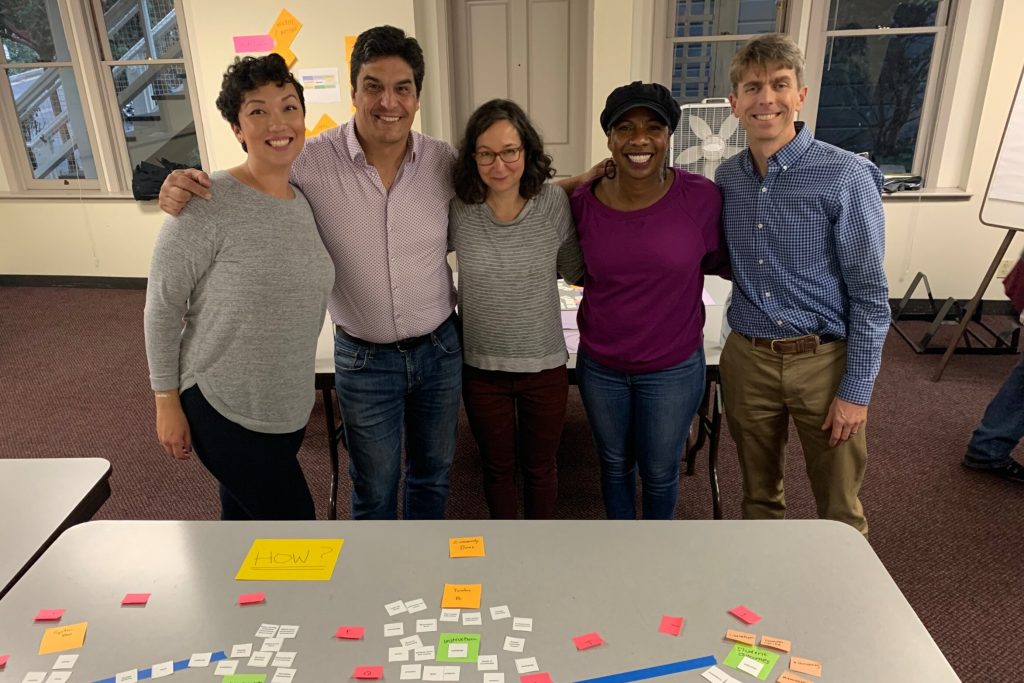
Part of the ELP team prototyping at a 2019 retreat.
What do you enjoy most about working for ELP?
Colleagues. The people. (ELP has the best people). The deep expertise and wisdom about working with schools and districts to shift mindsets, to re-align educational systems for equity and learning that matters, and to build tools collaboratively that make these shifts and re-alignments sustainable. Being able to draw on what ELP colleagues are doing at the scale of systems, and in relation to other content areas, provides a much more holistic perspective than is possible in professional settings narrowly bounded by content area.
I also enjoy all of the opportunities to collaborate with the incredible staff at Envision Schools. Partnering with STEM leaders at Envision Schools has been an ongoing source of energy and an actively experimental space for professional learning design and assessment design.
What do you like to do when you’re not working?
Anything that does not involve a screen: being and moving outside (walking, running, hiking, biking, kayaking); touching and reading printed pages; playing cards, Pentago, chess, Codenames, Just One, and other games with my 14 year old daughter and 11 year old son; playing with our accidental pet, Philmore the fabulous rat. And — when all goes well — living car-free until our summer cross-country road trip to Carrboro, NC, visiting family and friends along the way.
Insights, partner highlights, guest perspectives, and resources to support your work
Roanoke County Public Schools has been partnering with Envision Learning Partners for the past four years to develop and implement a comprehensive performance assessment system aligned with their Opportunity Ready Graduate Profile. This collaboration has fundamentally transformed how students demonstrate essential skills needed for future success in an increasingly complex world.
A Decade of Transformation
The journey began a decade ago when Roanoke County developed their C-Change Framework, which meticulously detailed the conditions needed for deeper learning to thrive within school communities. This framework addressed multiple dimensions, including school and classroom climate, professional growth, support services, and learning culture. It also emphasized finding balance between preparing students for standardized testing and developing the critical skills needed to navigate a rapidly changing world.
Working with diverse stakeholders, they articulated the Opportunity Ready Graduate Profile, which defines the skills and attributes necessary for students to successfully navigate evolving life and career pathways and seize opportunities that come their way. Despite this solid foundation, the district initially struggled to quantify these skills in ways that were both meaningful and conducive to growth.
Partnership with Envision Learning Partners
This challenge led Roanoke County to form a strategic partnership with Envision Learning Partners. Over the past four years, they’ve evolved from conceptualizing what their assessment system could be to implementing a robust program across all 26 schools in the district. This systematic approach to performance assessment now forms a cornerstone of their educational philosophy.
Opportunity Ready Portfolio Process
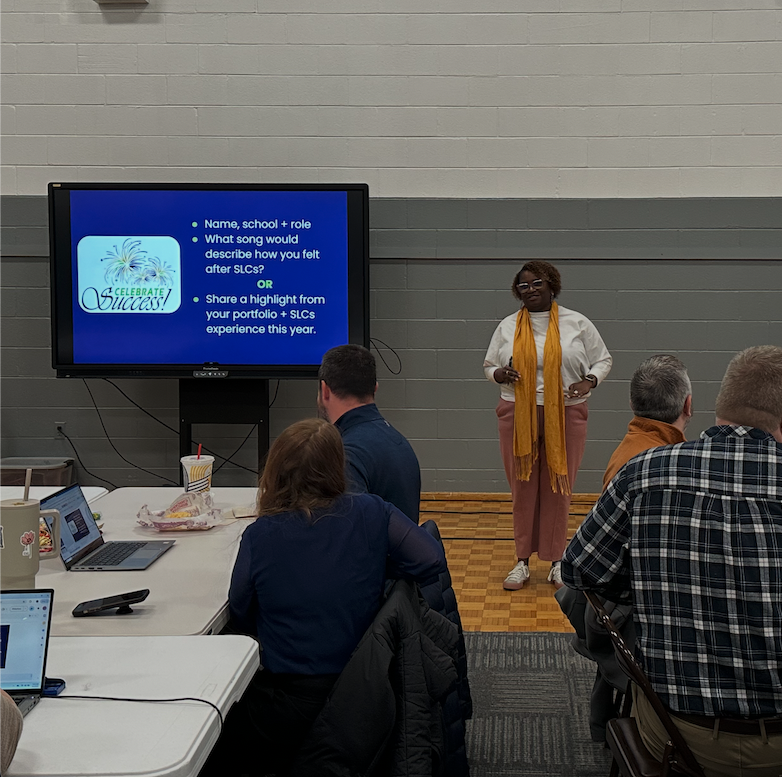
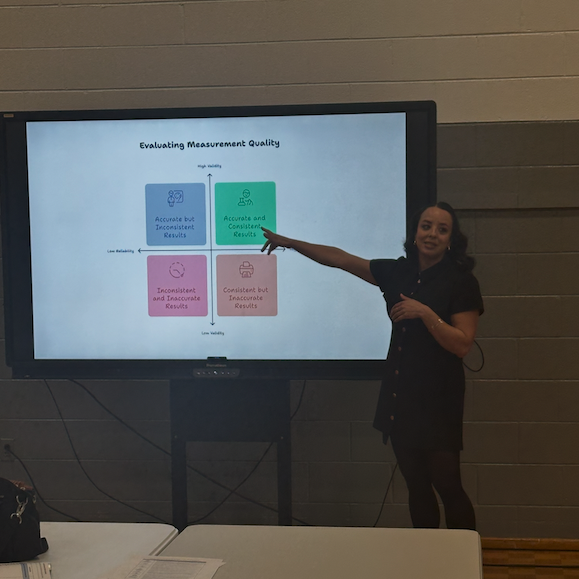
At the heart of this work is the Opportunity Ready Portfolio Presentation, where students demonstrate mastery of three critical skills: Communication, Collaboration, and Critical Thinking. Using a structured process guided by clear rubrics and expectations, students select artifacts from their in-school and out-of-school learning experiences as evidence of their skill development.
Each student presentation is guided by the driving question: “How have I demonstrated and grown in my Opportunity Ready Skills as a Communicator, Collaborator, and Critical Thinker this school year, and how will I apply these Opportunity Ready skills to what’s next for me, including my future career?”
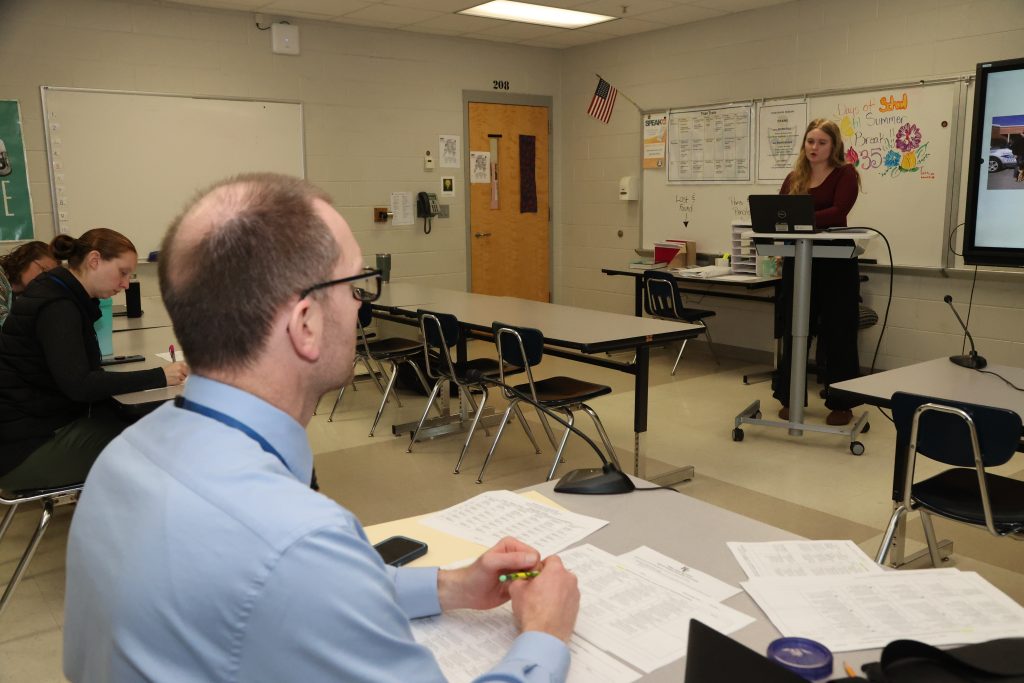
Trained panel members, including at least one member from the school’s design team, evaluate these presentations using standardized rubrics that assess specific performance outcomes for each skill area. The panels follow a structured protocol for scoring student work, ensuring consistency and fairness while providing constructive feedback.
Transformative Impact
“We learned that you don’t know what your students are capable of until you ask and give them a chance to respond,” shares one district leader. “We have been blown away by what our students are able to demonstrate through our performance assessment system.”
The impact of this work extends throughout the educational community:
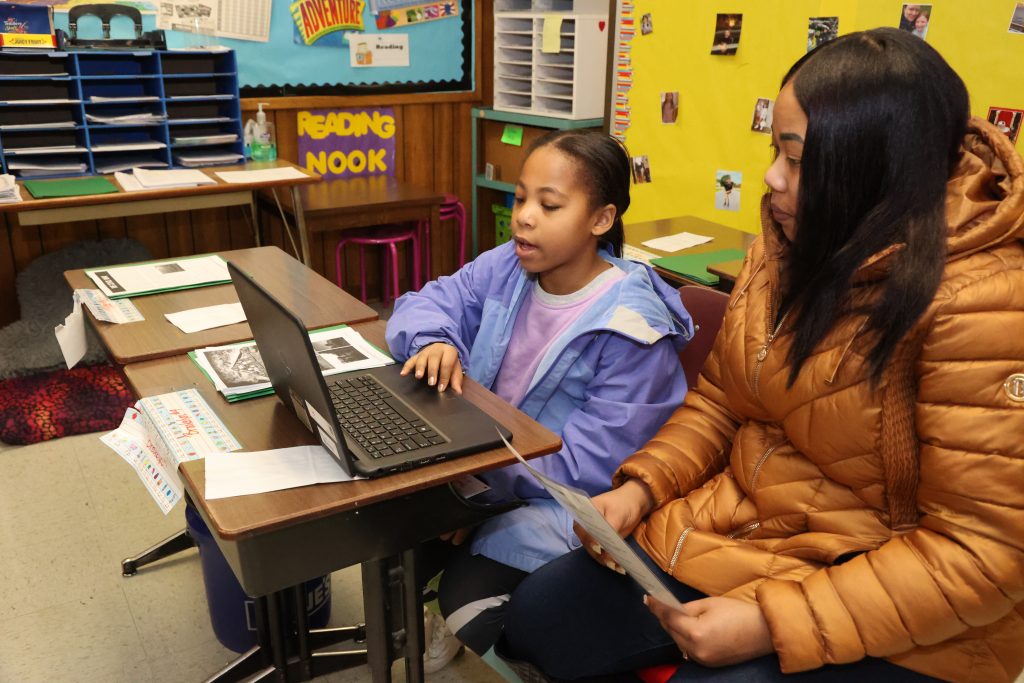
For students, the process has revealed the power of reflection. Many students express surprise at how much they’ve grown until they take time to reflect on their learning journey. This metacognitive awareness strengthens their sense of personal growth and achievement.
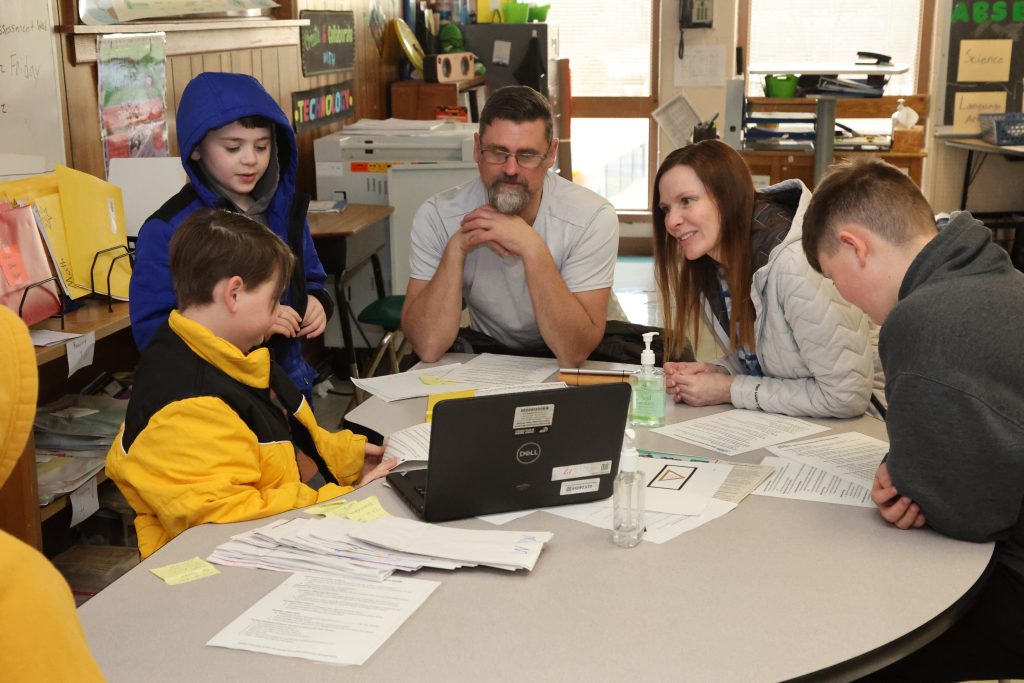
Teachers, while initially cautious about the workload involved in preparing for conferences and defenses, become enthusiastic advocates after witnessing students’ presentations. As one administrator noted, “To a person, they are invigorated and excited to begin planning for the next year once they see it in action.”
For administrators and district leaders, the presentations have rekindled passion for educational transformation. “The impact the presentations have on the panel, parents, and staff has reignited our drive for this work,” reports a district representative.
Stories of Transformation
The most compelling evidence comes from individual student experiences. One particularly moving example involved a student who had struggled significantly during middle school. During their senior defense, the student articulated their growth journey with such clarity and reflection that “there was not a dry eye in the room.” This transformative moment exemplifies how the process helps students recognize and celebrate their own development while preparing them for future challenges.
Looking Forward
Through this ongoing partnership with Envision Learning Partners, Roanoke County Public Schools continues to refine and expand their performance assessment system. The district’s commitment to developing the whole student—not just academic knowledge but essential life skills—positions their graduates to thrive in whatever paths they choose after high school, whether in higher education, careers, or military service.
By creating authentic opportunities for students to demonstrate mastery of critical skills, reflect on their growth, and connect their learning to future aspirations, Roanoke County Public Schools is preparing students not just for tests, but for life beyond graduation in a rapidly changing world.
In this special Guest Blog Video Interview, hear from Alcine Mumby and Laureen Adams, interviewed by Niloy Gangopadhyay and Courtney Katen.
This interview was sparked by Alcine’s recent travel to the Ghana ASCD Educators’ Summit 2024 earlier this year.
Learn about Alcine and Laureen’s history- all starting in Oakland at Envision Academy, what Laureen took away and still carries with her as leader of the Tutu Institute in Ghana, why she believes so deeply in performance assessment, and what’s up next for her work continuing to support educators and systems.
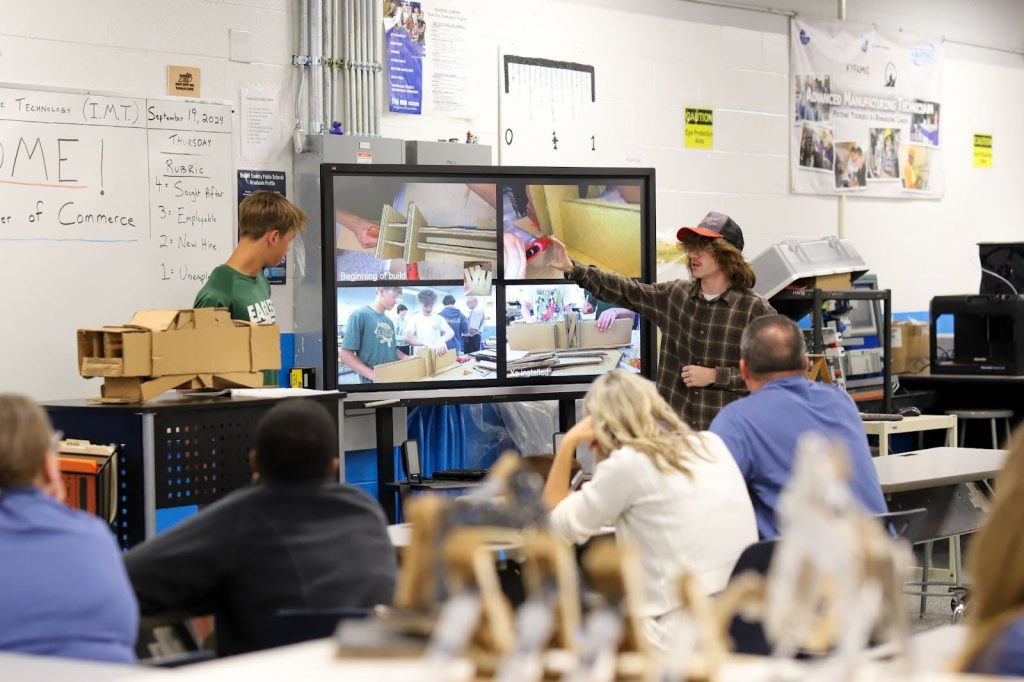
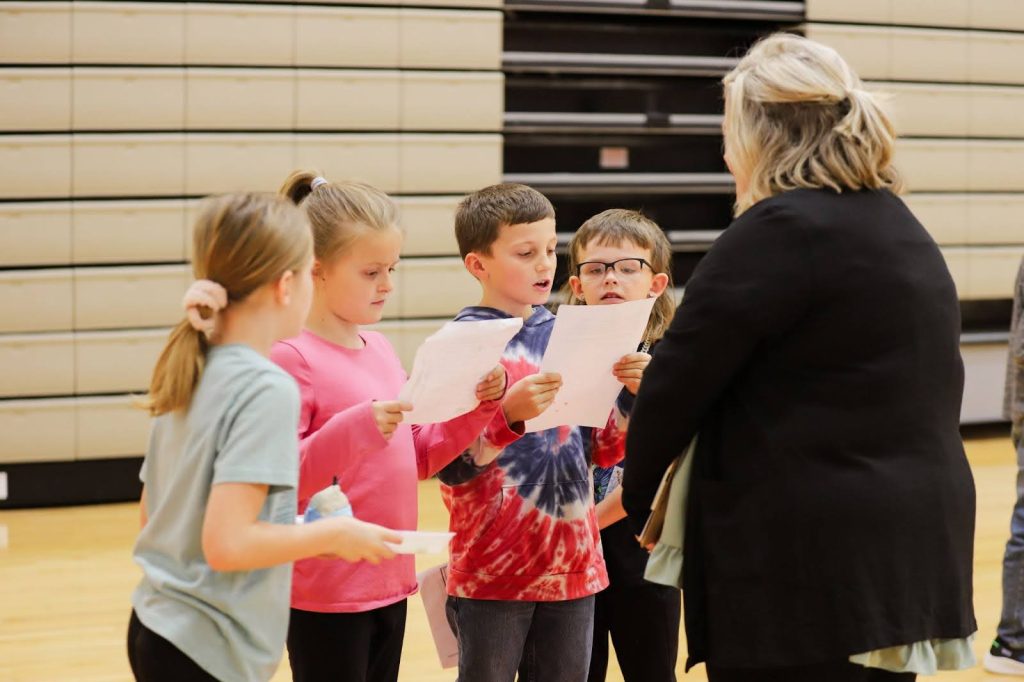
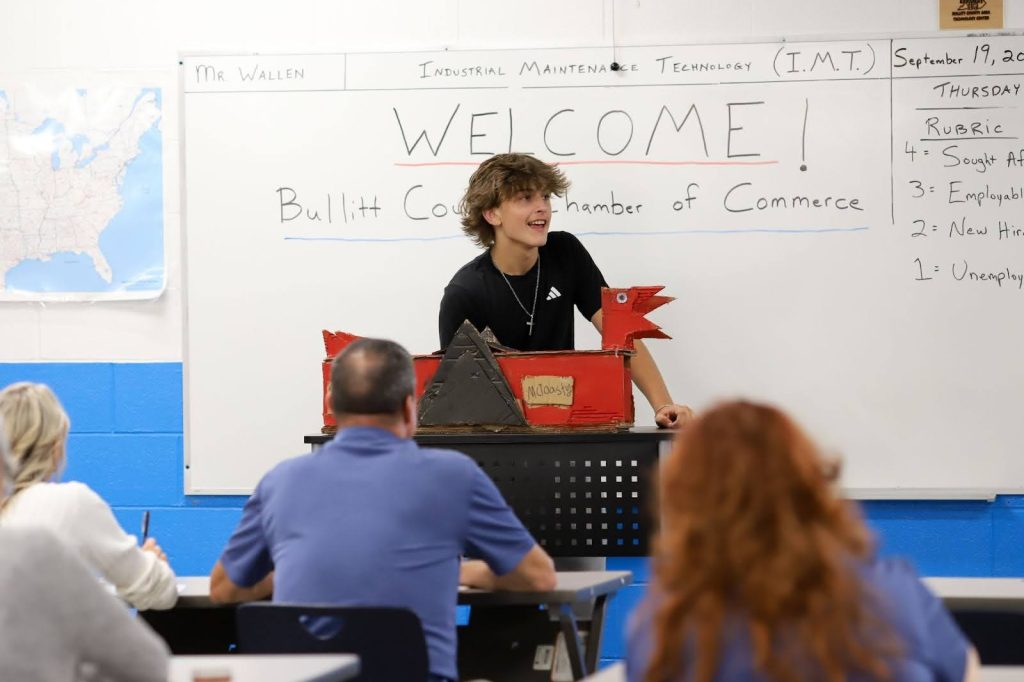
Bullitt County Public Schools is a public school district in Shepherdsville, KY that serves students from pre-K through 12th grade. The district is committed to providing a world-class education that prepares students for success beyond high school.
Envision Learning Partners has worked with Bullitt County Public Schools since 2018, partnering on their Graduate Profile development and performance assessment system. Bullitt County’s Superintendent, Dr. Jesse Bacon, and Assistant Superintendent, Dr. Adrienne Usher, are also both alumni of ELP’s Deeper Learning Leadership Forum.
In this Partner Profile, we hear from Assistant Superintendent, Adrienne Usher.
How are you advancing your Performance Assessment System? Is there one story you can share that illustrates how this work is benefitting your school, students or teachers?
Advancing the Performance Assessment System in Bullitt County Public Schools involves the creation of Graduate Profile Performance outcomes for students in Grades K-2, 3-5, and 9-12. A notable story comes from a graduate of the district who, after completing postsecondary education, entered the workforce. This individual reflected on a high school assessment experience involving a presentation to a city council to solve a community problem, which proved invaluable when preparing for an engineering position interview. College courses, according to this graduate, did not fully address aspects of the interview process, including content, dispositions, and competencies. This example highlights the effectiveness of the performance assessment system in preparing students not only for specific occupations but also for broader workforce preparation.
What have you learnt during this process?
The process of transforming assessment has revealed the need to rethink its purpose and identify who truly owns it—students. While teachers play a critical role in this process, it is students who take ownership of their learning. Empowering students to demonstrate their learning fosters motivation and a deeper understanding of its larger purpose.
What is the impact you are seeing on students and their work?
The implementation of performance assessments and student ownership of learning is having a significant positive impact on students and their work. Students are more motivated as they recognize the relevance of their learning beyond the classroom. This approach is also fostering necessary dispositions and competencies, aligned to our Graduate Profile, preparing students for future challenges in higher education, the workforce, and beyond. By developing the skills to articulate their knowledge and connect it to meaningful purposes, students are not only achieving academic success but also growing into lifelong learners equipped for a dynamic and evolving world.
What is the impact you are seeing on teachers and their practice?
The gradual shift embedding performance assessments is creating meaningful changes in teachers and their practice. Teachers are rethinking the purpose of assessment on a continuum of traditional, transitional, and transformational methods that emphasize student ownership of learning combining academics and our Graduate Profile competencies. Teachers are becoming facilitators of learning, guiding students to take responsibility for their growth and encouraging reflection and self-assessment. This approach is also enhancing teachers’ instructional practices, as they integrate more student-centered strategies and focus on developing dispositions and competencies alongside content knowledge. The process is reinvigorating teachers’ sense of purpose and enthusiasm for a new school experience.
What is the impact of this work ON YOU as a practitioner?
The impact of this work I have experienced, as a practitioner, is related to understanding a larger purpose for school and its connection to the community and society. School can be viewed as a place to gain knowledge and get a high school diploma and it ends there. However, connecting school and assessment that impacts students in more comprehensive ways is about life preparation. In reality, the school experience, which includes teaching, learning, and assessment, is a reflection of what the greater community (students, parents, community members, industry partners, etc.) values. If communities want graduates to be more prepared and successful in the workforce and as citizens, collaboration that provides opportunities for learning and assessment which connects academics to real world problem solving is a future-focused necessity.
Explore our diverse events. Enhance your expertise, connect with thought leaders, and broaden your horizons.
Roanoke County Public Schools has been partnering with Envision Learning Partners for the past four years to develop and implement a comprehensive performance assessment system aligned with their Opportunity Ready Graduate Profile. This collaboration has fundamentally transformed how students demonstrate essential skills needed for future success in an increasingly complex world.
A Decade of Transformation
The journey began a decade ago when Roanoke County developed their C-Change Framework, which meticulously detailed the conditions needed for deeper learning to thrive within school communities. This framework addressed multiple dimensions, including school and classroom climate, professional growth, support services, and learning culture. It also emphasized finding balance between preparing students for standardized testing and developing the critical skills needed to navigate a rapidly changing world.
Working with diverse stakeholders, they articulated the Opportunity Ready Graduate Profile, which defines the skills and attributes necessary for students to successfully navigate evolving life and career pathways and seize opportunities that come their way. Despite this solid foundation, the district initially struggled to quantify these skills in ways that were both meaningful and conducive to growth.
Partnership with Envision Learning Partners
This challenge led Roanoke County to form a strategic partnership with Envision Learning Partners. Over the past four years, they’ve evolved from conceptualizing what their assessment system could be to implementing a robust program across all 26 schools in the district. This systematic approach to performance assessment now forms a cornerstone of their educational philosophy.
Opportunity Ready Portfolio Process
At the heart of this work is the Opportunity Ready Portfolio Presentation, where students demonstrate mastery of three critical skills: Communication, Collaboration, and Critical Thinking. Using a structured process guided by clear rubrics and expectations, students select artifacts from their in-school and out-of-school learning experiences as evidence of their skill development.
Each student presentation is guided by the driving question: “How have I demonstrated and grown in my Opportunity Ready Skills as a Communicator, Collaborator, and Critical Thinker this school year, and how will I apply these Opportunity Ready skills to what’s next for me, including my future career?”
Trained panel members, including at least one member from the school’s design team, evaluate these presentations using standardized rubrics that assess specific performance outcomes for each skill area. The panels follow a structured protocol for scoring student work, ensuring consistency and fairness while providing constructive feedback.
Transformative Impact
“We learned that you don’t know what your students are capable of until you ask and give them a chance to respond,” shares one district leader. “We have been blown away by what our students are able to demonstrate through our performance assessment system.”
The impact of this work extends throughout the educational community:
For students, the process has revealed the power of reflection. Many students express surprise at how much they’ve grown until they take time to reflect on their learning journey. This metacognitive awareness strengthens their sense of personal growth and achievement.
Teachers, while initially cautious about the workload involved in preparing for conferences and defenses, become enthusiastic advocates after witnessing students’ presentations. As one administrator noted, “To a person, they are invigorated and excited to begin planning for the next year once they see it in action.”
For administrators and district leaders, the presentations have rekindled passion for educational transformation. “The impact the presentations have on the panel, parents, and staff has reignited our drive for this work,” reports a district representative.
Stories of Transformation
The most compelling evidence comes from individual student experiences. One particularly moving example involved a student who had struggled significantly during middle school. During their senior defense, the student articulated their growth journey with such clarity and reflection that “there was not a dry eye in the room.” This transformative moment exemplifies how the process helps students recognize and celebrate their own development while preparing them for future challenges.
Looking Forward
Through this ongoing partnership with Envision Learning Partners, Roanoke County Public Schools continues to refine and expand their performance assessment system. The district’s commitment to developing the whole student—not just academic knowledge but essential life skills—positions their graduates to thrive in whatever paths they choose after high school, whether in higher education, careers, or military service.
By creating authentic opportunities for students to demonstrate mastery of critical skills, reflect on their growth, and connect their learning to future aspirations, Roanoke County Public Schools is preparing students not just for tests, but for life beyond graduation in a rapidly changing world.
In this special Guest Blog Video Interview, hear from Alcine Mumby and Laureen Adams, interviewed by Niloy Gangopadhyay and Courtney Katen.
This interview was sparked by Alcine’s recent travel to the Ghana ASCD Educators’ Summit 2024 earlier this year.
Learn about Alcine and Laureen’s history- all starting in Oakland at Envision Academy, what Laureen took away and still carries with her as leader of the Tutu Institute in Ghana, why she believes so deeply in performance assessment, and what’s up next for her work continuing to support educators and systems.
Bullitt County Public Schools is a public school district in Shepherdsville, KY that serves students from pre-K through 12th grade. The district is committed to providing a world-class education that prepares students for success beyond high school.
Envision Learning Partners has worked with Bullitt County Public Schools since 2018, partnering on their Graduate Profile development and performance assessment system. Bullitt County’s Superintendent, Dr. Jesse Bacon, and Assistant Superintendent, Dr. Adrienne Usher, are also both alumni of ELP’s Deeper Learning Leadership Forum.
In this Partner Profile, we hear from Assistant Superintendent, Adrienne Usher.
How are you advancing your Performance Assessment System? Is there one story you can share that illustrates how this work is benefitting your school, students or teachers?
Advancing the Performance Assessment System in Bullitt County Public Schools involves the creation of Graduate Profile Performance outcomes for students in Grades K-2, 3-5, and 9-12. A notable story comes from a graduate of the district who, after completing postsecondary education, entered the workforce. This individual reflected on a high school assessment experience involving a presentation to a city council to solve a community problem, which proved invaluable when preparing for an engineering position interview. College courses, according to this graduate, did not fully address aspects of the interview process, including content, dispositions, and competencies. This example highlights the effectiveness of the performance assessment system in preparing students not only for specific occupations but also for broader workforce preparation.
What have you learnt during this process?
The process of transforming assessment has revealed the need to rethink its purpose and identify who truly owns it—students. While teachers play a critical role in this process, it is students who take ownership of their learning. Empowering students to demonstrate their learning fosters motivation and a deeper understanding of its larger purpose.
What is the impact you are seeing on students and their work?
The implementation of performance assessments and student ownership of learning is having a significant positive impact on students and their work. Students are more motivated as they recognize the relevance of their learning beyond the classroom. This approach is also fostering necessary dispositions and competencies, aligned to our Graduate Profile, preparing students for future challenges in higher education, the workforce, and beyond. By developing the skills to articulate their knowledge and connect it to meaningful purposes, students are not only achieving academic success but also growing into lifelong learners equipped for a dynamic and evolving world.
What is the impact you are seeing on teachers and their practice?
The gradual shift embedding performance assessments is creating meaningful changes in teachers and their practice. Teachers are rethinking the purpose of assessment on a continuum of traditional, transitional, and transformational methods that emphasize student ownership of learning combining academics and our Graduate Profile competencies. Teachers are becoming facilitators of learning, guiding students to take responsibility for their growth and encouraging reflection and self-assessment. This approach is also enhancing teachers’ instructional practices, as they integrate more student-centered strategies and focus on developing dispositions and competencies alongside content knowledge. The process is reinvigorating teachers’ sense of purpose and enthusiasm for a new school experience.
What is the impact of this work ON YOU as a practitioner?
The impact of this work I have experienced, as a practitioner, is related to understanding a larger purpose for school and its connection to the community and society. School can be viewed as a place to gain knowledge and get a high school diploma and it ends there. However, connecting school and assessment that impacts students in more comprehensive ways is about life preparation. In reality, the school experience, which includes teaching, learning, and assessment, is a reflection of what the greater community (students, parents, community members, industry partners, etc.) values. If communities want graduates to be more prepared and successful in the workforce and as citizens, collaboration that provides opportunities for learning and assessment which connects academics to real world problem solving is a future-focused necessity.

.svg)
.svg)


.svg)
.svg)







.svg)
.svg)

.svg)

.svg)

