A Parent’s Reflection on the Driver’s Test Analogy
Written by
Full Name
Published on
September 8, 2026
Heading 1
Heading 2
Heading 3
Heading 4
Heading 5
Heading 6
Lorem ipsum dolor sit amet, consectetur adipiscing elit, sed do eiusmod tempor incididunt ut labore et dolore magna aliqua. Ut enim ad minim veniam, quis nostrud exercitation ullamco laboris nisi ut aliquip ex ea commodo consequat. Duis aute irure dolor in reprehenderit in voluptate velit esse cillum dolore eu fugiat nulla pariatur.
Here at Envision, we frequently use the Driver’s License Test analogy to talk about Performance Assessment: it is a clear and familiar example of showing you are ready for a momentous next step by demonstrating what you are able to do (drive) with what you know (driving rules and regulations).
As a mom, I recently had a chance to consider this analogy from a distinct vantage point: the passenger seat. Helping my daughter learn to drive has given me the opportunity to expand on this beloved Envision metaphor with some key observations related to Performance Assessment.
First, it can be abjectly terrifying to drive with an “emerging” driver. In Lola’s first few forays on the road, I had several white-knuckle experiences that will be familiar to any parent of teens. I had multiple visions of catastrophe. I may have screamed a couple of times. And I realized it was the loss of control that really unsettled me. It is daunting to realize there is NO OTHER WAY for your child to learn how to drive except by LETTING GO OF CONTROL. It dawned on me that it must also be hard for teachers to let go of control in the classroom. Of course, classroom performance assessment does not pose the threat of bodily harm the way hurtling over the Bay Bridge on my daughter’s maiden voyage did. But I found it interesting that I struggled to give up control even though I knew she was ready for this important step. I struggled in safer situations too—complete with pressing on the non-existent, passenger side brake—and sometimes found it hard to articulate instructions. It made me curious about how teachers confront and manage this struggle.
Secondly, teacher-student relationships really do make a difference in student success. Lola took the test twice: she failed the first time. The first instructor was dour, unfriendly, and impatient. According to Lola, she gave the directions (turn left, turn right) with very little time between instruction and execution. She wasn’t receptive to clarifying questions. She did not smile. Two weeks later and the difference could not have been more stark: the second instructor was friendly and engaging, immediately introducing herself to both of us. After the successful test, Lola was effusive about how different this second experience was. This instructor took the time to give Lola a friendly overview of what the test would be like. When she noticed Lola was nervous, she offered suggestions for how to relax a little bit. For Lola, having the instructor see and acknowledge her anxiety helped enormously. Out on the road, when Lola made some small mistakes, the instructor said things like “this is a mistake I make sometimes too, so just keep in mind xyz…”. She also gave directions clearly, with time for Lola to execute on them, and was patient with questions. With that kind of assessor in the seat next to her, Lola was able to drive the way she knew how, and of course she passed.
In the days since Lola has been whizzing around the Bay Area on her own, I have thought often about this woman, her skill at her job, and the way she helped my daughter. It strikes me that performance assessment, at its best, is about not only challenging the learner but also creating conditions for her success. And I’m once again grateful for teachers who are practiced in the art of both supporting students and letting them truly show what they know and are capable of.
Insights, partner highlights, guest perspectives, and resources to support your work
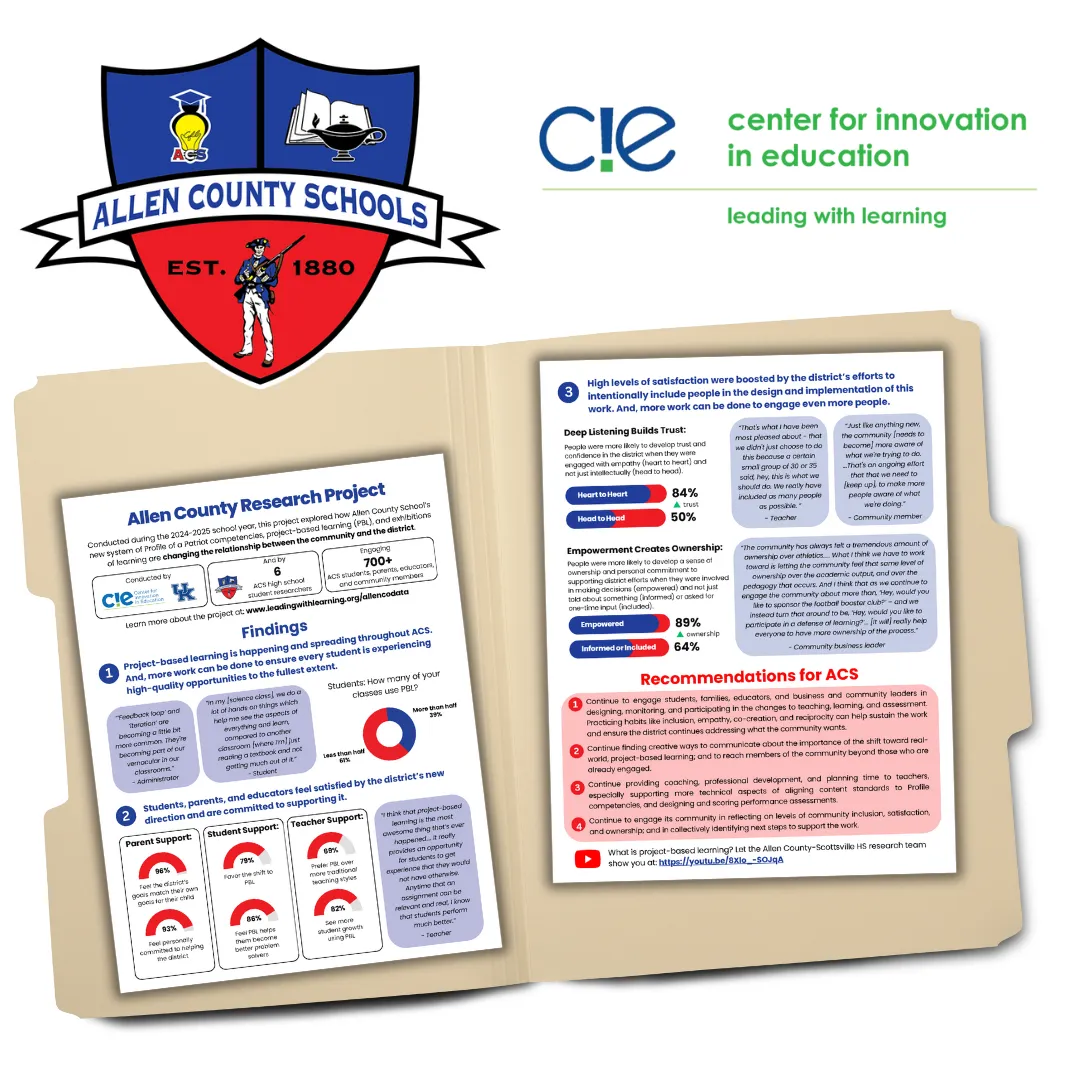
A newly published case study from the Center for Innovation in Education (C!E), featuring Envision Learning Partners in Appendix C, highlights Allen County, Kentucky’s multi-year effort to redesign assessment and accountability through Inclusive Design. The report, Better Together, shows how the district co-created their graduation competencies called “Profile of A Patriot” and embedded project-based learning and performance assessments to place students’ passions and real-world skills at the center of learning.
Envision Learning Partners has been proud to support Allen County in this work, and we’re excited to share C!E’s new case study. We’ve partnered closely with C!E through the Assessment for Learning Project, working together to advance learner-centered assessment practices nationally.
By Michael Viera, Envision Education’s College and Career Pathways Manager
Several years ago the city of Oakland came together to support college and career programming for high schoolers, by advancing and deepening career pathways in alignment with the Linked Learning Alliance standards and methodology. The Linked Learning Alliance hosts an annual conference where educators share best practices and takeaways from school sites around the state. Oakland schools always show out in big numbers at the conference, but this year it took place in downtown Oakland, so the presence was even greater.
I had been to the conference previously, but this time was different. Being my 3rd year at Envision in this role, I felt like I finally understood what it was all about. I had colleagues from Envision Learning Partners in attendance and collaborating with me. I got to connect with colleagues from other Oakland schools. I knew what to look for and who to listen to in order to improve our programming at Envision Academy and across the Envision network.
The conference was motivating, to say the least. It is a breath of fresh air being in rooms of educators who are excited and realistic about their work in schools, and who understand the skills students need to have success in their futures.
I came back from the conference and immediately organized Envision Academy’s first job fair since COVID. We had twelve community partners visit our campus to share information with students on internship opportunities, after school and summer programs, and community resources. Students seemed excited about these experiences that they can be a part of outside of their regular curriculum.
At the end of the event, two students stayed back and pulled me aside. I thought something bad had happened. Instead, one of them simply said, “Mr. Viera, we just wanted to thank you for putting together this event. It’s really inspiring to see all these opportunities we didn’t know about until now.”
After a couple of weeks of back and forth emails and phone calls with partners, planning meetings with administration, and quite literally running around setting up tables and chairs on the day of the event, those students made it all worth it. When students are able to take their learning outside of school walls and make connections with their community, they feel seen and they thrive.
Hear from Michael and ELP Assessment Design Partner, Josette Neal-De-Stanton on their takeaways from the Linked Learning Conference.
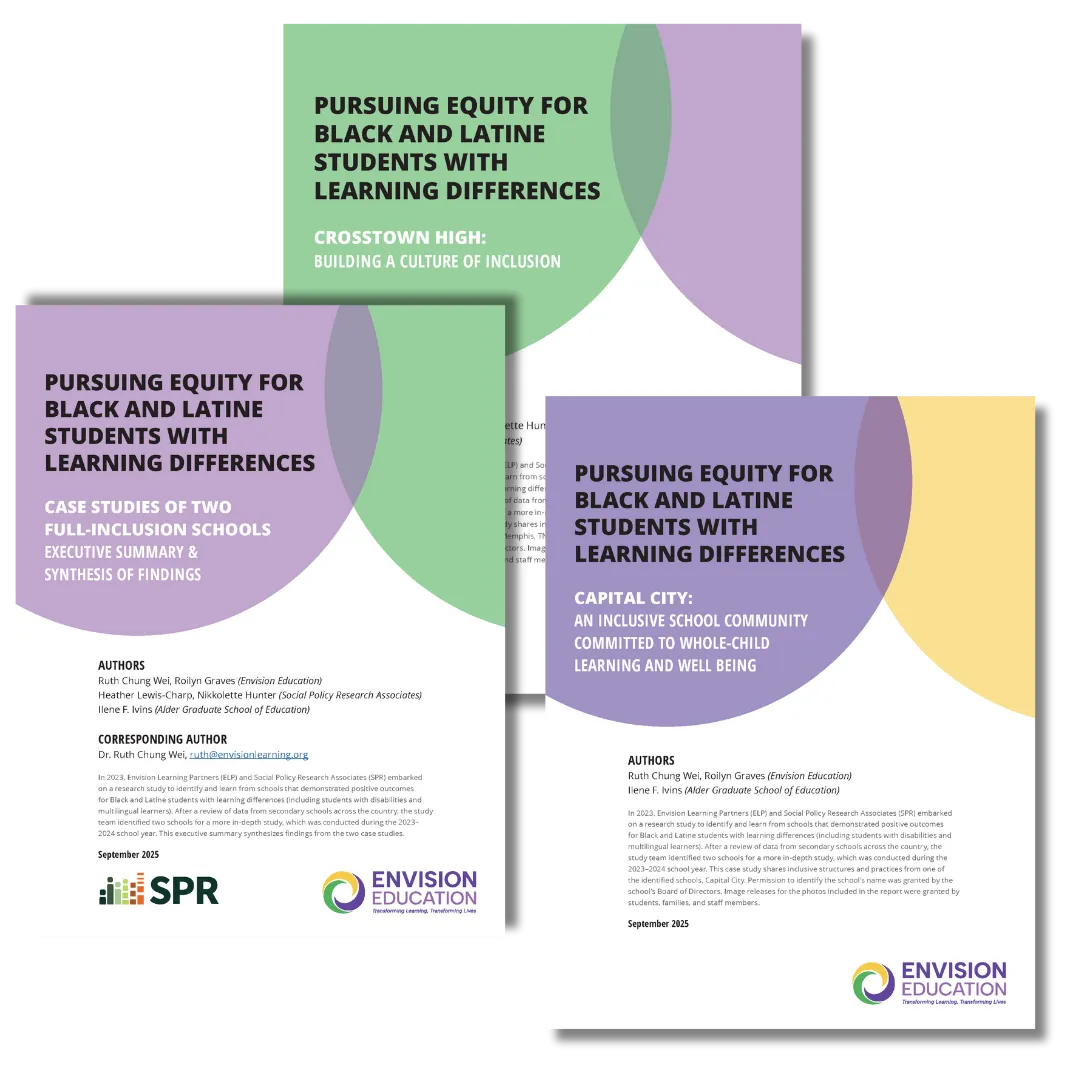
Envision Education is excited to share the culmination of its two-year research project, Pursuing Equity for Black & Latine Students with Learning Differences, which
documents and illustrates the systems, practices, cultures, and supports that are associated with the well being and success of Black and Latine students with learning differences – students with disabilities and multilingual students with disabilities.
In 2023, Envision Learning Partners (ELP) and Social Policy Research Associates (SPR) embarked on a research study to identify and learn from schools that demonstrated positive outcomes for Black and Latine students with learning differences (including students with disabilities and multilingual learners). After a review of data from secondary schools across the country, the study team identified two schools for a more in-depth study, which was conducted during the 2023–2024 school year.
The results of the research are shared through case studies of the two schools that were the focus of the research: 1) Crosstown High: Building a Culture of Inclusion; 2) Capital City: An Inclusive School Community Committed to Whole-Child Learning and Well Being; and 3) An Executive Summary/Synthesis of Findings.
In addition, we have authored four practice briefs based on the findings of the research that provide practical steps that schools can take to create more inclusive environments that support the success of Black and Latine students with learning differences.
Co-teaching: A Means to Creating Inclusive and Equitable General Education Classrooms
UDL: Universal Design for Learning in a Culturally Responsive Context
Culturally Responsive Practices: An Inclusive, Culturally Responsive School Culture That Fosters Relationships
Competency-Based Learning and Assessment: Assessment and Grading Practices That Support an Inclusive Learning Culture
This research was made possible through the generous support of New Profit, a venture philanthropic organization, and the Oak Foundation.
Explore our diverse events. Enhance your expertise, connect with thought leaders, and broaden your horizons.
A newly published case study from the Center for Innovation in Education (C!E), featuring Envision Learning Partners in Appendix C, highlights Allen County, Kentucky’s multi-year effort to redesign assessment and accountability through Inclusive Design. The report, Better Together, shows how the district co-created their graduation competencies called “Profile of A Patriot” and embedded project-based learning and performance assessments to place students’ passions and real-world skills at the center of learning.
Envision Learning Partners has been proud to support Allen County in this work, and we’re excited to share C!E’s new case study. We’ve partnered closely with C!E through the Assessment for Learning Project, working together to advance learner-centered assessment practices nationally.
By Michael Viera, Envision Education’s College and Career Pathways Manager
Several years ago the city of Oakland came together to support college and career programming for high schoolers, by advancing and deepening career pathways in alignment with the Linked Learning Alliance standards and methodology. The Linked Learning Alliance hosts an annual conference where educators share best practices and takeaways from school sites around the state. Oakland schools always show out in big numbers at the conference, but this year it took place in downtown Oakland, so the presence was even greater.
I had been to the conference previously, but this time was different. Being my 3rd year at Envision in this role, I felt like I finally understood what it was all about. I had colleagues from Envision Learning Partners in attendance and collaborating with me. I got to connect with colleagues from other Oakland schools. I knew what to look for and who to listen to in order to improve our programming at Envision Academy and across the Envision network.
The conference was motivating, to say the least. It is a breath of fresh air being in rooms of educators who are excited and realistic about their work in schools, and who understand the skills students need to have success in their futures.
I came back from the conference and immediately organized Envision Academy’s first job fair since COVID. We had twelve community partners visit our campus to share information with students on internship opportunities, after school and summer programs, and community resources. Students seemed excited about these experiences that they can be a part of outside of their regular curriculum.
At the end of the event, two students stayed back and pulled me aside. I thought something bad had happened. Instead, one of them simply said, “Mr. Viera, we just wanted to thank you for putting together this event. It’s really inspiring to see all these opportunities we didn’t know about until now.”
After a couple of weeks of back and forth emails and phone calls with partners, planning meetings with administration, and quite literally running around setting up tables and chairs on the day of the event, those students made it all worth it. When students are able to take their learning outside of school walls and make connections with their community, they feel seen and they thrive.
Hear from Michael and ELP Assessment Design Partner, Josette Neal-De-Stanton on their takeaways from the Linked Learning Conference.
Envision Education is excited to share the culmination of its two-year research project, Pursuing Equity for Black & Latine Students with Learning Differences, which
documents and illustrates the systems, practices, cultures, and supports that are associated with the well being and success of Black and Latine students with learning differences – students with disabilities and multilingual students with disabilities.
In 2023, Envision Learning Partners (ELP) and Social Policy Research Associates (SPR) embarked on a research study to identify and learn from schools that demonstrated positive outcomes for Black and Latine students with learning differences (including students with disabilities and multilingual learners). After a review of data from secondary schools across the country, the study team identified two schools for a more in-depth study, which was conducted during the 2023–2024 school year.
The results of the research are shared through case studies of the two schools that were the focus of the research: 1) Crosstown High: Building a Culture of Inclusion; 2) Capital City: An Inclusive School Community Committed to Whole-Child Learning and Well Being; and 3) An Executive Summary/Synthesis of Findings.
In addition, we have authored four practice briefs based on the findings of the research that provide practical steps that schools can take to create more inclusive environments that support the success of Black and Latine students with learning differences.
Co-teaching: A Means to Creating Inclusive and Equitable General Education Classrooms
UDL: Universal Design for Learning in a Culturally Responsive Context
Culturally Responsive Practices: An Inclusive, Culturally Responsive School Culture That Fosters Relationships
Competency-Based Learning and Assessment: Assessment and Grading Practices That Support an Inclusive Learning Culture
This research was made possible through the generous support of New Profit, a venture philanthropic organization, and the Oak Foundation.

.svg)
.svg)


.svg)
.svg)



.svg)
.svg)

.svg)

.svg)

